Affiliate disclosure: This article contains affiliate links. If you buy through them, Energy Revolution may earn a commission at no extra cost to you.
What does “240V solar power” actually mean?
Although people commonly say 240V, the UK’s nominal household supply is 230V. For ordinary UK appliances, look for compatible 230V, 50Hz output and check their labels.
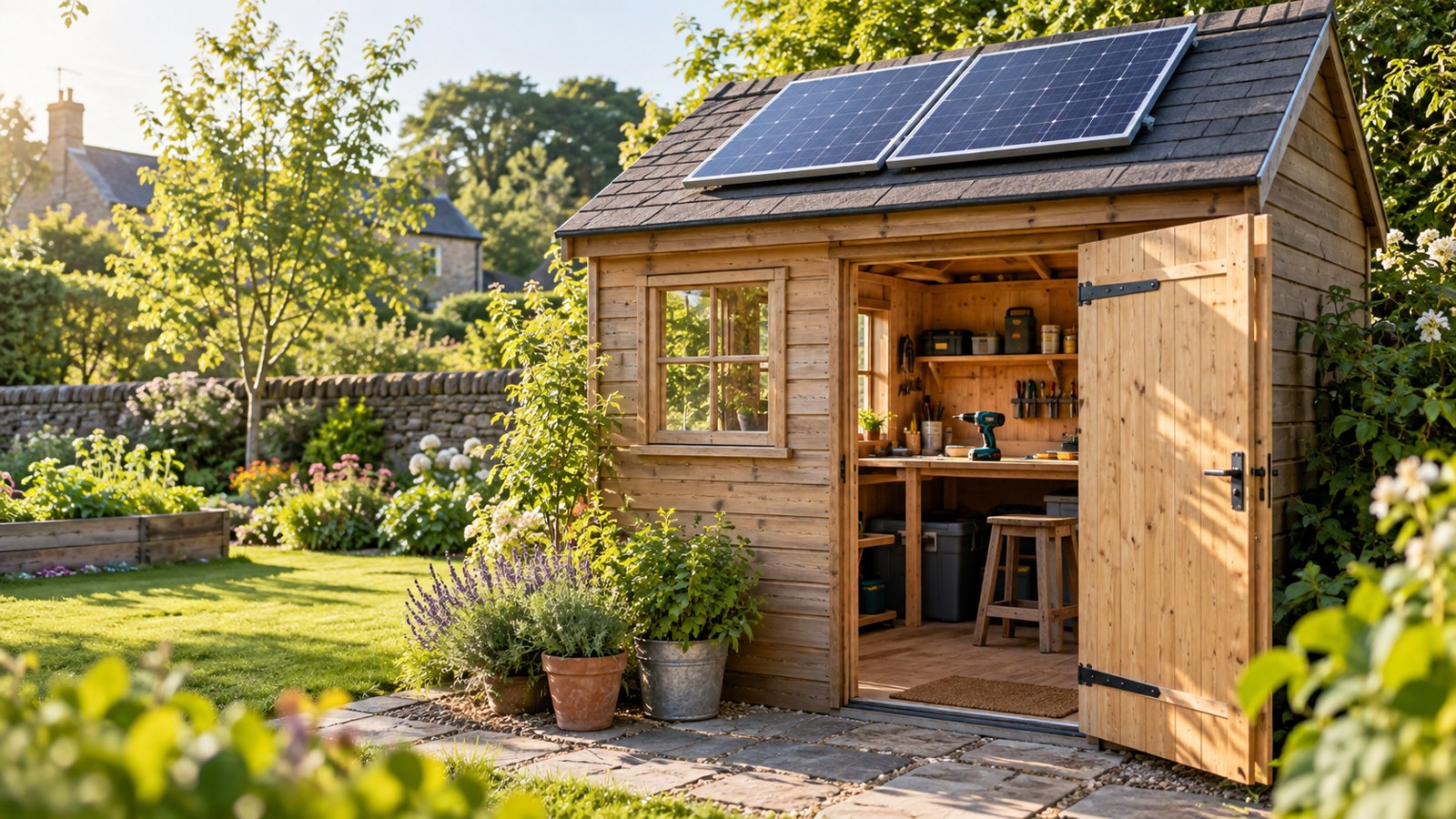
In a typical battery-based shed system, panels produce direct current (DC), a charge controller manages battery charging, and an inverter converts battery power into alternating current (AC). Some products combine these functions.
The inverter does not create energy. A larger model cannot compensate for an empty battery or persistent shade. Before buying panels, read our guide to mapping shade on a shed roof.
Size the inverter around simultaneous loads
Panel wattage and inverter wattage answer different questions. The first describes rated generation under test conditions; the second describes AC power the inverter can supply.
Start with an appliance list. As an illustrative example, suppose you want two 10W lights, a 65W laptop charger and a 150W tool charger running together. Their combined demand is 235W, before allowing for starting behaviour and suitable headroom. Use actual appliance input ratings or measurements when planning your system.
Check the inverter’s continuous output, rather than choosing from a large “peak” figure on the box. Also check watts and volt-amperes (VA): they are not always interchangeable. Victron’s sizing guidance explains combined loads, start-up demand and temperature-related output reductions.
Starting a tool can demand more power than running it
Motors, pumps and compressors can briefly draw substantially more power when starting. Some electronic power supplies also create an initial surge.
A tool that runs within an inverter’s continuous rating may still trip it during start-up. Compare the appliance’s starting requirements with the inverter’s surge capacity and the duration for which it can deliver that output. Ask the manufacturers if these details are missing.
For occasional workshop use, charging cordless batteries may be more manageable than running large mains tools. Our shed solar tool-charging guide explores that approach.
Check the waveform and battery supply
A pure sine wave inverter is a sensible starting point for a mixed collection of chargers, electronics and tools. Manufacturers such as Victron use this technology for sensitive electronics. Still confirm compatibility with each appliance; waveform quality does not remove power limits.
Match the inverter’s DC input to the battery system. A 12V inverter cannot simply be substituted into a 24V installation.
The battery must also deliver the required current. For illustration, 1,000W of AC output at an assumed 90% efficiency requires about 93A from a battery at 12V: 1,000 ÷ 0.90 ÷ 12. Actual current varies with voltage and efficiency. Battery discharge limits, the battery management system, cables and protection all need to suit the design.
Runtime depends on energy, including idle losses
Watts describe power; watt-hours describe energy. If you have 500Wh of usable battery energy, an assumed 90% conversion efficiency and a steady 100W load, the simplified estimate is 4.5 hours. Real runtime also depends on operating conditions and other losses.
An oversized inverter may consume valuable energy while switched on with nothing connected. A hypothetical 10W idle draw uses 240Wh over 24 hours. Compare no-load consumption, not just headline maximum efficiency. Manufacturer specifications list these separately.
Economy modes can reduce standby consumption, but small loads may fall below their wake-up threshold. Check whether your lights and chargers work reliably in that mode. Then estimate daily demand using our home-energy planning guide.
Plan the installation as carefully as the purchase
Choose equipment suitable for its surroundings and follow its mounting, ventilation and moisture requirements. A hot, damp or dusty shed deserves particular attention.
Have a qualified electrician design and test fixed mains-voltage wiring, earthing and protective devices. An inverter’s output arrangement affects how RCD protection works; simply adding a plug-in RCD does not prove the installation is safe. Victron’s manual specifically warns about protection with floating outputs.
Never feed an inverter into a household wall socket. Any connection to another supply needs properly designed equipment and professional assessment.
Choose a balanced shed system
Write down what must run together, how it starts and how long you use it. Match those needs to continuous output, surge performance, battery capability and realistic solar replenishment.
If you are also considering the separately promoted Energy Revolution offer, review the seller’s details here. It is not evidence that a particular inverter or shed installation will meet your needs.
The best purchase is a system whose parts suit your workload—not simply the largest panel or inverter advertised.
Further reading: Inverter installation requirements; economy-mode operation; garden electrical safety.
Explore the Energy Revolution offer
For a practical comparison checklist, see the solar inverter kit with two mini panels on our products page. Its listing advertises 12V-to-220V pure sine wave operation; confirm continuous output, frequency, socket type and appliance compatibility rather than assuming the title establishes suitability for a UK shed.
The ECO-WORTHY 400W kit lists an 1100W inverter alongside its panels and battery. Compare that output with your appliances’ running and startup requirements, and confirm the UK model and installation requirements before purchasing.