

Quick answer
An inverter can draw battery power even when its AC sockets supply no appliances. Its electronics still need energy to keep the output ready. At an illustrative 15W, that becomes 180Wh over 12 hours or 360Wh over a full day. Check your model’s no-load specification, confirm the operating mode and compare battery-side measurements before changing anything.
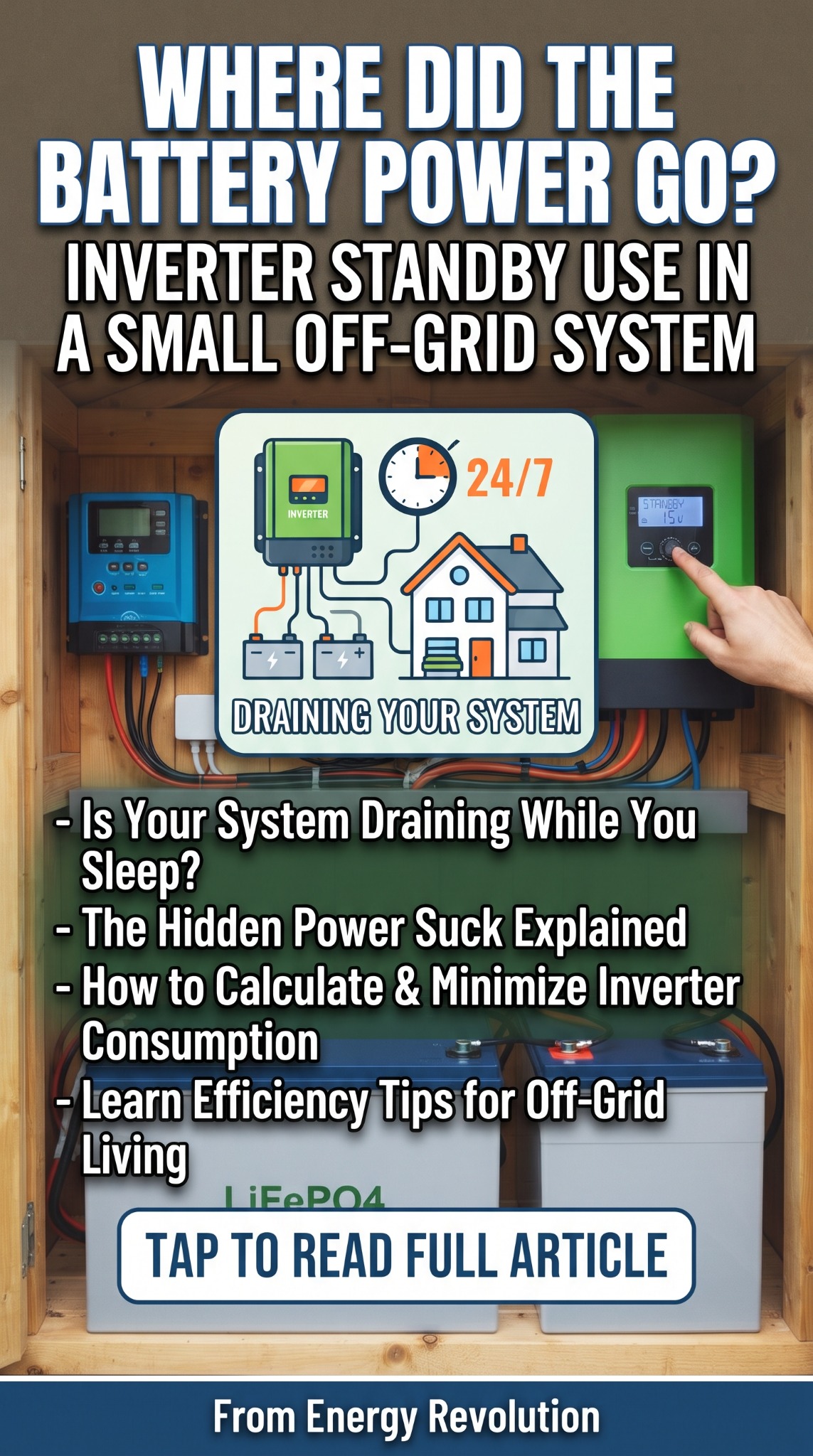
Our Pinterest pin asks whether your system is draining while you sleep. That is a sensible question for a small shed, cabin or weekend off-grid setup, where a modest background demand can consume a noticeable share of stored energy.
The answer is not automatically a bigger battery. First separate the inverter’s own consumption from appliance standby, other DC loads and an inaccurate battery percentage. Then decide which savings are practical without interrupting equipment you need.
Affiliate disclosure: Purchases through affiliate links may earn us a commission at no extra cost to you. We also link to our own digital bundle. All numerical examples below are illustrative, not measurements from the equipment pictured.
What is the inverter doing with no appliances running?
Your battery stores DC electricity. An inverter converts that into AC electricity for appliances designed for mains power. Keeping that conversion system ready consumes energy, even when the appliance load is zero.
Manufacturers may call this no-load power, idle consumption or another similar term. “Standby” can be ambiguous: it might describe normal operation with nothing plugged in, or a special reduced-power mode. Read the definition rather than comparing two numbers with different meanings.
An inverter’s headline efficiency is a separate issue. A high maximum efficiency does not mean it draws almost nothing at zero load. Check the conditions behind the efficiency rating and the specific no-load figure for your model and battery voltage.
Turn watts into a daily energy cost
The calculation is straightforward: power in watts × hours = energy in watt-hours. Divide watt-hours by 1,000 to express the answer in kilowatt-hours.
| Illustrative idle draw | 12 hours | 24 hours | Seven days |
|---|---|---|---|
| 5W | 60Wh | 120Wh | 840Wh |
| 15W | 180Wh | 360Wh | 2,520Wh |
| 30W | 360Wh | 720Wh | 5,040Wh |
These are calculation examples, not a typical range or a claim about your inverter. Actual consumption depends on design, operating mode and conditions.
Suppose you have 1,000Wh of usable stored energy measured at the battery side. A constant 15W idle draw consumes 36% of that in 24 hours. With no charging and no other loads, the arithmetic gives about 67 hours to exhaust that usable allowance. It is not a guaranteed runtime: battery protections, temperature and changing consumption still matter.
That 360Wh daily draw also has to be replaced by your charging source. During a dull winter week, eliminating avoidable consumption can be more useful than comparing panel ratings alone.

Do not confuse nominal capacity with usable energy
A battery labelled 12.8V and 100Ah has a nominal energy of 1,280Wh: 12.8 × 100. That does not mean you should plan to deliver every watt-hour to appliances.
Allow for the battery’s permitted operating range, your chosen reserve and any losses between the battery and the loads. Age and temperature can also affect available capacity. Use the battery manufacturer’s instructions, not a universal discharge percentage copied from another battery chemistry.
When comparing idle consumption with stored energy, keep the measurement boundary consistent. Battery-side inverter consumption should be compared with energy available at the battery. An appliance-side runtime estimate needs the conversion losses accounted for too.
Check for three different kinds of background demand
Inverter consumption: the energy required to keep its AC output operating or its search mode active.
Appliance standby: chargers, televisions, routers, monitors and other connected equipment may still draw energy even when they appear inactive.
Other system loads: communications equipment, battery monitoring, DC appliances, controller electronics or battery heating can consume energy independently of the inverter’s AC output.
A display reading “0W output” may show only AC appliance demand, may round small values down, or may update slowly. It does not prove that nothing is leaving the battery. Similarly, a falling battery percentage is a clue, not a measurement of inverter losses by itself.
How to investigate without opening the equipment
Begin with the exact model manual and existing monitoring. Note the operating mode, battery voltage, charging sources and connected loads. If possible, compare readings during a stable period without solar or other charging obscuring the discharge.
- Identify anything that must stay powered before changing a setting.
- Switch off or unplug only nonessential AC appliances using normal user controls.
- Read battery-side power or current from an appropriately installed monitor.
- Compare normal inverter operation with its manufacturer-approved off or low-power state, where safe.
- Repeat under similar conditions and record the difference over a meaningful period.
If a monitor shows 1.2A leaving a 12.8V battery, that is approximately 15.4W at that moment. But it represents everything included in that measurement—not necessarily the inverter alone. Over time, voltage and current can change, so logged watt-hours provide a better energy total than one snapshot.
An AC plug-in meter is useful for appliance demand but does not directly measure the inverter’s internal DC consumption. Do not open housings or break high-current battery connections to insert a handheld meter. Ask a competent installer if suitable battery-side monitoring is missing.
Will ECO or search mode solve the problem?
It may reduce idle use, but it changes how the AC supply behaves. In Victron’s Inverter Smart manual, ECO operation can enter a search state at low load and briefly check for a load that requires normal operation. Detection depends on the equipment and settings.
This creates an important question: will every appliance you need wake the inverter reliably? A small charger or electronic control may not behave like a large resistive load. Test the complete appliance cycle, including starting, stopping and restarting.
A fridge is especially worth checking because it cycles automatically. Do not assume that powering it once proves reliable overnight operation. Our guide to a cabin’s night-time loads explores when keeping the inverter continuously available makes sense.
Use the operating modes and procedures specified for your model. The cited Victron manual reserves configuration changes for a qualified engineer; do not copy another model’s thresholds or alter battery protection settings merely to avoid a shutdown.
Calculate the saving before changing the routine
Suppose an inverter consumes 15W with no AC load, and an approved low-power state averages 2W under your measured conditions. Reducing its draw for ten unused hours would save (15 − 2) × 10 = 130Wh per day.
That is a hypothetical comparison, not an ECO performance promise. If an appliance repeatedly wakes the inverter, the saving may be smaller. If the equipment is essential, losing dependable operation could outweigh the energy benefit.
For a weekend shed, an approved shutdown routine between visits may be useful. For a permanently occupied cabin with refrigeration, alarms or communications, the priorities differ. Write the routine around the actual loads rather than aiming for the lowest possible standby number.
Avoid counting the same losses twice
Suppose a monitor records 500Wh leaving the battery over an evening. If that measurement includes the inverter and its appliances, do not add another estimated inverter allowance to the same period.
Likewise, an efficiency figure measured at a particular load may already include the inverter’s internal overhead. Dividing appliance energy by that efficiency and then adding a full idle allowance can overstate demand.
For an initial estimate, separate clearly defined operating periods and assumptions. For a real system, compare logged battery energy with the actual equipment use. Our panels-or-battery upgrade guide helps distinguish generation shortfalls from storage and operating problems.
Other sensible ways to reduce the demand
Batch nonessential charging into periods when AC is already on. Switch off unused adapters and check whether an unnecessarily active display or communications accessory is contributing to the total.
Suitable DC or USB supplies may avoid using the large inverter for tiny loads. They must match the appliance’s voltage, polarity, protection and connector requirements, and they also have their own losses. Do not connect a mains appliance straight to a battery or assume all “12V” devices tolerate the full battery voltage range.
If replacing an inverter, compare continuous output, starting capability, efficiency at your actual loads and no-load consumption together. A smaller unit is not automatically the right choice if it cannot start the equipment you need.
Our Recommended Products page includes storage and solar options, but check standby information for the exact product before buying. Portable power stations also need energy to keep their AC output available; a large capacity alone does not answer that question.
Frequently asked questions
Does switching off AC stop every battery load?
Not necessarily. Other DC loads and control electronics may remain active. Check the manual and the measured battery-side draw.
Is overnight battery loss proof of a faulty inverter?
No. Separate normal consumption, connected equipment, charging shortfalls and monitoring accuracy before reaching that conclusion.
Does a high efficiency rating mean low standby use?
No. Check the no-load specification separately, alongside efficiency at the loads you actually use.
Should I turn the inverter off every night?
Only when the approved procedure preserves every essential load and suits your system. Otherwise, budget for continuous operation or assess a compatible low-power mode.
Will a bigger battery fix it?
It can extend runtime, but it does not remove the recurring energy demand. Measure the cause before paying for extra capacity.
Make the invisible load visible
Record the no-load specification, measure what your system actually draws and turn that into watt-hours per day. Then test one sensible change at a time. Our off-grid reserve guide can help you include the remaining background demand in a realistic backup plan.
For broader research, you can view this separate affiliate energy offer. Check the seller’s details; it is not a diagnosis of your system or a tested inverter recommendation.
Explore practical energy projects
Our DIY Alternative Energy Projects bundle includes the ebook and additional project pack. Explore the listing for ideas to investigate alongside the instructions for your equipment.
Explore the DIY Alternative Energy Bundle on Payhip