What is a monocrystalline solar panel?
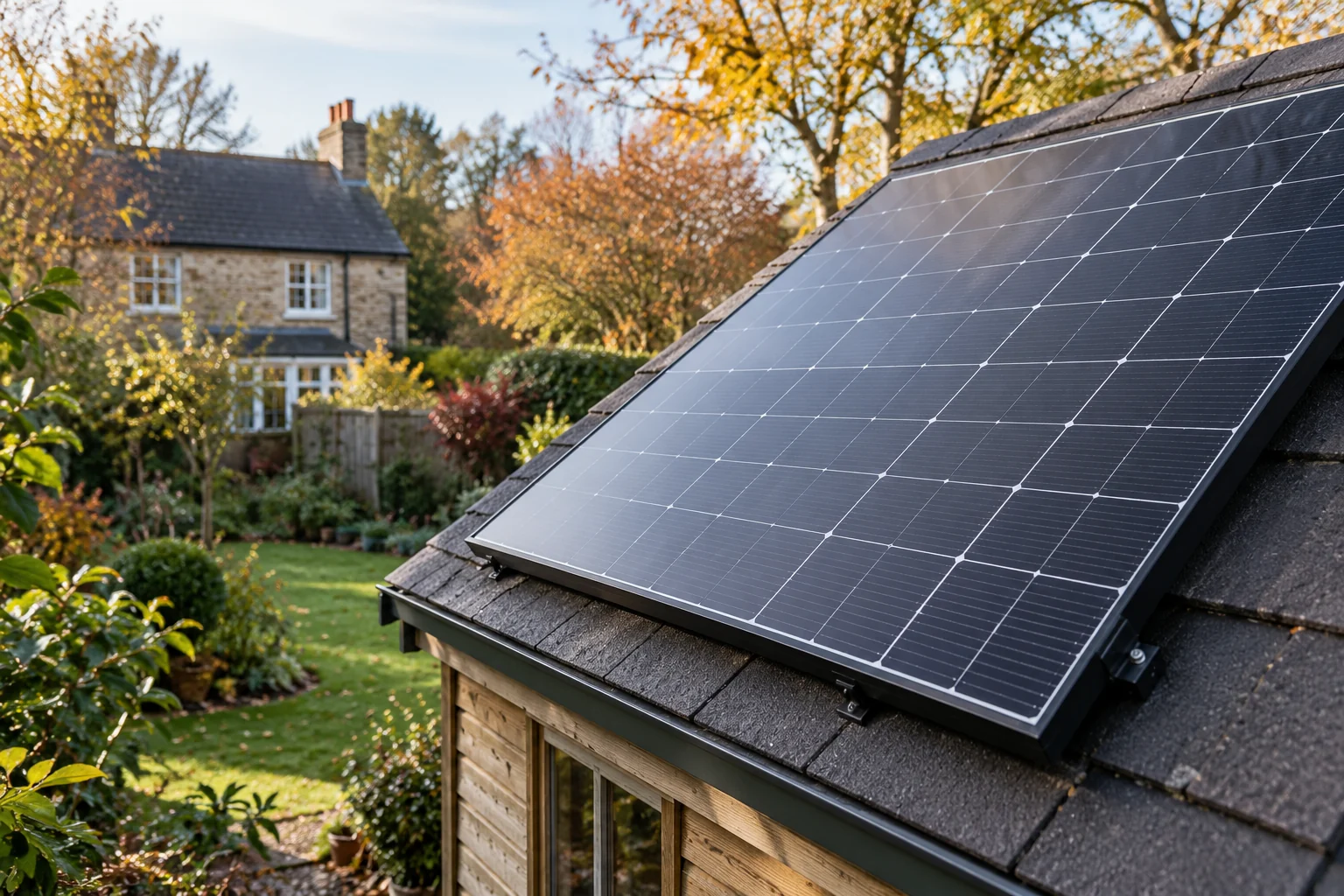
A monocrystalline solar panel uses photovoltaic cells made from single-crystal silicon. It converts light into direct-current electricity and can be a useful choice where installation space is limited. However, the word “monocrystalline” alone tells you neither how much electricity a complete system will deliver nor whether a particular panel fits your equipment.
If you have started comparing panels for a shed, garden office or house, you have probably encountered this term repeatedly. Product descriptions often place it beside impressive wattages, efficiency percentages and long warranties. Understanding what each claim actually means helps you compare panels without buying on one headline figure.
This guide explains the technology, its practical advantages and the checks that matter before purchase. The numerical examples are illustrations, not forecasts for your property.
How a monocrystalline panel is made
The “mono” refers to the crystal structure of the silicon used for each cell. It does not mean that the entire finished panel is one enormous crystal.
In a common manufacturing process, a seed crystal is used to grow a larger silicon ingot, which is sliced into thin wafers. Those wafers undergo further processing to become electricity-generating cells. The US Department of Energy explains this sequence in its solar manufacturing guide.
Cells are connected and protected within a module, typically using glass, encapsulating materials and a rear protective layer or second sheet of glass. A frame and junction box complete many rigid designs. Our guide to what solar panels are made of looks more closely at those layers.
Many mono panels appear dark and fairly uniform. Appearance is not a reliable specification, though: cell coatings, the backing and frame all affect the finished look. Read the manufacturer’s datasheet to identify the technology.
How it turns sunlight into electricity
When light reaches the semiconductor, it can transfer energy to electrons. The cell’s structure allows electrical charge to be collected through a circuit. The Department of Energy’s photovoltaic cell explanation describes the underlying process.
The panel produces DC electricity. A household system normally uses an inverter to supply AC electricity to suitable appliances. A stand-alone shed system may also need a solar charge controller and battery, while an integrated power station combines several components.
The panel itself does not store energy for night-time use. It also does not provide a ready-made mains socket simply because its advertised wattage seems adequate. The complete system must match the intended loads and installation.
Monocrystalline versus polycrystalline: what changes?
Polycrystalline cells contain multiple crystal grains rather than the single-crystal structure used in mono cells. Monocrystalline technology generally offers higher conversion efficiency than traditional polycrystalline modules, but compare actual products rather than assuming the label decides everything. The DOE’s PV cell primer provides background on these silicon technologies.
| Question | What the mono label tells you | What you still need to check |
|---|---|---|
| What are the cells made from? | Single-crystal silicon | The precise cell design and module construction |
| Will it fit my roof? | Nothing about physical fit | Dimensions, weight, mounting and usable roof area |
| How much will it generate? | It identifies a technology family | Rated power, location, shading and system losses |
| Is it good value? | No guaranteed answer | Installed cost, expected useful energy and support |
| Will it work with my battery? | No compatibility guarantee | Controller limits, battery charging requirements and design |
A higher-efficiency module can be attractive on a small roof. If you have ample suitable space, the total installed cost and expected energy may matter more than a small efficiency difference. An existing working polycrystalline array does not need replacing merely because newer panels use mono cells.
Efficiency and wattage are different measurements
Module efficiency describes the proportion of incoming solar power converted into electrical power under specified conditions. Rated wattage describes the panel’s output under its rating conditions. A physically larger panel can have a higher wattage without being more efficient.
As an illustration, a 2.0-square-metre module at 22% efficiency under 1,000W of sunlight per square metre would produce 440W: 2.0 × 1,000 × 0.22 = 440. Efficiency is already reflected in that wattage. Do not multiply a 440W rating by 22% again when estimating output.
For a real, dated example, Trina Solar’s 2023 TSM-NEG9R.28 datasheet lists a 450W variant at 22.5% module efficiency. This illustrates how specifications are presented; it is not a claim about current availability or the best panel to buy.
Standard test conditions include 1,000W/m² irradiance, a 25°C cell temperature and a specified sunlight spectrum. Your roof experiences changing light and cell temperatures, so rated watts are a comparison point rather than a continuous-output promise.
Will it work in UK cloud, shade and heat?
Solar panels can generate in daylight without uninterrupted direct sunshine, but output changes with the available light. Cloudy conditions do not make a mono panel useless; equally, “works in low light” is not a guarantee of enough electricity for your appliances.
Energy Saving Trust’s solar guidance highlights the importance of location, roof direction and shading. For a shed, nearby trees or a house can be particularly significant. Check shadows across the intended operating hours and seasons, not just during one sunny visit.
Monocrystalline cells do not make a panel shade-proof. Electrical layout and bypass arrangements influence the response to partial shading, but cannot replace missing sunlight. Ask the installer how the proposed location affects the complete array.
Heat is another consideration. Silicon modules generally lose power as their cells become hotter, other conditions being equal. Check the power temperature coefficient, and distinguish cell temperature from the air temperature in a weather forecast.
For an illustrative coefficient of −0.30% per °C, a 25°C rise above the reference cell temperature corresponds to about 7.5% lower power from temperature alone. That is a simplified calculation, not a prediction of daily yield. Follow the specified mounting and ventilation requirements.
How much electricity could one panel produce?
Start with energy, measured in watt-hours or kilowatt-hours. An illustrative 400W panel receiving the equivalent of three hours at rated output produces 1,200Wh before system losses. Assuming 20% losses to the chosen measurement point leaves 960Wh, or 0.96kWh.
“Three equivalent hours” is not the same as three hours between sunrise and sunset. It represents accumulated solar energy. Both this assumption and the loss percentage must be replaced with figures appropriate to the site and system.
Use the European Commission’s PVGIS modelling guidance to explore local and seasonal output. For an off-grid shed, check storage and poor-weather recovery as well as total generation.
Then compare against measured demand. Lights, charging tools and a laptop need different energy budgets from electric heating. If an existing system is struggling, our panels-versus-battery upgrade guide helps identify whether generation, storage or power delivery is the limiting factor.
What about TOPCon, half-cut and bifacial panels?
These labels describe different aspects of a module and can appear together. TOPCon names a cell design; half-cut describes cells divided into smaller pieces; bifacial means the module can generate from light reaching its rear as well as its front. They are not mutually exclusive alternatives to monocrystalline silicon.
Ask the seller which feature creates a useful benefit in your installation. Rear-side generation needs light to reach the back of a bifacial module. Do not apply an advertised extra-yield percentage automatically to a panel mounted close to an opaque shed roof.
Likewise, a design feature advertised to improve performance in some conditions does not remove the need for a shade assessment or compatible electrical equipment. Request an estimate based on the exact proposed module and layout.
Five checks before buying
- Confirm the purpose. Write down appliances, operating hours, season of use and whether you need mains-connected or stand-alone power.
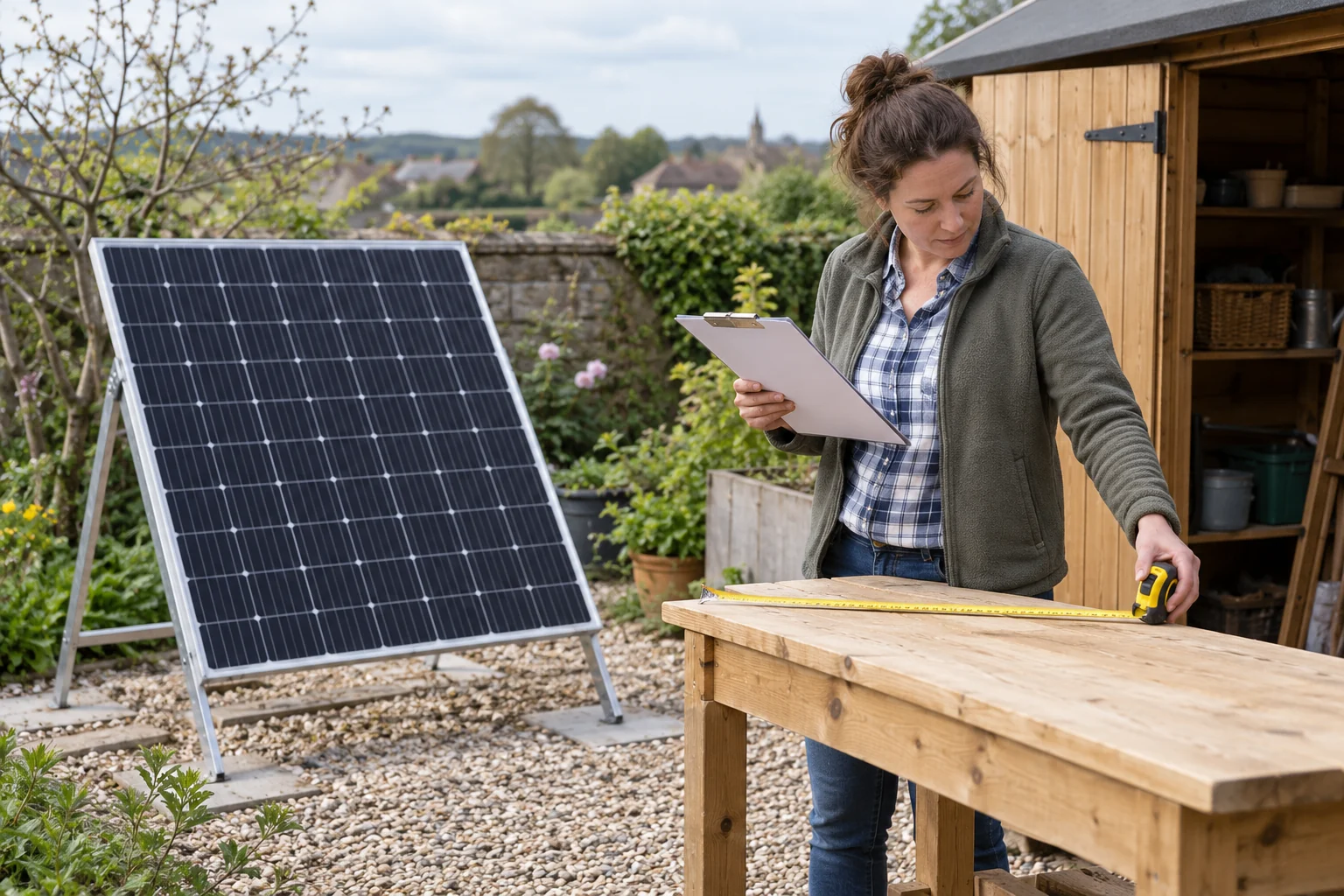
- Check physical suitability. Measure the usable area and have the mounting and roof capacity assessed. Panel weight is only part of the structural question.
- Check electrical compatibility. Ask the designer to verify voltage and current limits, including cold-weather open-circuit voltage, against the controller or inverter.
- Compare the whole price. Include delivery, mounting, wiring, protection, controls, labour and any storage. Panel-only cost is not installed-system cost.
- Read the warranty documents. Product cover and power-performance cover address different issues. Check exclusions, claim procedures and who pays removal or replacement labour.
A large module intended for a roof array is not automatically suitable for a small portable power station. Victron’s solar-controller installation guidance illustrates why the specific equipment ratings matter. Leave system wiring and permanent installation to a competent installer.
If you are exploring broader energy ideas alongside conventional solar, you can also view the separate energy offer and full details. It is not a verified monocrystalline panel recommendation or a substitute for a site survey.
Frequently asked questions
Is a monocrystalline solar panel always better?
No. It can be a strong choice where space is limited, but suitability depends on the particular module, installation, compatibility, expected output and complete cost.
Does it need a battery?
Not every solar system does. Storage is useful when you need electricity at a different time from generation. Stand-alone and grid-connected systems have different designs.
Will it produce electricity at night?
A conventional solar panel provides no useful solar generation in darkness. Night-time loads need stored energy or another electricity supply.
How long will it last?
Read the exact product and performance terms. A long output warranty does not promise unchanged output or cover every component in the system for the same period.
Choose a panel around your project
A monocrystalline solar panel can make good use of limited space, but the most useful specification is the one that solves your actual need. Compare dimensions, expected seasonal energy, electrical compatibility and installed cost before deciding.
Explore the linked energy offer
Open the seller’s presentation to review the contents, evidence, price and current terms. We have not tested the product or verified its performance claims. Check what is included before purchasing.
View the Energy Product and Full Details