
Quick answer
A seasonal stream can supply useful electricity to an off-grid cabin while sufficient water is flowing, but it cannot provide dependable year-round power on its own if it dries up. The decision depends on usable flow, vertical drop, permitted water use and when you occupy the cabin. For many sites, seasonal hydro is a possible partner for solar and batteries rather than the entire supply.
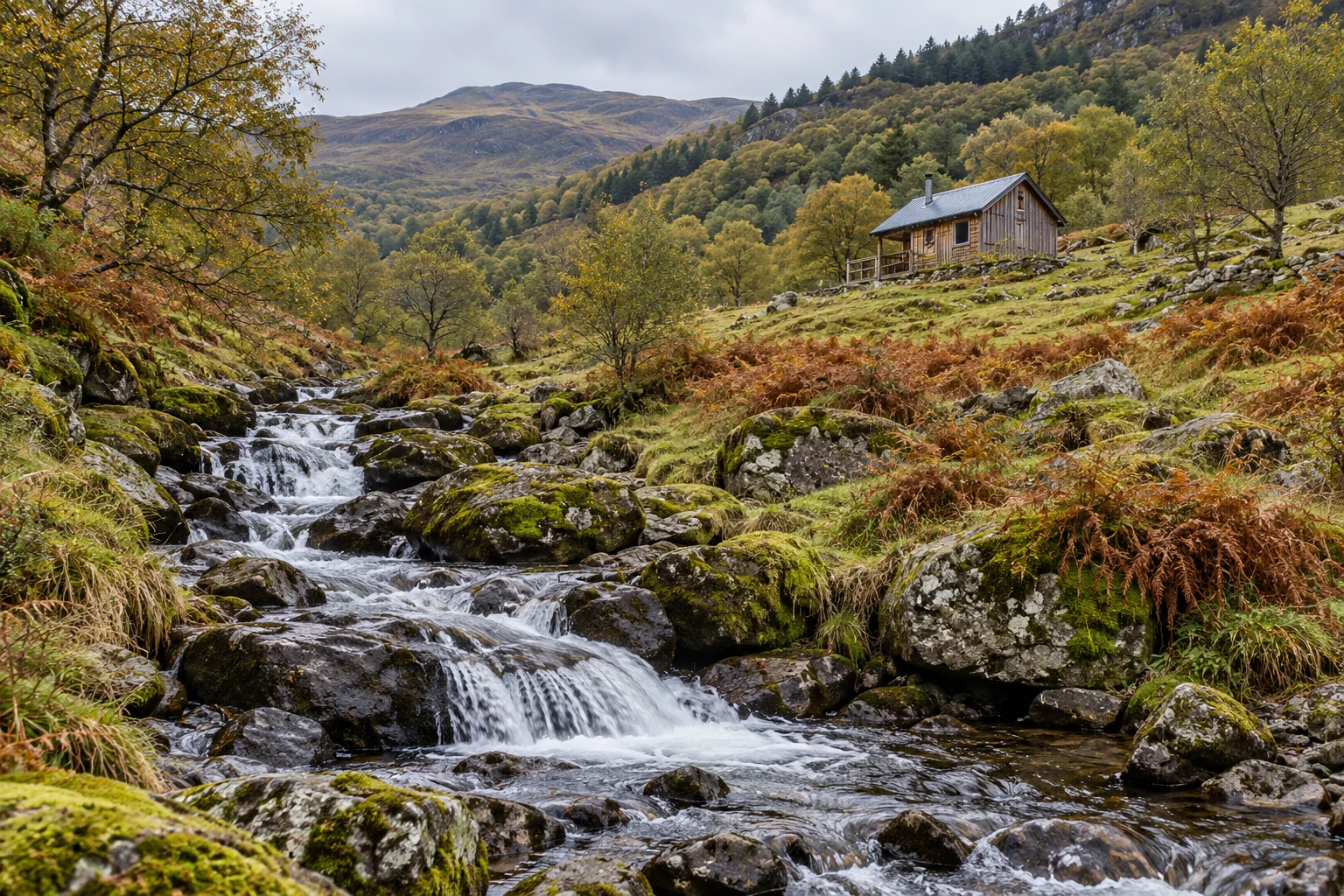
A lively stream beside a cabin looks like an obvious source of energy. It keeps moving after sunset, and a modest continuous output can add up over a day. The difficulty is knowing whether that attractive winter flow represents what the site can deliver when you actually need electricity.
Before choosing a turbine, establish what the stream does through dry weather and what the cabin needs. Those two records will tell you much more than a generator's advertised wattage.
Affiliate disclosure: This article contains affiliate links. We may earn a commission if you buy through them, at no extra cost to you. The separate energy offer linked below is not a recommendation for a particular hydro turbine.
What does “seasonal” mean at your site?
A stream that runs steadily for eight months is a different resource from a channel that flows for two days after heavy rain. Both might be described as seasonal, but their usefulness to a cabin differs enormously.
Start a dated record of flowing, low-flow and dry periods. Record whether the cabin is occupied at those times. Photographs from a consistent safe viewpoint help document changes, although a photograph cannot measure flow.
A summer holiday cabin beside a winter-only stream has a poor match between generation and demand. A cabin used mainly in autumn and winter may have a better match, provided the water is sufficiently dependable and the installation can operate through those conditions.
Build observations across the seasons and ask a hydrologist to relate site measurements to longer-term records. One wet year is not proof of drought resilience. Nearby river data may help, but a small catchment can behave differently from the gauged river.
Head and flow matter more than appearances
The US Department of Energy explains that hydro output depends on water flow and the change in elevation, known as head. In a conventional small scheme, water travels through a pipe, or penstock, to a turbine and then returns downstream.
Flow is a volume per unit of time, such as litres per second. Gross head is the vertical height difference available to the scheme. Net head accounts for hydraulic losses before water reaches the turbine.
A long pipe is not necessarily a large drop. Nor does a noisy, fast-looking stream prove that it has enough usable flow. Accurate measurement comes before equipment selection.
This head-and-flow guide by hydro specialist Dan New also identifies pipe length and electrical transmission distance as key site measurements. Have a specialist assess the proposed route and losses; rough map elevations are only an initial screening tool.
Estimate power with realistic assumptions
For a preliminary calculation, electrical output in watts is approximately:
9.81 × usable flow in litres/second × net head in metres × turbine-and-generator efficiency.
This comes from the gravitational energy in falling water. Use the flow actually available to the turbine after environmental restrictions—not the entire stream flow. Efficiency must match the proposed equipment and operating point.
Consider an illustrative site with 5 litres per second available, 10 metres of net head and an assumed 50% turbine-and-generator efficiency:
9.81 × 5 × 10 × 0.50 = about 245 watts.
If that output continues for 24 hours, it produces approximately 5.9kWh at the generator. Cable, charging, battery and inverter losses reduce the energy reaching appliances. Downtime reduces it further.
| Illustrative operating condition | Power | Energy over 24 hours |
|---|---|---|
| 5 litres/second at 10m net head, 50% efficiency | 245W | 5.9kWh |
| 2 litres/second at the same assumed head and efficiency | 98W | 2.4kWh |
| No permitted or usable turbine flow | 0W | 0kWh |
The second row is arithmetic, not a prediction: efficiency and net head change with flow, and some turbines cannot operate effectively at that low input. Request an output curve covering the site's expected conditions, including the minimum operating flow.
For a smaller worked example, see what a continuous 100W stream could actually support.
Match daily energy and peak demand separately
A cabin's daily energy budget tells you how much generation it needs. Peak demand tells you what the inverter, battery and electrical system must deliver at one moment. A small continuous hydro supply can charge a battery between larger appliance loads.
Here is an example only; replace every figure with measured consumption or appropriate appliance data.
| Cabin load | Example use | Daily energy |
|---|---|---|
| LED lighting | 20W for 5 hours | 100Wh |
| Laptop | 50W for 4 hours | 200Wh |
| Router | 10W for 12 hours | 120Wh |
| Efficient fridge | Assumed measured daily total | 600Wh |
| Phone charging and small devices | Daily allowance | 80Wh |
| Total appliance energy | Before system losses | 1,100Wh / 1.1kWh |
Add inverter standby consumption and conversion losses separately. Fridge and pump starting surges also need checking. Our guide to a small cabin's night-time loads explains why leaving the inverter running deserves its own calculation.
Electric heating changes the picture quickly. A 1kW heater running for six hours uses 6kWh by itself. Do not extend a lighting-and-fridge estimate to electric space heating, cooking and hot water without a fresh load budget.
Make a plan for zero-flow weeks
Batteries shift energy through time; they do not replace missing seasonal generation. Suppose your essential demand, including losses, is 1.5kWh per day. Three days require 4.5kWh of usable stored energy. Thirty days require 45kWh before any extra reserve.
Those are usable-energy figures, not the battery's nameplate capacity. Allow for permitted discharge limits, temperature, ageing and the chosen operating reserve when specifying storage.
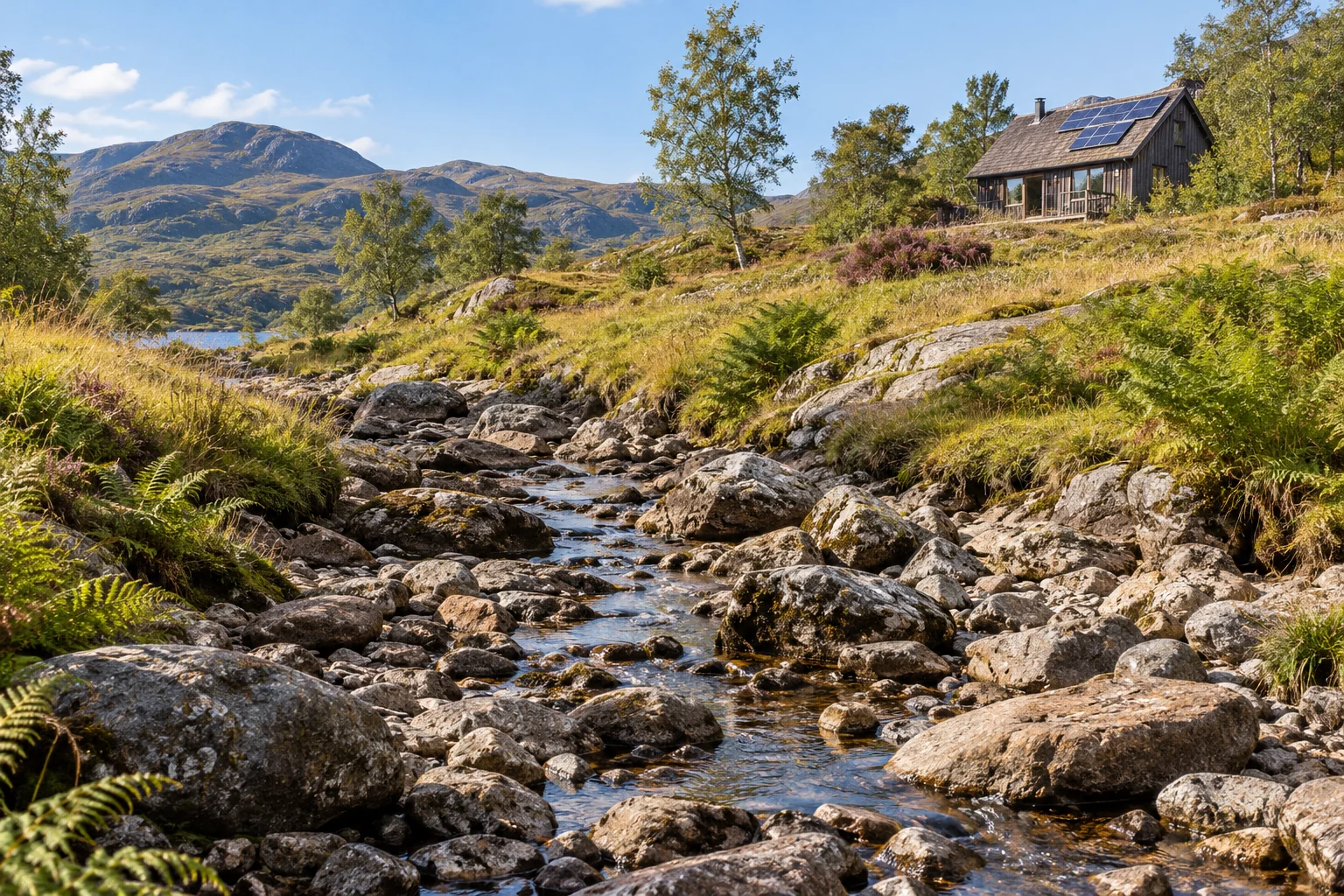
Solar may complement a winter-flowing stream, but check shading and monthly solar yield at the cabin. Do not assume a sunny-season average covers every cloudy spell. A suitable backup source and a reduced-load operating plan may still be needed.
Our three-day off-grid reserve plan helps separate essentials from loads you can postpone. For a seasonal stream, extend that thinking to the longest plausible period with no hydro output.
Exploring other energy ideas too? You can view this separate affiliate energy offer and read the seller's details. It does not establish whether your stream is suitable for hydropower.
Check permissions before designing around the water
Owning the bank does not automatically authorise a hydro installation. In England, the Environment Agency's hydropower guidance covers abstraction, impoundment, fish passage and works in or near watercourses. The permissions required depend on the scheme; check local planning requirements and access rights too.
The Agency's flow-management guidance includes limits on abstraction and a hands-off flow below which abstraction must stop. Water can therefore remain visible while no water is available for your turbine.
Wales, Scotland and Northern Ireland have separate regulatory arrangements. Outside England, confirm requirements with the relevant local authority and environmental regulator. Returning water downstream does not remove the effects of reducing flow in the intervening stretch. Establish feasibility before buying equipment or altering the channel.
Consider the complete system and maintenance
The turbine is only one part of the project. Budget for the intake and screening, pipework, turbine housing, discharge arrangements, cable route, electrical protection, controls and any battery-and-inverter system. Civil works and difficult access can make a cheap turbine an expensive installation.
Charging controls must be suitable for hydro. Morningstar describes diversion control as sending surplus energy to a secondary load while regulating battery charging. The appropriate control and shutdown arrangement depends on the generator and battery; do not assume an ordinary solar controller can be substituted.
Ask how the system behaves when batteries are full, a battery disconnects or cabin loads switch off. Have the electrical design, earthing, protection and commissioning handled by appropriately qualified specialists.
Discuss leaf and sediment clearance, flood exposure, frost, safe isolation and seasonal restart with the installer. Decide who checks the intake while you are away. A site requiring frequent visits may be unsuitable for an occasionally occupied cabin, even if its energy estimate looks attractive.
What should you take to a hydro installer?
- A site plan showing possible intake, turbine, discharge and cable routes.
- Seasonal observations and professionally assessed head and flow data.
- A daily cabin load budget, peak demand and occupancy calendar.
- Initial advice on water availability, permissions and access rights.
- Your acceptable maintenance commitment and backup arrangements.
Ask for monthly expected generation, zero-generation periods and a complete installed-cost estimate. Compare useful energy delivered during occupancy with the alternatives. Winter surplus has limited value if the cabin is empty and there is no useful load or export arrangement.
Frequently asked questions
Can a small stream really produce enough electricity?
Possibly. Adequate head and usable flow can support worthwhile output. Measure both and compare the resulting energy with your cabin's actual demand.
Does the stream have to run all year?
Not for seasonal generation. It does need dependable flow whenever you intend to rely on it; otherwise another source must cover the gap.
Can I place a turbine directly in the stream?
Some equipment uses moving-water current, but that is different from the head-based calculation above. Do not assume a portable device will deliver its rated output at your site or avoid permissions.
Would a bigger battery solve the dry-season problem?
Only if enough energy can be stored and the system is sized for the full gap. Weeks of storage are a very different proposition from overnight backup.
Can hydro and solar share a battery?
They can in a properly designed system with compatible charging controls and protection. The installer must coordinate both sources with the battery's limits.
Decide from the lean months
A seasonal stream is worth investigating when its usable flow overlaps your cabin use and the head, permissions and maintenance requirements are workable. Assess the dry periods first, then compare hydro with the solar, wind and micro-hydro resources on your plot. A good design starts with the site and the loads.
Explore a separate energy offer
For readers researching broader home energy ideas, the affiliate offer below provides the seller's product information. Check its description, price and terms before deciding; it is not a hydro feasibility assessment or a turbine recommendation.
View the Energy Product and Full Details