
What are solar panels made of?
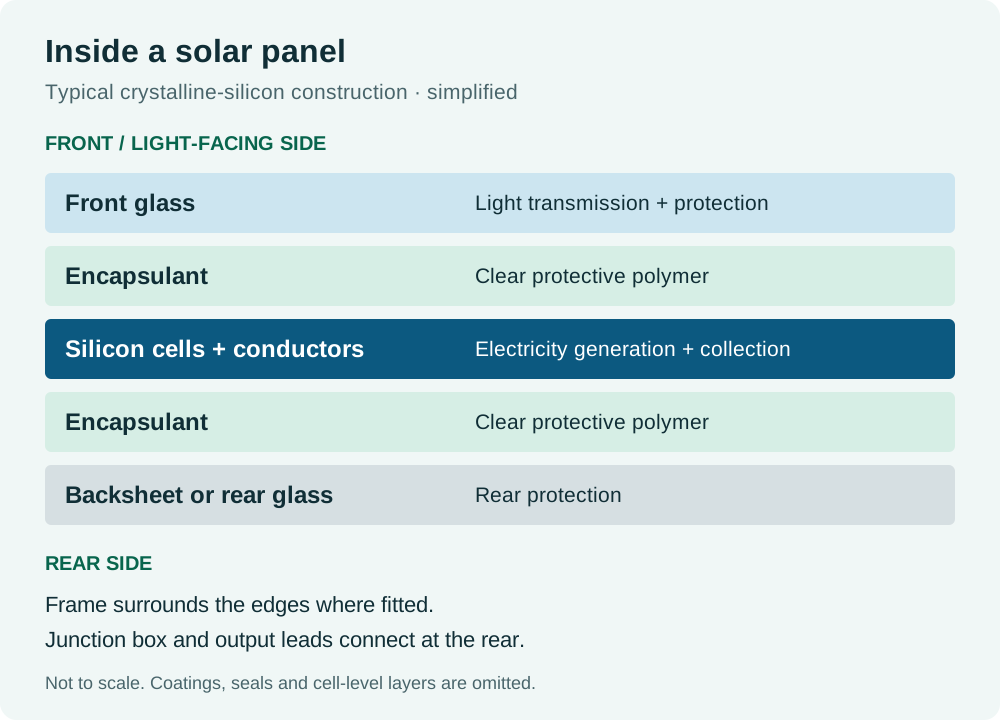
Most rooftop solar panels contain silicon solar cells, protective glass, polymer encapsulation, metal electrical connections and a rear protective layer. Many also have an aluminium frame, a junction box and cables. Some use glass on both sides; others have a polymer backsheet. The exact materials depend on the panel technology and model.
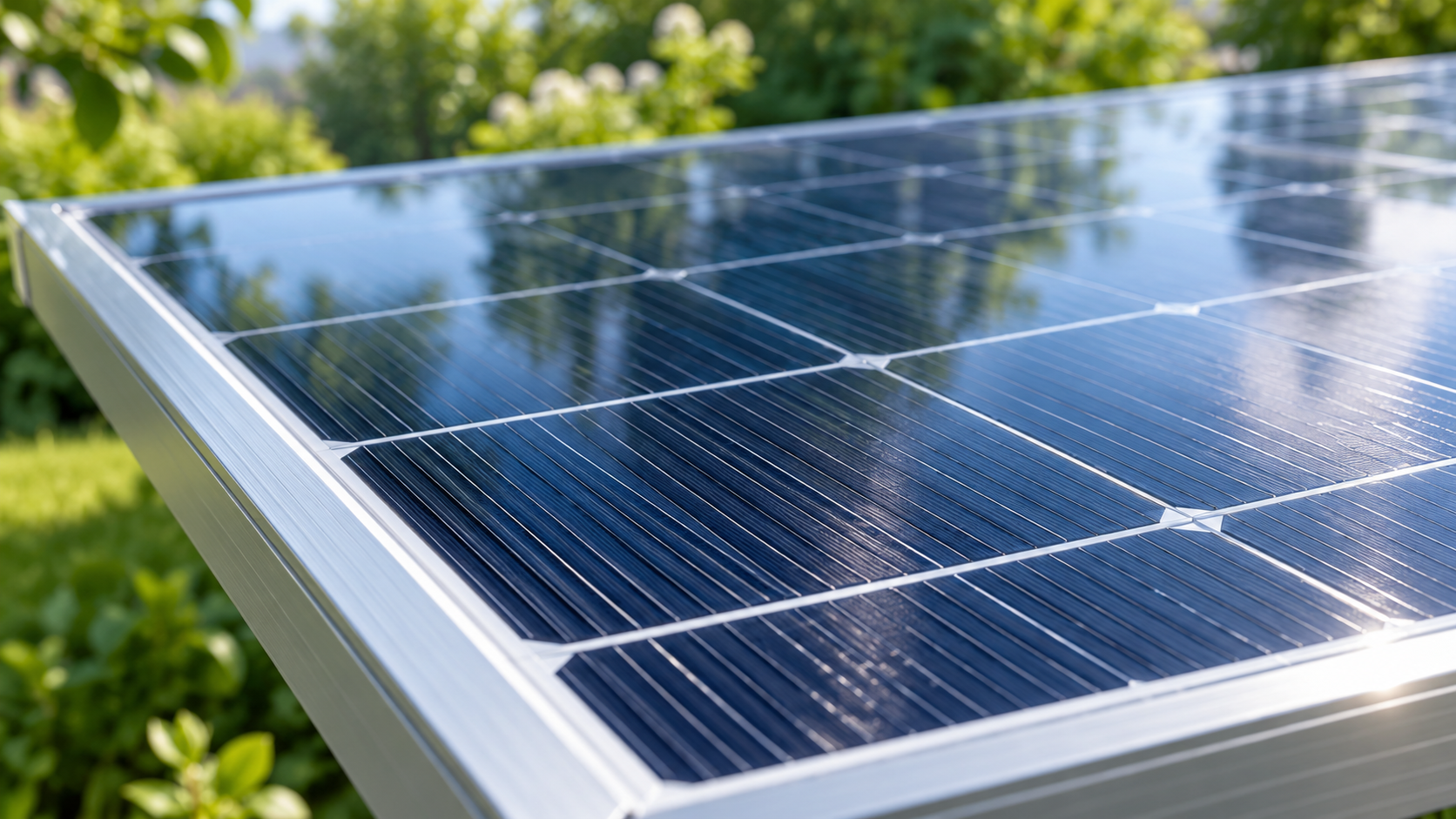
From the garden, a solar panel can look like a single dark sheet. Look more closely and it becomes a collection of cells protected inside a carefully assembled package. Each part has a job: capturing light, carrying electricity, supporting the structure or keeping the weather away from vulnerable components.
Understanding those jobs helps you read a quotation and ask better questions about weight, durability and recycling. This guide covers electricity-generating photovoltaic panels, usually called PV. Solar water-heating collectors are a different technology and should not be confused with them.
The main materials inside a typical panel
| Component | Typical material | Main purpose |
|---|---|---|
| Solar cells | Processed crystalline silicon | Convert sunlight into electricity |
| Front cover | Solar glass | Admit light and protect the cells |
| Encapsulation | Polymers such as EVA or POE | Bond and protect the cell assembly |
| Rear cover | Polymer backsheet or glass | Provide rear protection |
| Electrical connections | Silver contacts, copper conductors and joining materials | Collect and carry current |
| Frame, where fitted | Usually aluminium | Support the module and provide mounting interfaces |
| Junction box and leads | Insulating housing, conductors and electronic components | Provide protected electrical connections |
This is a typical construction, not a universal recipe. A flexible camping panel, a rigid rooftop module and a thin-film solar-farm panel may use different combinations. Ask for the specification of the product being offered rather than applying a generic material list to every panel.
1. Silicon: the electricity-generating material
Silicon is the semiconductor used in most conventional rooftop cells. When a suitably designed cell absorbs sunlight, it can produce electrical current. The material is processed and its electrical properties controlled during manufacture; a piece of ordinary silicon is not automatically a finished solar cell.
Monocrystalline cells are made from wafers cut from a single-crystal ingot. Multicrystalline, often called polycrystalline, cells contain multiple crystal grains. Both use silicon. Their names describe the crystal structure rather than two completely different raw materials.
The US Department of Energy’s cell overview explains the role of semiconductor materials. For a buyer, the useful question is how the complete module performs and is warranted, rather than whether a familiar material name sounds impressive.
Are solar panels really made from sand?
There is a connection, but the shortcut misses a great deal. Silicon production commonly starts with silica-rich raw material such as quartz. Silica is silicon dioxide, a compound of silicon and oxygen. Industrial processing produces silicon, which is purified for solar manufacturing.
The silicon is formed into ingots, cut into thin wafers and processed into cells. Those cells receive surface treatments and electrical contacts before being assembled into a module. The Department of Energy’s manufacturing guide describes these stages.
So “made from sand” is a rough origin story, not a manufacturing instruction. It also overlooks the glass, metals, polymers and supporting components needed to make a working panel.
2. Glass: protection that lets light through
The front glass has to protect the assembly while allowing useful light to reach the cells. Solar glass suppliers offer low-iron products because reducing iron content improves light transmission. Depending on the product, glass may also receive surface treatment or anti-reflective coatings.
AGC’s solar-glass range illustrates that the cover is an engineered material, not merely any convenient windowpane. Its thickness and strengthening treatment should be checked on the module datasheet.
Do not assume every panel uses the same glass specification. For example, a double-glass module may use thinner individual sheets than a different single-glass design. Compare complete module weight and the manufacturer’s installation requirements rather than trying to judge strength from one number.
3. Encapsulation: the clear layers around the cells
The cells sit within protective polymer layers called encapsulants. Common examples include ethylene-vinyl acetate, abbreviated EVA, and polyolefin elastomer, or POE. Some designs use combinations of materials.
These layers help hold the assembly together and protect the cells and connections. They must also allow light through on the illuminated side. They are part of an engineered package whose performance depends on material selection and manufacturing quality.
Dow’s photovoltaic materials information describes POE products used in encapsulation and compares different film constructions. That is useful evidence of the materials in use, but a supplier’s promotional claims do not establish that every panel using one polymer will outlast every alternative.
For readers exploring broader energy ideas, view the separate energy-information offer (affiliate link). We have not tested this product or verified its claims; it is not a panel specification or materials certificate.
4. The rear layer: backsheet or another sheet of glass
Many modules have a protective polymer backsheet. This may combine several layers with different jobs, including electrical insulation and resistance to outdoor exposure. DuPont’s backsheet information describes constructions using its PVF film; other materials and suppliers also exist.
Glass-glass modules instead use glass at the front and rear, with the cell assembly between them. “Double glass” describes the outer construction. It does not, by itself, tell you the module’s weight, mounting limits or expected output.
Check those details for the exact model. A product description that lists only “premium glass” gives you less useful information than a complete datasheet and installation manual.
5. Metals, frame and electrical connections
Cells need conductive contacts and connections to deliver their electricity. Silver is commonly used in cell contacts, while copper is used in interconnections and cables. Joining materials and contact designs vary between manufacturers and cell technologies.
The familiar aluminium perimeter frame supports many rigid modules and provides defined places for mounting hardware. It is separate from the rails and roof fixings that hold the installation to the building. Some modules are frameless, so a metal border is not essential to every design.
A junction box provides protected connections to the module’s leads and may contain bypass diodes. These help manage electrical behaviour when sections are shaded; they do not recover the sunlight lost to shade. Keep the box closed and leave electrical inspection to a suitable professional.
For an outbuilding, see our lightweight shed roof questions. Knowing the materials is helpful, but the roof assessment must consider the complete installation.
Are bifacial and thin-film panels made differently?
Bifacial means the cells can use light reaching both their front and rear surfaces. The rear of the module therefore needs to admit light. Double-glass designs are common, but transparent backsheets are also used. Bifacial describes a generating capability; glass-glass describes a construction.
A LONGi bifacial datasheet provides one example of double-glass construction. Rear-side output still depends on how the panel is installed and how much light reaches it. Do not assume a bifacial label promises a fixed gain on every roof.
Thin-film cells use thin semiconductor layers deposited on a supporting surface. Examples include cadmium telluride, or CdTe, and copper indium gallium diselenide, or CIGS. They are not simply ordinary silicon wafers made slightly thinner. Also, thin-film does not automatically mean flexible: some modules use rigid glass.
Can solar panel materials be recycled?
Many can, but separating them is the challenge. The same bonded construction that protects the cells outdoors makes dismantling more complicated. The US Environmental Protection Agency’s recycling overview explains that glass, aluminium and copper can be recovered, while small quantities of other materials may be harder to recover economically.
Glass makes up much of a conventional module’s weight. That means a high recovery percentage by weight does not necessarily show that every valuable or difficult material has been recovered. Recycling processes differ, particularly between crystalline-silicon and thin-film products.
Ask the supplier who accepts the exact panel at end of life and what collection costs apply. Use an appropriate local recycling route; do not dismantle or break a panel to separate its materials yourself.
Do the materials make solar panels environmentally friendly?
Solar manufacturing uses energy and raw materials, and some processes involve hazardous substances. The US Energy Information Administration explains why manufacturing impacts belong in the environmental assessment alongside the electricity generated during operation.
Some products contain lead in joining materials; cadmium is part of CdTe technology. This does not mean every panel has the same composition or that an intact module is equivalent to loose chemicals. Damaged equipment needs professional assessment and appropriate handling.
For the wider decision, read our advantages and disadvantages of solar energy. Material choices are one part of that comparison, alongside useful generation, cost and site suitability.
You can also examine the optional energy-information promotion (affiliate link). Check the seller’s contents and terms; the offer is separate from the technical sources used in this article.
What should you ask before buying?
Request the model number, datasheet, installation manual and written warranty. Check the cell technology, front and rear construction, dimensions, weight, mounting instructions and aftercare arrangements. Ask what the product warranty covers separately from any output warranty.
The best specification is one your installer can relate to your property. For shading concerns, use our shade-mapping guide to prepare observations. A sophisticated cell cannot compensate for sunlight that never reaches it.
Frequently asked questions
Are solar panels made entirely of silicon?
No. Silicon forms the cells in most conventional rooftop modules, but glass, polymers and metal components make up the surrounding panel.
Is silicon the same as silicone?
No. Silicon is a chemical element used in semiconductor cells. Silicones are a family of polymers that can be used in sealants and other applications.
Do solar panels contain lithium?
A conventional crystalline-silicon PV module does not need a lithium battery inside it. A separate home-storage battery may use lithium chemistry; it is a different component of the energy system.
Does double glass mean double electricity?
No. It describes two glass covers. Output depends on the cells, module design and available light, including any useful rear illumination in a bifacial product.
Can I repair cracked panel glass myself?
Do not treat it like a broken window. A module is an electrical assembly with bonded layers. Ask the installer to assess damage and advise on replacement or specialist handling.
Understand the whole panel
A solar panel combines a light-converting material with protection, support and electrical connections. Understanding that combination turns an unfamiliar equipment list into useful questions—and helps you judge the actual product rather than its advertising.
Next step: How are solar panels installed? explains what to expect from survey to handover.
Sources and further reading
Sources checked 6 October 2026. Manufacturer sources illustrate material choices and construction, not independent product rankings. Local collection arrangements must be checked separately.
- US Department of Energy: Solar photovoltaic cell basics
- US Department of Energy: Solar photovoltaic manufacturing basics
- AGC: Solar glass products
- Dow: Photovoltaic encapsulants
- DuPont: Tedlar backsheets
- LONGi: Example double-glass module datasheet
- LONGi: PV module user manual
- DuPont: Example bifacial module with transparent backsheet
- US EPA: Solar panel recycling
- US EIA: Solar energy and the environment
Explore the separate energy-information offer
Review the seller’s contents, price and terms before purchasing. This optional digital product is not a panel, installation service or guarantee of performance.
View the energy offer — affiliate link