
Quick answer
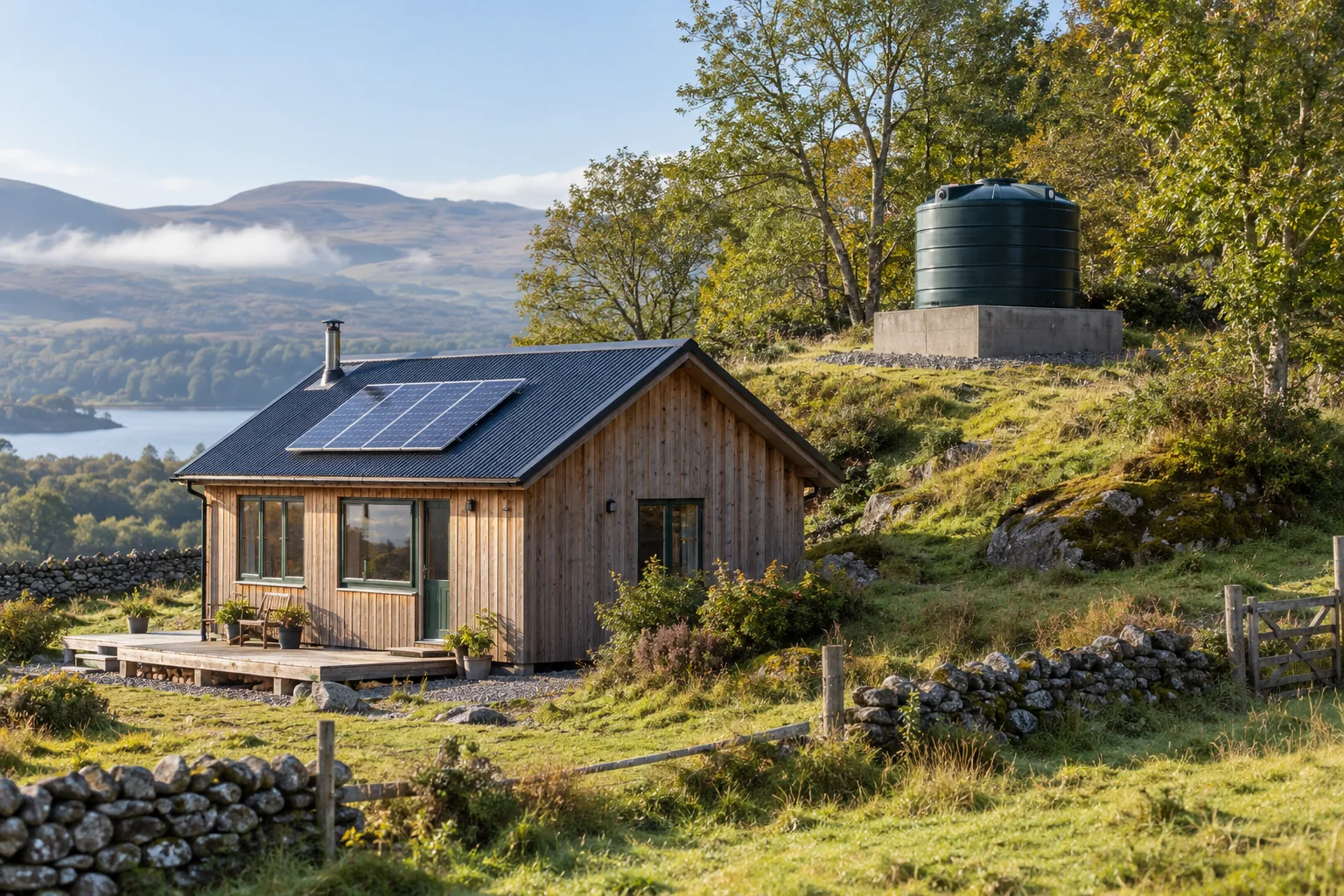
Gravity-fed water suits a cabin when a safely positioned tank provides enough height above every outlet to deliver the required flow. A pressure pump suits a cabin when that height is unavailable or the fittings need more pressure. You can also combine them: pump water into storage during daylight, then use gravity for basic delivery. Check the lowest tank level, the highest outlet and any water-treatment requirements before deciding.
An off-grid cabin does not necessarily need mains-like water pressure. A simple sink may work satisfactorily with a modest gravity supply. A shower, instantaneous heater or several outlets used together may demand something different.
The useful comparison is not “simple versus complicated”. It is whether the system delivers the water you need, at the right pressure, without imposing unreasonable power, maintenance or structural demands.
Affiliate disclosure: This article includes affiliate links. We may earn a commission if you purchase through them, at no extra cost to you. The separate energy offer below is not a recommendation for a specific water pump or treatment system.
Start with the outlets, not the pump catalogue
List the cabin's sink, basin, shower, toilet and any appliances. For each, record its required flow, minimum operating pressure and whether it will run alongside another outlet.
Check the actual product instructions. A fitting described as suitable for low pressure may have different requirements from another apparently similar fitting. A water heater can also have a minimum activation flow and its own pressure loss.
For a modest cabin, you might decide that only one outlet needs to run at a time. That can simplify the design, provided everyone using the cabin understands the limitation. A holiday rental or shared cabin may need to accommodate less predictable use.
How much pressure can gravity provide?
For a vented tank, gravity pressure comes from the vertical distance between the water surface and the outlet. It is approximately 0.098bar per metre, commonly rounded to 0.1bar per metre. Grundfos's pressure guidance explains the corresponding relationship between bar and metres of water height.
| Water surface above outlet | Approximate static pressure | What to remember |
|---|---|---|
| 1 metre | 0.10bar | A small pressure budget before losses. |
| 3 metres | 0.29bar | Check low-pressure fittings carefully. |
| 5 metres | 0.49bar | Pipework and equipment still consume pressure. |
| 10 metres | 0.98bar | Usually requires suitable terrain or substantial engineered elevation. |
These values describe water at rest. Pressure available while water flows is lower because pipes, bends, valves, filters and other equipment create resistance.
Measure to the outlet you care about. A tank may sit comfortably above a kitchen tap yet offer much less height above a shower head. Measure from the lowest intended water surface, not the tank lid or the highest level after filling.
A gravity example: why the last metre matters
Suppose the tank water surface is 4m above a shower outlet when full but only 2.5m above it near the minimum operating level. Static pressure falls from about 0.39bar to 0.25bar as the tank empties.
If the pipework and equipment lost an illustrative 0.10bar at your chosen flow, only about 0.15bar would remain at the lower water level. That loss is an assumption for this example, not a standard allowance: the real figure depends on the installation and flow.
Compare the result with the shower and heater requirements. If they cannot operate at that pressure, buying a larger tank at the same water-surface height will not fix the problem. Greater volume extends the reserve; height creates gravity pressure.
Similarly, a long downhill pipe does not provide pressure according to its length. The vertical difference matters, while additional pipe length can add friction losses.
When gravity is a good fit
Gravity deserves serious consideration where the landscape provides a safe tank position above the cabin, the pipe route is practical and the selected fittings can work with the available pressure.
Delivery can be quiet and continue during an electrical outage while the tank holds water. That can be useful for a cabin with a small solar system or occasional occupation.
However, the tank must still refill. If a pump lifts water uphill, gravity delivery shifts when electrical energy is used; it does not make filling energy-free. A spring-fed arrangement has different source and seasonal constraints.
Tank support can dominate the decision. A 500-litre tank contains roughly 500kg of water before the tank's own weight. Do not put it on a cabin roof, loft floor or improvised platform without an appropriate structural design. Naturally higher ground may be more practical than building a tower.
When a pressure pump makes more sense
A pump can provide useful delivery pressure from low-level storage, avoiding the need for a high tank. It may suit a level plot, a shower with specific requirements or a cabin where several outlets must work together.
Select it at the required flow and pressure, rather than comparing maximum figures on product listings. As Grundfos explains in its pump-curve guide, the pump and system characteristics determine the operating point. Maximum flow and maximum head are not normally delivered simultaneously.
Account for the height difference, pipe losses, treatment equipment and required outlet pressure. Also check inlet conditions: a pump pushing from a nearby tank has a different job from one drawing through a long suction line.
Choose equipment intended for the water quality, duty cycle and installation. Some compact pumps are for intermittent use, and a pump marketed for garden irrigation is not automatically suitable for a domestic water supply.
Estimate the pump's electricity use
Suppose a pump delivers a measured 6 litres per minute at the required operating pressure and draws 90W electrically. If the cabin uses 120 litres through it daily, the illustrative calculation is:
- Runtime: 120 ÷ 6 = 20 minutes, or one-third of an hour.
- Pumping energy: 90W × one-third of an hour = 30Wh per day.
Actual power and flow vary with the pump and operating point. Add controls, losses and any other loads separately. Avoid counting losses twice if your measurement already includes them.
An inverter drawing 8W continuously would use 192Wh over 24 hours, even before supplying the pump. This example shows why a short-running AC pump can have a larger system cost than its runtime suggests. A compatible DC pump may avoid that inverter requirement.
The supply must also handle starting current. Daily watt-hours do not prove that the battery, controller or inverter can start the motor. Our guide to cabin night-time loads and inverter operation helps with that wider energy budget.
Pressure control, noise and small accumulators
A demand pump typically starts when an outlet opens and pressure falls. Depending on the design, it may switch on and off or vary its speed to match demand.
A compatible accumulator can store a small amount of water under pressure and reduce rapid cycling. Pentair describes these benefits for its Shurflo accumulator. However, some pump designs do not require one; follow the pump manufacturer's guidance.
The vessel's total capacity is not the amount of usable water you can draw before the pump restarts. That depends on operating pressures and the specified air pre-charge. A small accumulator is not a substitute for the cabin's bulk water reserve.
Plan accessible mounting, vibration control and pipework that will not transmit noise into sleeping areas. Frequent starts with every outlet closed deserve investigation for leaks or another fault, not simply a larger battery.
Researching wider off-grid energy ideas? You can view this separate affiliate energy offer. Read the seller's description and terms; it does not replace a water-system design.
A combined arrangement can be practical
You do not have to make every outlet follow the same approach. One option is pumping into elevated storage during daylight, then gravity-feeding suitable fittings. Another is low-level storage with a demand pump and an accessible manual draw-off for interruptions.
If considering a gravity bypass around a pump, have the arrangement designed properly. Non-return valves, backflow protection, treatment and pressure compatibility can prevent a simple-looking bypass from working as expected.
Our article on solar pump battery backup after sunset compares storing water with storing electricity. Choose a fallback that provides usable water without compromising its quality.
Keep water quality separate from water pressure
Neither gravity nor a pump makes water safe to drink. A clear spring, stream or rainwater tank still needs assessment for its intended use.
The Drinking Water Inspectorate's treatment guidance explains that treatment selection depends on the source water and contaminants. A sediment filter alone should not be assumed to provide drinking-water safety. Get appropriate source assessment, testing and treatment advice, including local requirements for private supplies.
Treatment can affect both options through pressure loss and electrical demand. If disinfection depends on electricity, water continuing to flow during an outage does not necessarily mean the supply remains safe. Agree suitable fault protection with the installer.
Plan for frost, low water and time away
Both systems need protected storage, suitable pipework and a winter plan. Insulation slows heat loss but does not guarantee that stagnant water will stay unfrozen through prolonged cold.
Specify low-water protection where a pump could run dry, controlled overflow at the tank, accessible isolation and a manufacturer-approved drain-down procedure if the cabin is left unheated. Avoid an automatic restart that could pump a tank empty through a damaged pipe.
Keep maintenance access in mind when positioning filters, pumps and tanks. Record the useful storage volume, rather than relying only on the tank's label. Our dry-spell storage guide explains how reserve and daily demand interact.
Frequently asked questions
How high must a gravity tank be?
High enough to provide the required pressure while water flows at the lowest operating level. Use roughly 0.1bar per metre as a starting point, then account for losses.
Can gravity run a cabin shower?
It can if the available pressure and flow meet the requirements of the shower, mixer and hot-water system. There is no single tank height that suits every installation.
Does a pressure pump use much electricity?
Calculate measured electrical draw multiplied by runtime, then add controls and conversion losses. Standby consumption can dominate when pumping is brief.
Will a bigger tank improve pressure?
Not just because it stores more water. Gravity pressure depends on water-surface height; pumped pressure depends on the pump and system operating conditions.
Choose the arrangement that meets the difficult case
Check the highest outlet, the lowest tank level and the greatest realistic simultaneous demand. Gravity is attractive where those checks work without costly elevation. A suitable pressure pump can solve insufficient head, provided you budget for its supply, controls and maintenance.
Explore a separate energy offer
For broader home energy research, the link below provides the seller's product details. Check the description, price and terms before deciding. This affiliate offer is separate from the cabin plumbing options discussed above.
View the Energy Product and Full Details