
How much rainwater storage do you need?
Start with daily dry-weather demand × the number of days you want to cover. Then allow for water you cannot draw from the tank and a chosen contingency. Finally, check whether your connected roof can refill it. A bigger tank helps when useful rain currently overflows; it cannot solve a shortage of incoming water.
A water butt that overflows in April can be empty by the second week of a summer dry spell. That does not necessarily mean you bought the wrong product. It may mean its capacity was chosen around the space beside the shed rather than the watering it needs to support.
This guide focuses on garden irrigation in the UK. It offers a practical first estimate for domestic storage, not a design specification for a whole-house rainwater system. All numerical examples are illustrative: replace the assumptions with your own measurements before buying.
Why annual rainfall is the wrong starting point
Annual collection potential tells you how much water might pass through your system over a year. It does not tell you how much remains available after fourteen hot days without a useful refill.
Imagine two gardens receiving the same monthly rainfall. One gets small showers throughout the month; the other gets most of its rain in one storm followed by three dry weeks. The second garden needs more carry-over storage to provide the same dependable supply.
The Met Office’s location-specific averages are useful climate context. Monthly rainfall totals and average wet-day counts are not a sequence of actual rain events, however. For a costly installation, ask the designer to model daily rainfall and seasonal demand across multiple years.
1. Measure the watering you actually need
Keep a watering log during representative warm, dry weather. Count watering-can fills, read an irrigation flow meter, or collect and measure emitter output over a timed interval. Write down litres per session and sessions per week.
For example, four full 10-litre cans used each day mean 40 litres a day. An irrigation zone delivering 120 litres twice weekly averages about 34 litres a day, but the tank must still supply a 120-litre session. Preserve those peaks in a detailed simulation.
Separate priority plants from optional watering. Your first aim might be keeping productive containers and recently planted shrubs healthy, rather than keeping every part of the garden equally green. The RHS watering guide explains why requirements vary with plant type, establishment, soil and weather.
Do not size from one cool evening’s consumption. Record a normal dry-week estimate and a higher-demand scenario. If an automatic system runs while you are away, measure its real delivery rather than assuming the timer setting equals a particular volume.
2. Choose a dry-spell target
Choose how many days you want stored water to cover without useful rain: perhaps seven, fourteen or twenty-one. These are planning scenarios, not predictions or universal recommendations.
Be clear about what failure means. Running short for decorative pots is different from losing high-value crops during a holiday. Decide whether you need occasional backup, a reduced watering plan or a larger reserve.
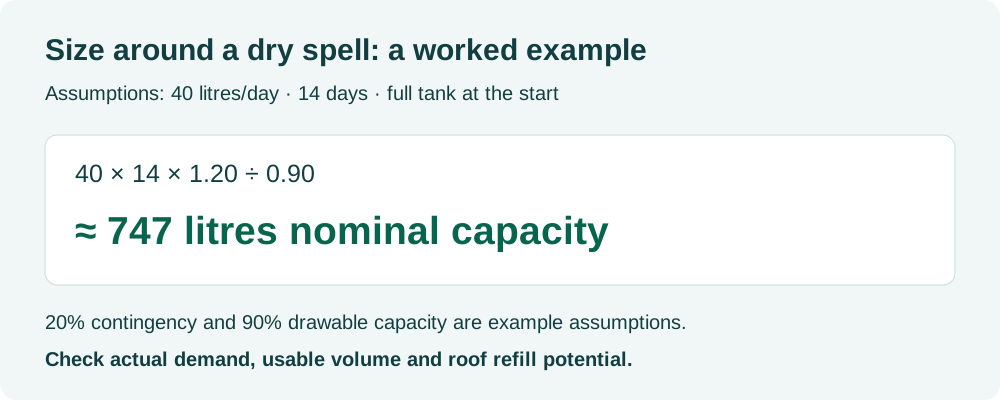
For illustration, assume demand is 40 litres a day, add a chosen 20% contingency, and assume 90% of nominal tank capacity is drawable. Those percentages are example assumptions, not industry rules.
| Days without refill | Basic water need | With 20% contingency | Nominal capacity at 90% drawable |
|---|---|---|---|
| 7 | 280 litres | 336 litres | 374 litres, rounded up |
| 14 | 560 litres | 672 litres | 747 litres, rounded up |
| 21 | 840 litres | 1,008 litres | 1,120 litres |
Here, the fourteen-day calculation is 40 × 14 × 1.20 ÷ 0.90 ≈ 747 litres. Compare products using confirmed working capacities and outlet arrangements, not simply the largest number in the product name.
3. Distinguish nominal capacity from usable water
Some water may remain below the tap, pump intake or low-level cutoff. Overflow level can also limit the volume retained. Ask the supplier what its stated capacity includes and how much water is accessible through your proposed outlet.
Do not count sediment-prone bottom water as a guaranteed reserve. Equally, do not subtract the same inaccessible volume twice if the manufacturer already quotes a usable capacity.
A nominal 750-litre tank with 90% drawable capacity offers 675 litres when full. At 40 litres daily, that is about 16.9 days before allowing for the chosen contingency. If it begins the dry spell half full, the accessible amount may be much less; calculate from the actual water level and outlet position.
Optional paid resource: Exploring wider home-energy ideas too? You can view the linked energy offer. This is separate from rainwater equipment; we have not tested the product or verified its performance claims.
4. Check whether your roof can refill the tank
The useful conversion is simple: 1mm of rain falling on 1m² represents 1 litre of water. Use the horizontal plan area of the roof draining into your connected gutter, not the sloping surface area or the entire house roof if only one part feeds the tank.
For an initial estimate:
Collected litres = rainfall in mm × connected roof area in m² × collection factor.
The collection factor allows for losses such as roof wetting, filtration and diversion. It varies with the installation and weather. For the following arithmetic only, assume 0.8 overall; this is not a measured efficiency or guaranteed yield.
- A 20m² connected roof receiving 10mm of rain: 10 × 20 × 0.8 = 160 litres.
- The same roof receiving 25mm: 25 × 20 × 0.8 = 400 litres.
- A 60m² connected roof receiving 10mm: 10 × 60 × 0.8 = 480 litres.
At 40 litres daily, 160 litres replaces only four days of use. Filling an empty 750-litre tank from the 20m² roof would require roughly 47mm under that assumed factor, with no withdrawals. Rain spread across several weeks may never fill it if watering continues.
The UK Water Reuse Association identifies local rainfall, collection area and demand as key sizing inputs. Storage and catchment should be assessed together.
5. Follow the water through a dry spell
Use a simple daily balance: yesterday’s water plus today’s captured rain, minus withdrawals, with storage capped at the tank’s working capacity. Record overflow and unmet demand separately. Stay consistent about whether your figures represent total water or drawable water.
Suppose drawable capacity is 600 litres, the tank starts full and demand is 40 litres daily. Seven rainless days leave 320 litres. A 10mm shower on the example 20m² roof adds 160 litres, taking storage to 480 litres before that day’s watering, or 440 afterwards.
Another eleven days at 40 litres daily then use that remaining 440 litres. The shower helped, but did not restart the tank from full. This is why a forecast showing “rain” does not necessarily reset your drought reserve.
For a close decision, model the timing within each day too. Rain arriving after an empty morning watering session cannot meet that earlier demand, and rain entering a full tank before watering may overflow.
Is the problem storage, collection or delivery?
- Frequent overflow, followed by shortages: more storage may capture water you currently lose.
- The tank rarely fills: investigate connected roof area, gutter blockages, diverter performance and withdrawals first.
- Water remains but plants receive little: check filters, outlet height, pump operation and irrigation pressure.
- Use is higher than expected: check leaks, timer schedules and measured emitter flow.
Our solar drip irrigation guide explains lift, pressure and flow. A bigger reservoir does not automatically improve delivery: gravity pressure depends on height, not tank volume alone.
Make each stored litre go further
The RHS recommends watering where plants need it and checking soil moisture rather than following a rigid calendar. Appropriate mulching and plant choices can also reduce demand. Keep records after changes so your storage estimate reflects the improved routine.
In the worked example, lowering measured demand from 40 to 30 litres daily changes the fourteen-day estimate to 30 × 14 × 1.20 ÷ 0.90 = 560 litres. That arithmetic is illustrative; do not reduce watering below the plants’ needs just to fit an existing tank.
Greenhouse crops also need appropriate temperature management. Our panel-free greenhouse solar guide discusses ventilation and monitoring. For broader planning, use our home-energy checklist before buying powered equipment, or review the optional energy offer separately as a paid affiliate resource.
Check the installation before ordering
A thousand litres of water weighs approximately a tonne, excluding the tank. Follow the manufacturer’s base and support requirements; do not improvise a tall platform simply to gain pressure. Plan maintenance access, secure lids and a safe overflow route away from foundations and neighbouring land.
Linked butts can add capacity incrementally, but inspect how they fill and empty. A high-level connection may pass overflow into the next container without making all stored water available at one tap. Ask the supplier to confirm the intended arrangement.
The RHS advises keeping gutters and tanks clean, using close-fitting lids and cleaning butts annually. It advises against using stored butt water on seedlings and recommends avoiding fine sprays of stagnant warm water. Harvested roof water is not drinking water.
For a UK installation with mains backup, Water Regs UK says alternative supplies must not connect directly to mains drinking water. Have a competent installer and your water supplier confirm the required separation and notification arrangements. Check your supplier’s current restrictions before using mains backup.
Frequently asked questions
Will a 1,000-litre tank last all summer?
Not without knowing demand and refills. Even 1,000 drawable litres lasts only 25 rainless days at 40 litres daily. Nominal capacity may provide less usable water.
Can I simply connect another water butt?
Often, using a compatible kit and suitable support. Check both filling and draw-off behaviour, overflow provision and access before assuming the capacities work as one reservoir.
Does a larger tank always save more mains water?
No. Extra capacity helps only when there is surplus inflow to retain and later demand to use it. Model the added benefit before paying for a much bigger installation.
Buy capacity that your garden can use and refill
Measure demand, choose a dry-spell target, check usable volume and test refill potential. That gives you a reasoned storage estimate—and helps distinguish a genuinely small tank from a collection or irrigation problem.
Explore broader home-energy ideas
Optional paid affiliate offer, separate from rainwater tank sizing. We have not tested the product or verified its claims. Check the seller’s contents, price and terms before purchasing.
View the energy offer — affiliate linkSources and further reading
Checked 3 October 2026. All worked quantities are illustrative calculations, not site measurements or guaranteed performance.