Can you use solar energy without panels?
Yes, for heat and daylight. Your greenhouse already captures sunlight, and thermal mass can store some daytime warmth for later. But this does not generate electricity for lights, fans or pumps. Non-photovoltaic solar electricity exists, notably concentrating solar power, but it is not a straightforward substitute for a small greenhouse solar kit.
If you are searching for how to generate solar power without panels for a greenhouse, start with the job you want the energy to do. Keeping seedlings warmer overnight is a different problem from running a water pump. A solution to one may do nothing for the other.
This guide focuses on ordinary domestic greenhouses in the UK and similar temperate climates. The aim is to use available sunlight sensibly, reduce unnecessary energy demand and identify when a dependable electricity supply or backup heat is still needed.
First, separate solar heat from solar electricity
Sunlight passing through glazing warms the surfaces inside. Those surfaces warm the surrounding air, while the enclosure reduces air exchange with outdoors. This is useful passive solar heating. It needs neither photovoltaic panels nor a battery.
Photovoltaic cells do a different job: they convert light into electricity. The US Department of Energy explains the distinction between photovoltaics and concentrating solar thermal technology. The latter collects heat that can drive an engine or turbine to produce electricity.
For a gardener, the practical question is therefore: can the task be done with heat, daylight, gravity or a temperature-responsive mechanism? If so, you may avoid an electrical load entirely.
| What you need | Possible approach without PV panels | Main limitation |
|---|---|---|
| Daytime warmth | Passive solar gain through glazing | Depends on available sunlight |
| Slower overnight cooling | Thermal mass plus reduced heat loss | Cannot guarantee frost protection |
| Automatic roof ventilation | Wax-operated vent opener | Moves a vent; produces no electricity |
| Watering | Gravity-fed system designed for low pressure | Needs adequate head and suitable emitters |
| Powered lights or pumps | Another electricity source | Passive warmth cannot run them |
1. Find out where winter sunshine actually reaches
Before adding equipment, sketch your greenhouse and mark shadows at several times during a clear day. Include fences, sheds, neighbouring buildings and trees. Repeat the exercise as the season changes: summer sunshine is not evidence of good winter exposure.
Record which parts receive direct light and which stay shaded. That helps you decide where plants belong and whether any proposed heat-storage container will receive enough energy to be useful. Do not sacrifice your best growing area to a large barrel without checking the trade-off.
Our guide to mapping shade before buying a solar kit uses the same observation-first approach. For this project, the useful output is a sketch and a few timed photographs, rather than a guessed energy saving.
Write down your growing priorities too. An unheated winter salad space has different requirements from a collection of tender plants. Set a crop-specific minimum temperature before deciding whether passive methods can meet the goal.
2. Understand what thermal mass can and cannot do
Water, masonry and other substantial materials can absorb heat as their temperature rises, then release it as their surroundings cool. The Department of Energy’s passive solar design guide describes the relationship between solar collection, thermal storage and heat distribution.
That principle applies to greenhouses, but the outcome depends on the whole structure. A sunny, well-designed growing space and a draughty, shaded glasshouse will not perform alike. Thermal mass stores energy; it does not create extra heat when sunlight is scarce.
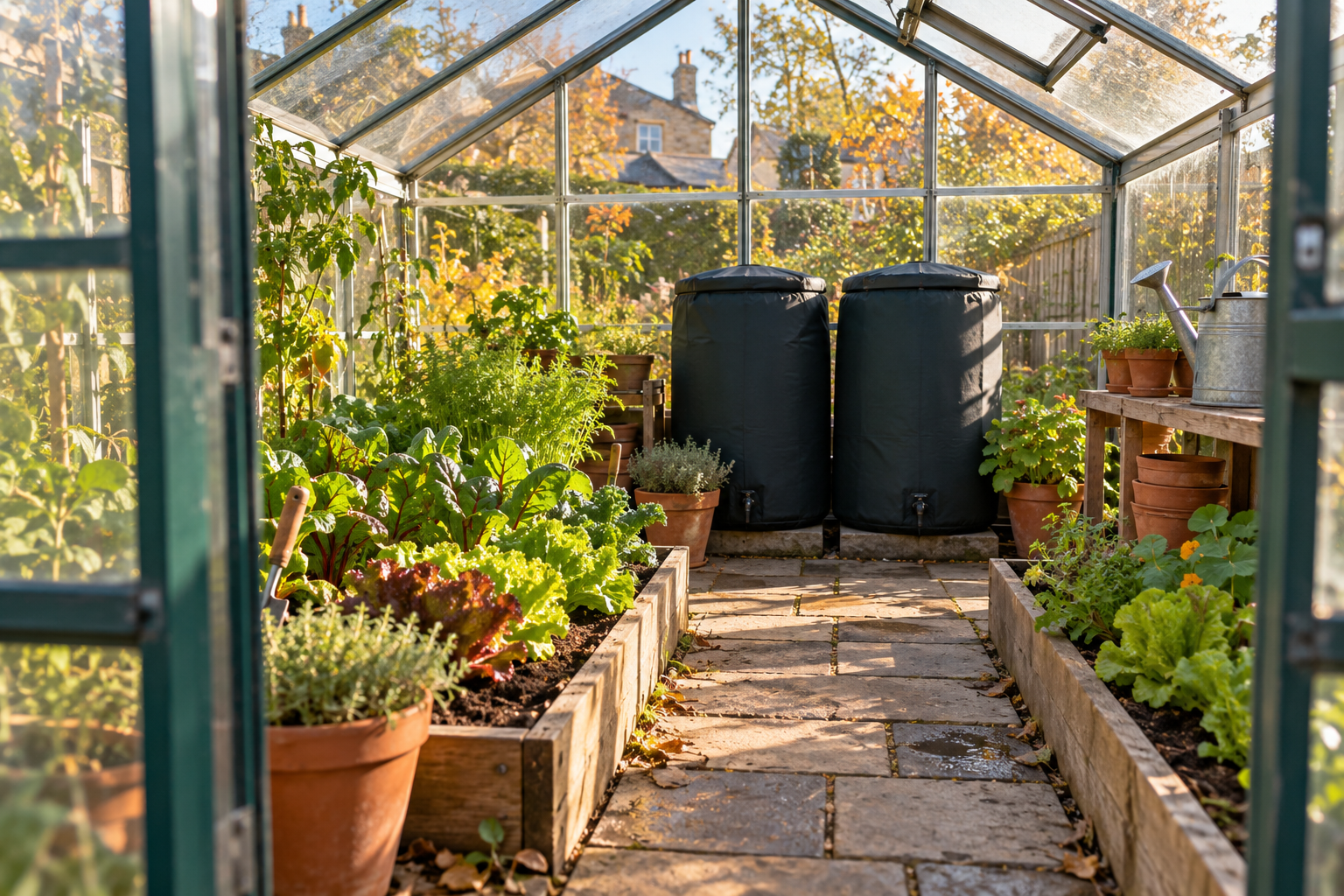
If you try water containers, use sound containers with secure lids, on a stable ground-level base, leaving access for gardening. A 100-litre quantity of water weighs approximately 100kg before adding the container. Do not put that load on ordinary staging. Allow for freezing according to the container manufacturer’s guidance.
A worked example: 100 litres of water
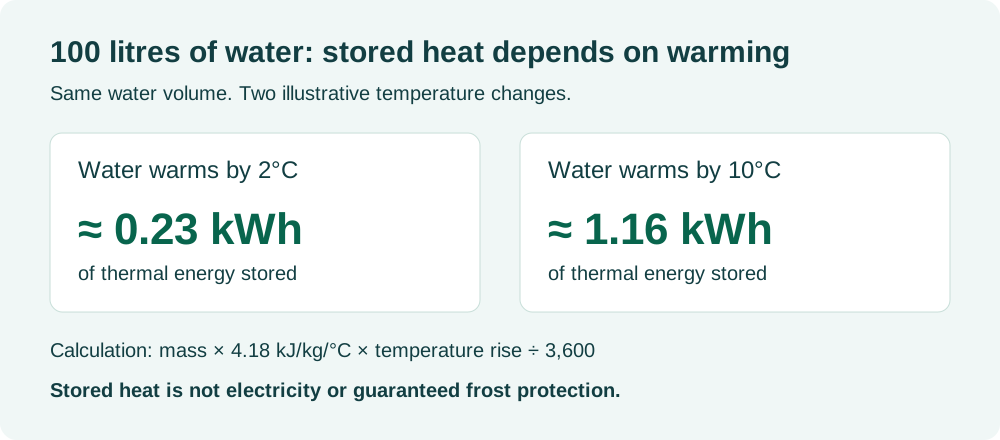
Suppose 100 litres of water actually warms by 10°C during the day. Using water’s approximate heat capacity:
Stored heat = 100kg × 4.18kJ/kg/°C × 10°C ÷ 3,600 ≈ 1.16kWh.
This is a theoretical change in thermal energy, not measured greenhouse performance. Spread evenly over ten hours, it corresponds to about 116W of average heat release. Actual release is uneven, and not all that energy will reach plants when needed. If the water warms by only 2°C, the stored amount is about 0.23kWh.
The example shows why a barrel is not equivalent to a powerful heater running all night. You would also need to know the greenhouse’s heat loss and the water’s changing temperature to predict the benefit. Never assume the illustrative 10°C rise will occur on a cloudy winter day.
The RHS specifically cautions against relying on water freezing to protect plants: the warming effect is negligible and damage may already have occurred. Storing warmth above freezing is a different process, but it still needs measurement and cannot promise a frost-free night.
Optional paid resource: If you are exploring broader home-energy ideas, you can view the linked energy offer. It is separate from the greenhouse methods explained here and is not verified evidence of panel-free electricity generation.
3. Reduce heat loss without losing essential light
The RHS recommends repairing damaged glazing and poor seals, considering insulation, and keeping ventilation available. It also notes the trade-off: extra layers reduce incoming light. A smaller protected growing area can be more practical than trying to maintain the same temperature throughout a large greenhouse.
Make your first inspection a maintenance exercise. List damaged panes, doors that do not close properly and gaps needing attention. Check repairs against the greenhouse manufacturer’s instructions. Then decide which plants actually need additional protection; do not insulate automatically just because winter is approaching.
Keep a record of each change. If you repair a door, add insulation and move every plant on the same afternoon, you will struggle to learn which adjustment helped. A staged approach makes the next decision easier.
4. Use automatic ventilation without electricity
A wax-operated opener provides a useful example of doing a job without an electrical supply. As its temperature rises, the material inside expands and moves a piston, lifting the vent. Cooling reverses the process. Bayliss explains this operating principle for its greenhouse openers.
This is mechanical temperature control, not a miniature electrical generator. Check the opener’s permitted vent weight, travel, mounting arrangement and operating range against your greenhouse. Follow the maker’s fitting and seasonal-care instructions.
The RHS warns that wax openers take time to respond, so other ventilation may still be necessary. Capturing sunshine should never mean letting the greenhouse overheat. Observe the vent on changing-weather days before leaving vulnerable plants unattended.
5. Remove electrical demand where possible
Write a separate list of tasks you currently expect electricity to perform. Could watering use a suitable gravity-fed kit? Could you work in daylight instead of installing lighting? Does a vent opener meet the need that prompted you to consider a fan?
These are questions to test, not interchangeable replacements. An opening roof vent does not reproduce every benefit of a circulation fan. Gravity irrigation also needs suitable pressure and emitters; height, pipe losses and the required delivery rate still matter.
Our water-butt irrigation guide explains lift, pressure and flow. If a powered pump remains necessary, treat its electricity supply as a separate project rather than expecting stored greenhouse heat to run it.
What about mirrors, solar generators and advanced systems?
Concentrated sunlight: electricity without photovoltaic cells is technically possible. The Department of Energy describes mirror-based systems that concentrate sunlight onto a receiver and use the resulting heat to drive an engine or turbine. That is fundamentally different from placing a reflector beside seedlings. For this domestic application, we would not treat it as a simple alternative to PV. Do not experiment with focused sunlight near plants, plastics or timber.
“Solar generators”: a portable battery power station stores electricity; the name does not mean it creates solar electricity without a collector. Check exactly how the model recharges. Charging it from the mains may be useful, but it is not generating solar power at the greenhouse.
Purpose-designed solar greenhouses: the University of Minnesota’s deep winter greenhouse work shows that solar growing systems can be developed as complete designs. Their approach includes solar capture and underground thermal storage, with fans moving air. It should not be confused with a universally electricity-free retrofit for a standard glasshouse.
Before buying any energy guide, ask what energy enters the system, what usable output is measured and what equipment is required. Our review of “free energy” claims provides a useful starting point. You can also inspect the seller’s energy presentation as a paid affiliate offer; independently verify its claims before purchasing.
A simple trial before spending more
Use a minimum–maximum thermometer near the plants, shielded from direct sunshine. Record indoor and outdoor conditions over several days, including a cloudy spell if possible. A warm afternoon alone says little about overnight protection.
- Record the overnight minimum, afternoon maximum and weather.
- Note whether vents were open and what protection was used.
- Change one thing, then continue recording.
- Compare the greenhouse-to-outdoor temperature difference, not just two unrelated indoor readings.
- Check results against the needs of the most vulnerable crop.
This is a practical observation exercise, not a controlled performance test. Different wind and cloud conditions can explain apparent improvements. Keep backup arrangements for plants that cannot tolerate the measured minimum. Where electrical heating is required, use greenhouse-suitable equipment and a professionally installed supply.
Frequently asked questions
Can black water barrels power a greenhouse light?
No. They may absorb and store heat, but there is no electrical output. A light needs a separate electricity source.
Will a passive greenhouse stay frost-free?
Not necessarily. Results depend on sunlight, weather, construction and heat storage. Measure overnight temperatures and avoid relying on an untested setup for tender plants.
Are flexible solar sheets a panel-free solution?
They may avoid rigid panels, but if they contain photovoltaic cells they are still PV collectors. Check light transmission, mounting requirements and rated output rather than relying on the wording.
What should I do first?
Define the crop’s temperature needs, map sunlight and record temperatures. Those three steps reveal whether your real problem is insufficient heat, excessive heat or an electrical task needing its own supply.
Make sunlight work for the job you actually need
For most small greenhouses, the useful panel-free opportunity is collecting solar heat and daylight while reducing avoidable demand. Treat heat storage as a limited buffer, maintain ventilation and measure the results. If electricity is essential, plan a genuine electricity supply separately.
Explore the linked energy offer
Optional paid affiliate resource. We have not tested the product or verified its performance claims. It is not a greenhouse equipment recommendation or proof of electricity generation without panels. Check the seller’s contents, price and terms before buying.
View the energy offer — affiliate linkSources and further reading
Checked 3 October 2026. Worked energy figures are illustrative calculations, not field-test results.