
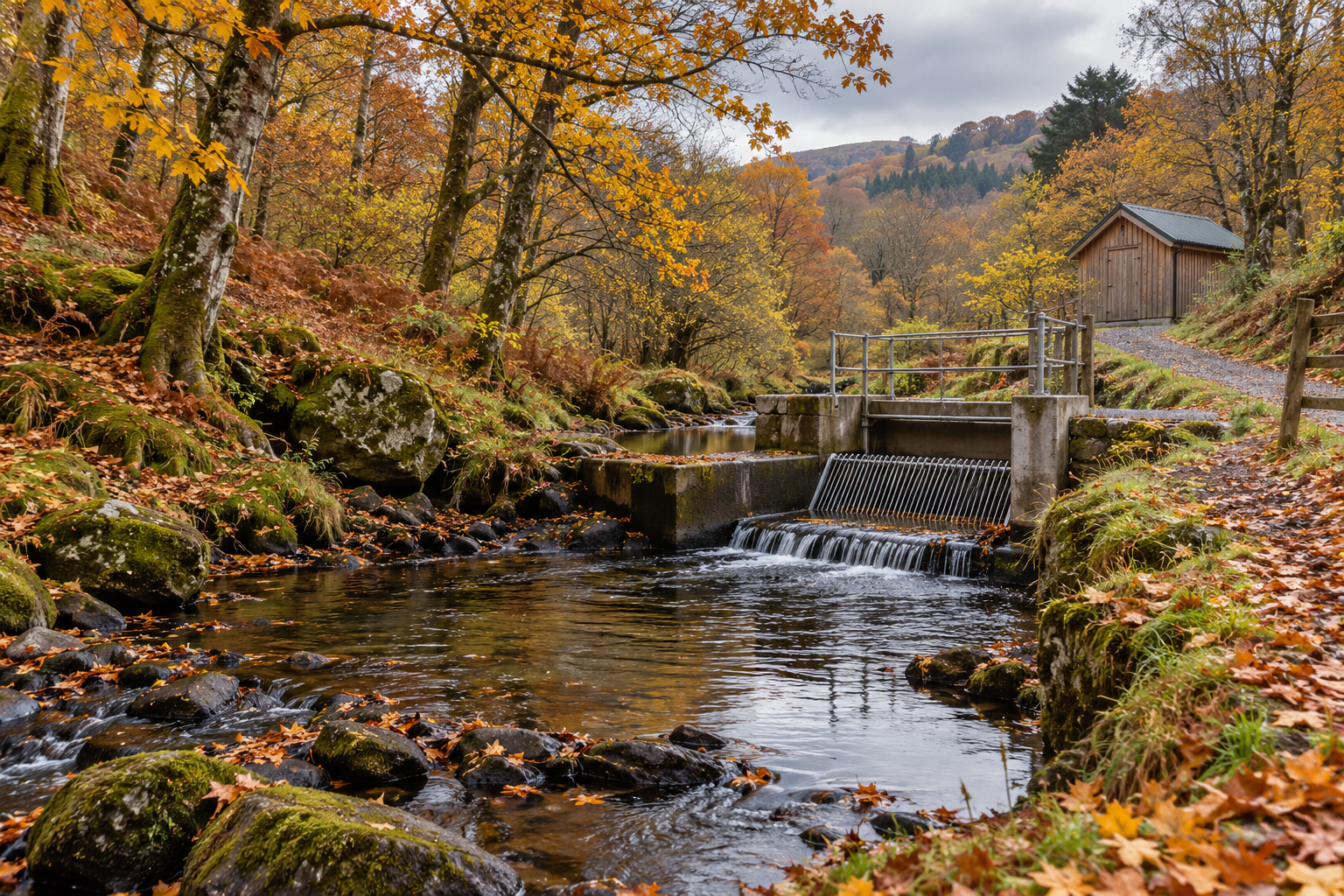
Autumn rain can bring welcome water to a micro-hydro scheme. It can also bring wet leaves, twigs and sediment that reduce output or increase wear. A stream looking fuller does not guarantee more electricity if the intake cannot pass water properly.
Prepare a site-specific autumn plan covering monitoring, safe screen cleaning, sediment management and access. The aim is to notice problems early, preserve the river protections built into the scheme and know when to leave equipment stopped until conditions improve.
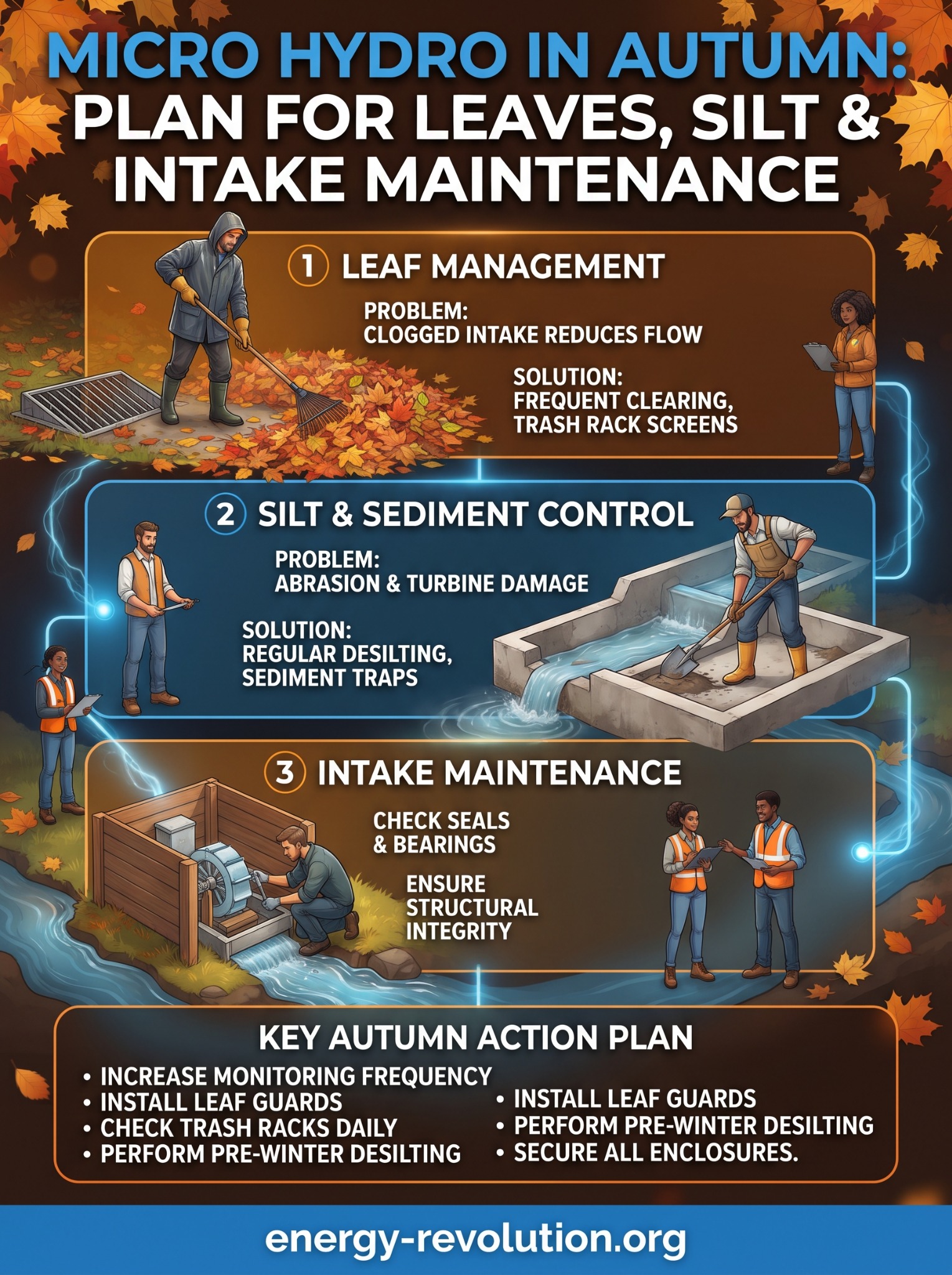
Your Pinterest pin highlights three useful themes: leaves, silt and intake maintenance. We will use those themes below, while separating routine observations from work that needs isolation, specialist help or permission.
Start with a picture of normal operation
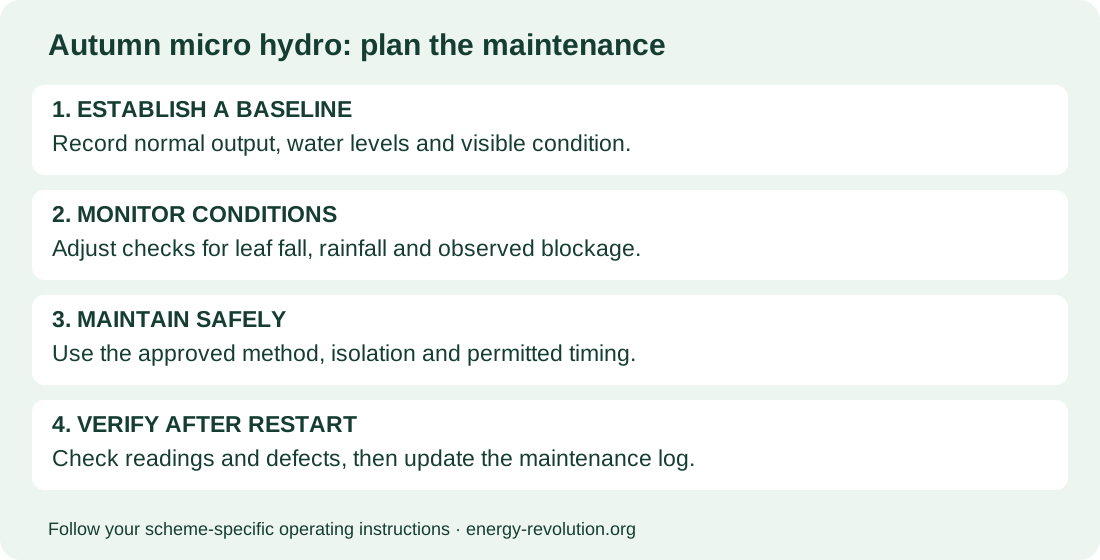
Before heavy leaf fall, record how the system behaves when the intake is clear and operating normally. Note electrical output, the available flow or water-level readings, weather and any controller messages. Photograph the screen, access route and visible structures from safe, repeatable positions.
Compare like with like. A lower output reading may reflect less stream flow, a control setting or battery charging behaviour rather than a blockage. Treat a change as a reason to investigate, not proof of a particular fault.
Keep the scheme's drawings, maintenance instructions, contact numbers and permissions together. Identify the intake, any channel or settling basin, the forebay before the pressure pipe, the penstock itself, the turbine and the return channel or tailrace. Each can affect performance.
PowerSpout's document library includes model-specific installation, intake and maintenance guidance. Whatever equipment you own, obtain the matching instructions rather than applying another turbine's servicing schedule.
1. Leaves: a thin mat can become a real restriction
A trash rack intercepts larger debris before it reaches vulnerable equipment. Depending on the design, separate finer screening may protect the turbine and aquatic life. Wet leaves can overlap across openings and restrict flow even when the rack does not look completely buried.
Check the water route as well as the visible leaf pile. Where the installation has designed level indicators, an unusual difference across a screen can help reveal restriction. Do not lean over a live intake or improvise a measuring arrangement to obtain a reading.
The US Department of Energy's microhydropower handbook notes that trash-rack cleaning can become a daily task during leaf fall. Daily is not a universal maximum or minimum: an exposed wooded catchment may change much faster during wind and rain.
Use the designer's inspection and cleaning criteria, then adjust monitoring with operating experience. A screen that blocked within three hours yesterday needs a different plan from one that remained clear for a week.
Do not solve blockage by removing protection
Removing a screen, widening its gaps or attaching improvised mesh can change flow behaviour and undermine fish protection. Ask the designer before modifying it. SEPA's run-of-river guidance highlights the need to keep screens clear because partial blockage can concentrate flow through the remaining openings.
“Self-cleaning” also needs context. PowerSpout explains that debris can accumulate on parts of its Coanda intake during low flows. A product designed to shed debris still needs monitoring under the conditions at your site.
Arrange collected leaves so they cannot wash straight back into the intake or obstruct another drainage route. Use the scheme's approved debris-handling method; do not push everything through the screen towards the turbine.
2. Sediment: a different problem from leaves
A leaf rack does not necessarily remove fine mineral particles. Sand and other abrasive sediment can pass through unsuitable screening and wear turbine components. The amount and severity of wear depend on the sediment, equipment and operating conditions.
A properly designed settling basin or sand trap slows water enough for specified particles to settle before it reaches the turbine. It does not remove every particle, and its performance depends on its geometry, flow and available sediment-storage space.
The SEIAPI micro-hydropower design guideline describes settling basins as protection against abrasive sediment and stresses sufficient dimensions and careful management of the discharge route. A basin filling with deposits needs attention according to its design, not simply a larger leaf screen.
Record deposit levels using the scheme's safe inspection method. Look for trends after rainfall and changes upstream. Avoid climbing into chambers or basins to investigate; entry may introduce drowning, entrapment or confined-space hazards.
Desilting needs an agreed method and timing
The pin suggests pre-winter desilting. Treat that as a prompt to review the plan, not an instruction to excavate every autumn. Fish spawning, protected habitats, flow conditions and the terms of a permit can affect when and how work is allowed.
Distinguish cleaning an engineered sediment trap from removing material from the river bed. In England, Environment Agency guidance says to check permissions for maintenance and removal of bed material. Other UK nations have their own regulators and arrangements.
Do not improvise a sediment flush into the river. Use the approved method for removal or discharge, including erosion and pollution controls. If the method or permitted timing is unclear, ask the scheme designer and relevant authority before starting.
3. Intake checks extend beyond the screen
From a safe position, look for changes in the intake structure and the ground supporting it. New cracks, displaced components, undermined edges, unexpected leakage or fresh erosion deserve investigation. A clear screen does not make a damaged structure safe.
Check accessible covers, guards, handrails and access surfaces as specified. Keep required overflow, bypass and fish-passage routes functioning. An enclosure should exclude unwanted water without blocking ventilation, drainage or equipment clearances.
Follow the water downstream too. A visible penstock leak or movement at a support needs competent assessment. Branches or erosion around the tailrace may affect the return route even when the intake itself is clear.
The pin mentions seals and bearings. Those are generally part of turbine or generating-equipment servicing, rather than leaf-screen maintenance. Use the correct manual for inspection and lubrication; not every bearing should be greased, and an unfamiliar noise is not a reason to reach into running machinery.
Separate observation from hands-on maintenance
Make clear which checks can be completed from a designated safe position and which tasks require shutdown and isolation. HSE guidance stresses competent maintenance, safe access, isolation and control of stored energy.
For hydro, electrical isolation alone may leave water pressure and rotating equipment hazards. Equally, disconnecting an electrical load from a running turbine can be unsafe on some systems. Follow the designed shutdown sequence; do not invent a valve-closing or switching procedure.
Before approved hands-on work, the responsible person must secure relevant energy sources, prevent unintended restart and verify the condition required by the maintenance procedure. Pressurised pipework is not safe merely because a display reads zero watts.
Do not enter fast, deep or rising water to recover output. Wet banks, hidden edges and debris can make an otherwise familiar site unsafe. Have an agreed contact and emergency arrangement, suitable access and the equipment specified by the risk assessment. Gloves and boots alone do not solve unsafe access.
A practical autumn monitoring plan
| When | What to review | Decision to record |
|---|---|---|
| Before heavy leaf fall | Normal readings, screen condition, access, manuals and contacts | Inspection triggers and who can do each task |
| During active leaf fall | Output trend and safe visual observations | Whether the next check needs to be sooner |
| After wind or rain, once access is safe | Debris, deposits, erosion and visible damage | Continue, arrange maintenance or follow the stop procedure |
| At the planned service window | Approved cleaning and equipment servicing | Work completed and unresolved defects |
| After restart | Leaks, abnormal sounds, readings and controller status | Return to normal monitoring or seek support |
This is a planning framework, not a fixed service interval. Where remote monitoring is installed, use it to flag changes; it cannot confirm that a bank, guard or intake structure is safe.
What can a partly blocked intake cost in energy?
Consider an illustrative system that would otherwise deliver a steady 100W but instead averages 70W for a full day. The difference is 30W × 24 hours = 720Wh, or 0.72kWh. Seven days at that difference would mean 5.04kWh less generation.
This does not mean a particular percentage of screen blockage produces the same percentage of power loss. The example simply shows why a modest persistent reduction matters. Real output also depends on flow, net head, turbine efficiency and the electrical system.
Our 100W stream energy guide explains the value of continuous generation. For storage and peak demand, see whether micro hydro needs batteries.
A short, properly planned maintenance stop can be preferable to prolonged poor operation. It is never worth entering dangerous water to recover a few watt-hours.
Plan for a temporary loss of hydro
List the loads that must remain powered while the scheme is stopped. Decide which can wait and how the essential ones will be supplied. If a battery is the backup, use its available usable energy and the actual load, including relevant conversion and standby losses.
For example, a continuous 150W essential load for eight hours needs 1.2kWh at the load before those losses. That is a separate calculation from the turbine's normal rating.
Keep the backup plan usable when access is poor or repair takes longer than expected. Our seasonal-stream cabin guide covers the wider challenge of matching electricity demand to variable water availability.
Keep a log that makes next autumn easier
A simple entry can record date, weather, output, visible screen condition, sediment observations, action, downtime and the next review. Use photographs from the same safe viewpoint and note whether readings were taken before or after cleaning.
After the season, compare repeated problems. Does one wind direction bring rapid leaf accumulation? Does sediment increase after a particular upstream event? Take that evidence to the designer before buying a different screen or changing the intake. Better information can make maintenance easier without unnecessary equipment changes.
Frequently asked questions
Should I clear the rack every day?
Use the scheme's instructions and observed rate of blockage. Daily checks may suit some periods, while rapidly changing conditions can require closer monitoring or a planned shutdown.
Will a finer screen stop all silt?
No. Screen selection and sediment control are separate design questions. An unsuitable finer screen can create new blockage and hydraulic problems.
Can I remove sediment whenever generation falls?
No. First establish the cause and use the approved maintenance method, permissions and seasonal timing. Low output alone is not permission to disturb the river bed.
Should I restart immediately after clearing leaves?
Only after the required checks and reinstatement in your operating procedure. Unresolved damage, leakage or abnormal behaviour needs investigation.
Sources and project resources
Checked on 30 October 2026:
- US Department of Energy: Microhydropower Handbook, operation and maintenance.
- PowerSpout: installation and maintenance documents.
- PowerSpout: Coanda intake behaviour.
- SEPA: run-of-river hydropower and screening guidance.
- SEIAPI: micro-hydropower design, settling basins and sediment.
- HSE: safe machinery maintenance.
- Environment Agency: watercourse maintenance and permissions in England.
- Environment Agency: hydropower scheme permissions and environmental protection.
For wider projects, browse our Recommended Products and DIY Alternative Energy Projects bundle. Use the scheme designer's specification for safety-critical hydro components.
Explore the Energy Revolution offer
Affiliate offer: review the seller's claims and terms independently. We do not guarantee results.