A small turbine advertised at an attractive price can make micro hydro look like a simple purchase: buy the generator, put it near the stream and enjoy electricity. In practice, the machinery is only one part of the job. The site must deliver suitable water to the turbine, return it safely and connect the electricity to something useful.
The work between the watercourse and the electrical supply can cost more than the turbine itself. Surveys, permissions, an intake, pipework, access, construction and controls all deserve a place in the budget before equipment is ordered.
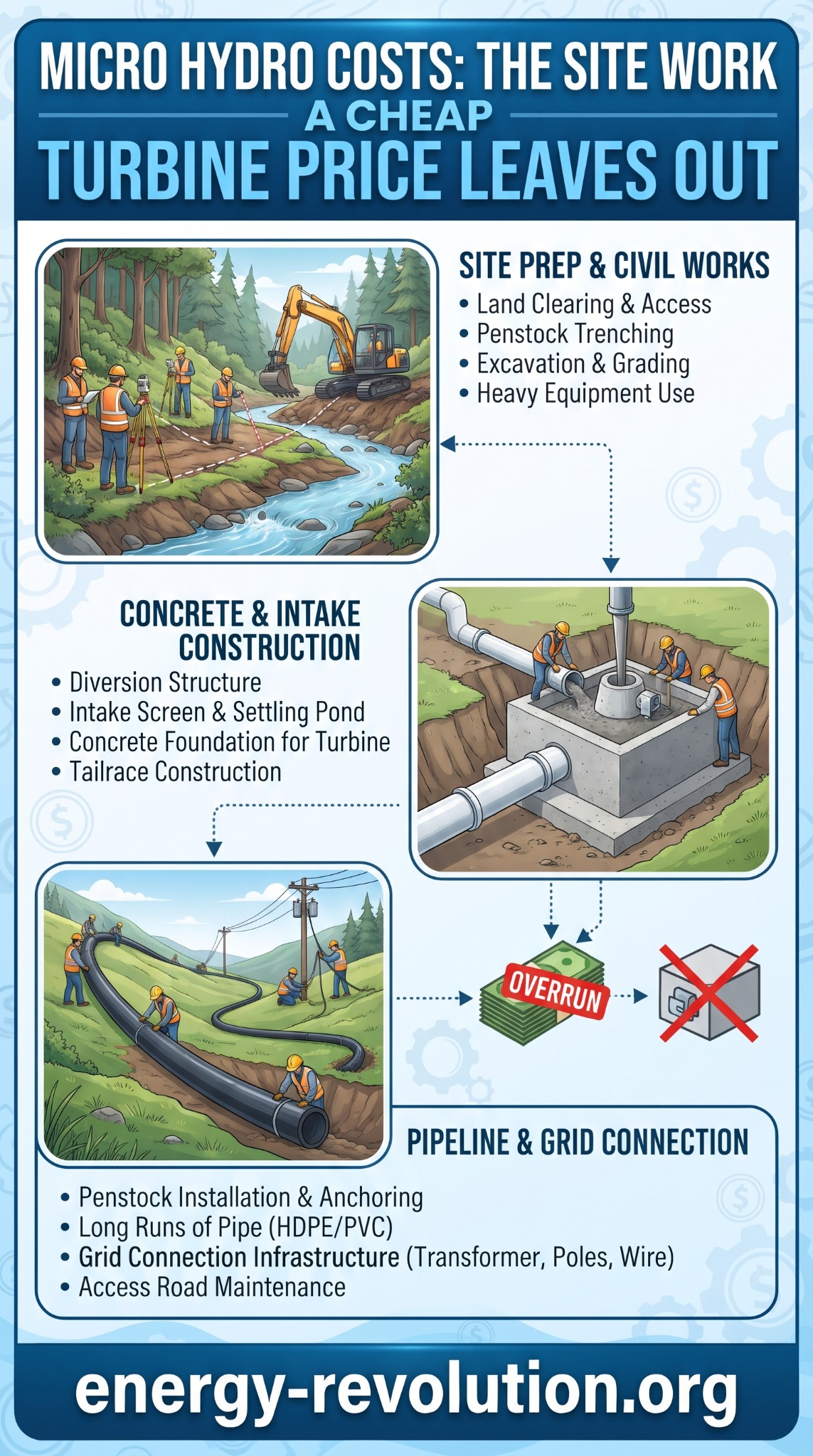
Your Pinterest pin highlights civil works, intake construction and the pipeline. These are useful categories, but the drawings are not installation instructions. Not every scheme needs a new dam, settling pond, access road or transformer. The right scope comes from the site and an appropriate design.
Why the turbine price tells you so little
Two properties can use similar turbines and have very different installation costs. One might have a short, accessible pipe route and useful existing structures. Another might need a long route across steep ground, difficult access and substantial environmental assessment.
The Centre for Alternative Technology gives a broad reference of around £5,000–£6,000 for the basic equipment for a 1kW off-grid battery-charging system, plus installation. Its guidance also notes that the turbine itself might represent only about one-fifth of a project’s cost. These are contextual figures, checked in November 2026, not a price promise or a percentage to apply automatically to your scheme.
Ask whether an offer covers the turbine alone, turbine and generator, controls, a complete equipment package or a commissioned system. A low headline price may describe only a small fraction of the work you actually need.
1. Survey the head, flow and route first
Head is the vertical drop available to drive the turbine. Flow is the amount of water passing through it per second. Both matter, alongside how they vary over the year and how much water may be used.
Budget for an appropriate level survey, flow assessment and route inspection. A wet-weather visit does not establish reliable summer output. A designer needs a defensible picture of seasonal water availability, not just a photograph of a lively stream.
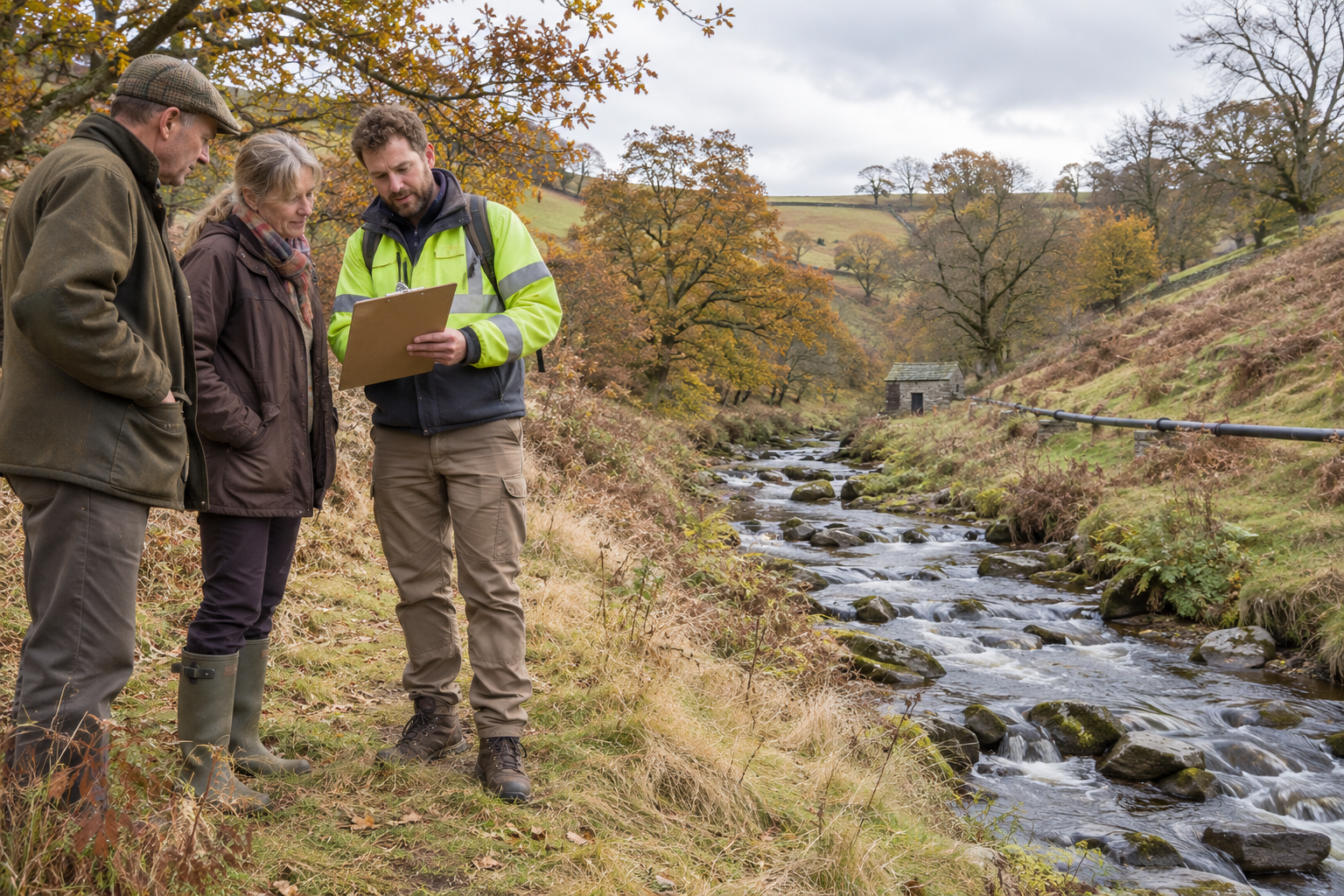
The survey should also identify the intake position, turbine location, water-return point and possible pipe route. Existing services, access restrictions and third-party land can alter the project before any concrete is poured. Our guide to using a seasonal stream for an off-grid cabin explains why timing matters as much as an impressive peak flow.
2. Permissions and ecology are part of the budget
Owning land beside a stream does not automatically settle the permissions needed to divert water or build structures. Establish land access and the regulatory position early, with specialist help where appropriate.
In England, Environment Agency hydropower guidance identifies permissions that may be needed for abstraction, impoundment, fish-pass work and activities affecting flood risk or drainage. It also calls for evidence showing how the scheme will protect the environment and other water users. The exact requirements depend on the proposal.
Elsewhere, consult Natural Resources Wales, SEPA in Scotland or the relevant Northern Ireland authorities. Local planning requirements need a separate check. Do not treat English guidance as a UK-wide permission checklist.
Ask for survey, design and application costs to be itemised. Clarify whether fees cover only an initial assessment or also the detailed information, revisions and monitoring required later. Check current charges directly; do not assume a smaller generator means negligible permission costs.
3. Getting people, pipes and equipment onto the site
Access is easy to overlook until a contractor asks how materials will reach the intake. Narrow gates, soft ground, steep slopes and restricted delivery space can change the method and cost of construction.
Discuss delivery, unloading, temporary access, material storage, machinery mobilisation and protection of existing surfaces. If a route crosses someone else’s land, establish the necessary agreement before relying on it.
Include clearing and reinstatement only where appropriate and permitted. The excavator in the pin is a reminder to budget for access, not a suggestion to drive into a watercourse. Construction methods and any working windows must fit the environmental requirements for the site.
4. The intake: more than the start of a pipe
The intake admits water while managing the debris and other conditions the system must cope with. Depending on the design, work may include screening, flow control, sediment management and arrangements for safe inspection and cleaning.
A large new concrete structure is not a universal requirement. Equally, an existing weir or old mill feature is not automatically suitable or authorised for reuse. Have its condition, hydraulic behaviour and permission status assessed.
Ask how the design addresses leaves, gravel, flood debris and required ecological safeguards. Confirm which screens and sediment-handling features are included and who specifies them. Cutting the intake budget can create recurring cleaning work or expensive alterations later.
5. The penstock: pipe, fittings and the route
A penstock is the pipe carrying water towards the turbine under pressure. Its cost includes much more than a length of plastic pipe. Depending on the route, there may be joints, valves, supports, anchors, trenching, bedding, crossings, testing and reinstatement.
Diameter, pressure rating, material and routing must suit the design. A cheaper, smaller pipe can increase friction losses, reducing the useful head at the turbine. The lowest pipe purchase price is therefore not necessarily the lowest cost per unit of electricity.
Ask for both gross head, the surveyed elevation difference, and net head, the head available after relevant hydraulic losses at the design flow. Do not size the turbine from the vertical drop alone.
For a hypothetical 120-metre route, a pipe price per metre does not include 120 metres of complete installation. Ask separately about ground conditions, joints, excavation, access and restoration. The distance is an illustration, not a recommended layout.
6. Turbine housing, foundations and the tailrace
The turbine needs suitable support and protection for its location. Budget for the specified base or foundation, housing, drainage, ventilation and maintenance access. Consider how the equipment is protected from foreseeable flood conditions without assuming a small shed solves every problem.
The tailrace is the route returning water downstream after the turbine. It needs to work hydraulically and environmentally, without creating erosion or an unsuitable return arrangement. The discharge point and downstream water levels can affect the design.
Confirm whether the quote includes all work from intake to water return. “Turbine installation” may cover positioning the machine while leaving its housing, foundation and discharge arrangements to another contractor.
7. Electrical equipment and grid connection
A generator is not a complete household electrical supply. Depending on the scheme, additional costs may include controls, suitable protection, isolation, earthing, monitoring, cabling and an inverter or other power-conditioning equipment.
Ask how the system manages changing electrical demand and surplus generation. Some off-grid designs need a suitable load-control or diversion arrangement; requirements depend on the equipment. Do not assume that a solar controller can safely manage a hydro generator.
For grid-connected projects, establish the network operator’s requirements and the cost of connection work, testing and any necessary upgrades. A transformer or new overhead line is not inevitable for every micro scheme. Nor is a grid connection automatically affordable because the turbine is small.
Budget for the actual electrical route to the building or connection point, including trenches and surface repairs. Get a clear division of responsibility between the hydro designer, civil contractor and electrician.
8. Batteries, maintenance and your time
A grid-connected scheme may operate without batteries. An off-grid household may use storage to cover peak loads or interruptions, even if the turbine normally runs continuously. Our guide to micro hydro batteries and peak loads explains the distinction.
Storage, when needed, brings costs for compatible charging, protection, installation and eventual replacement. Continuous generation also needs a plan for full batteries and equipment shutdown. Have those operating cases included in the design.
Include screen cleaning, sediment removal, inspections, spare parts and access after bad weather in the ongoing budget. Ask who services the equipment and what travel, labour and call-outs cost. Our autumn intake-maintenance guide explores the practical workload.
Your own time has value too. A scheme that requires awkward daily cleaning may be less attractive than a slightly more expensive arrangement with sensible access. Agree what routine observation you can safely undertake and which work needs a professional.
A quote checklist that exposes omissions
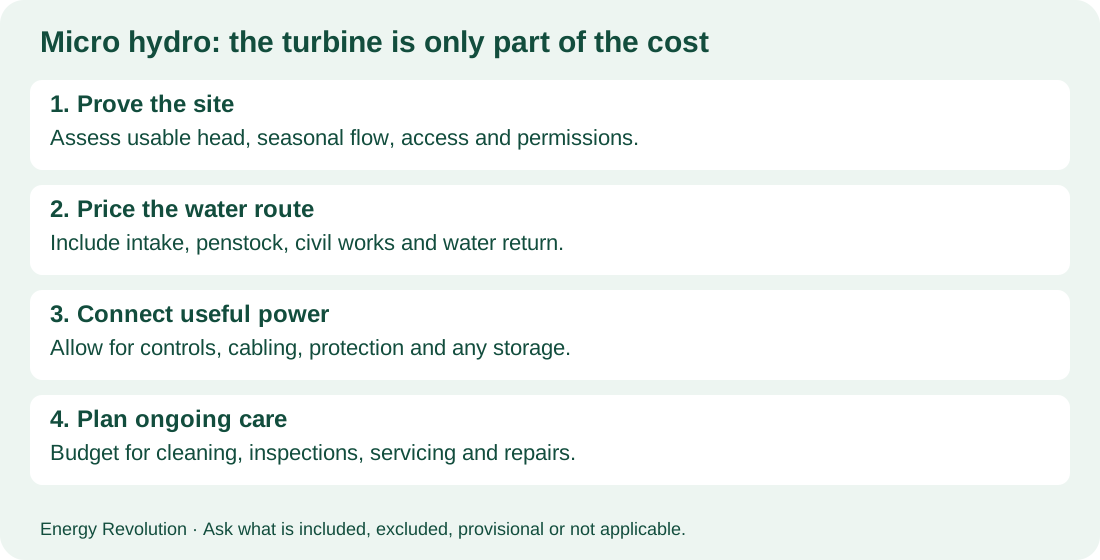
| Cost category | Check the quotation includes |
|---|---|
| Feasibility and permissions | Surveys, yield assessment, design, applications and stated exclusions |
| Access and construction | Delivery, machinery, temporary works and surface restoration |
| Intake and screening | Required flow controls, debris management and ecological measures |
| Penstock | Pipe, fittings, supports, route preparation, testing and reinstatement |
| Turbine location | Foundation, housing, drainage, access and tailrace |
| Electrical system | Controls, protection, cable route, commissioning and connection scope |
| Storage and aftercare | Any required batteries, servicing, monitoring and replacement plan |
Mark each item included, excluded, provisional or not applicable. Check applicable VAT treatment, quote validity, payment stages and who carries the risk of unexpected ground conditions. A provisional allowance is not a fixed price.
Use a complete budget, then test the energy estimate
Suppose a purely hypothetical equipment package costs £4,000, site works £7,000 and surveys, design and permissions £2,000. The subtotal is £13,000. A separately chosen £1,300 reserve would make the planning total £14,300.
These are invented arithmetic figures, not market quotes, typical costs or a recommended contingency rate. They show why an equipment-only price can be misleading. Do not add an item twice if it is already included in another package.
Next, ask for estimated annual energy in kWh after appropriate losses and downtime. For illustration, an actual electrical output of 200W maintained for 24 hours supplies 4.8kWh. If that output lasted only 12 hours, it would supply 2.4kWh. Neither figure establishes year-round production.
Useful annual energy depends on seasonal flow, permitted operation, maintenance and the electricity you can actually use or export. Do not multiply nameplate watts by every hour of the year unless the assumptions justify it. A realistic lower-output case helps you decide whether the civil work still makes sense.
Frequently asked questions
Does micro hydro always need a dam?
No. Designs vary. Do not assume that a large new impoundment is necessary or that installing one is a simple way to improve output. Get a site-specific design and the required permissions.
Can I reuse an old pipe or intake?
Possibly, but condition, dimensions, pressure suitability, ownership and permissions need assessment. Reuse is a potential saving, not a confirmed one until checked.
Is off-grid hydro cheaper because there is no grid connection?
It avoids that connection scope, but may need storage, different controls and another supply for interruptions. Compare complete designs serving the same loads.
What should I do before buying a cheap turbine?
Establish head, seasonal usable flow, permissions, access and the likely installed scope. Ask a hydro specialist to explain what the turbine price excludes.
Planning resources
Our recommended products and resources can support your research once the site requirements are clear. Our own DIY Alternative Energy Projects Bundle provides introductory learning and planning material. A download price is separate from the cost of equipment and construction.
Explore the alternative-energy guide ↗
Sources and further reading
Checked 5 November 2026. Published cost context is not a quotation; permissions and charges must be checked for the location and proposal.
- Centre for Alternative Technology: micro hydro, site assessment and cost context
- British Hydropower Association: components of a complete hydro project
- Environment Agency: applying to build a hydropower scheme in England
- Environment Agency: abstraction and impoundment licensing
- DAERA: abstraction and impoundment applications in Northern Ireland