

When a small off-grid home runs short of electricity, adding another battery can feel like the obvious answer. Sometimes it is. But if the existing battery rarely gets properly recharged, a larger bank can simply take longer to run down while leaving the underlying problem untouched.
Reduce avoidable energy use first, then size storage for the gap you still need to cover. More capacity helps when enough energy is available to charge it and the shortage is about timing or reserve. Lower consumption helps every day, including the days when generation is poor.
The right choice depends on what is failing: total daily energy, overnight storage, several dull days, or the ability to start a powerful appliance. Those are different problems.
1. Separate energy, power and storage
Energy, measured in watt-hours or kilowatt-hours, is how much electricity you use over time. Power, measured in watts or kilowatts, is how quickly equipment uses or supplies it. Battery capacity is an energy quantity; inverter output is a power limit.
A 100W load running for ten hours uses 1,000Wh, or 1kWh. A 1,000W load running for one hour uses the same energy, but asks much more of the inverter and battery at that moment.
The US Department of Energy distinguishes storage energy capacity from power capacity. That distinction matters when shopping: doubling stored kilowatt-hours does not automatically double the inverter's continuous rating or solve a motor-starting problem.
If the system trips when a pump starts while the battery appears charged, ask an installer to examine surge demand, battery discharge limits, cabling and inverter behaviour. If it runs normally but stops before breakfast, investigate usable energy and overnight demand.
2. Measure an ordinary day and a difficult day
Keep a short log before buying anything. Record generation, daily energy use, battery state of charge, alarms and the times high-demand appliances run. Include a dull-weather period as well as a sunny one where possible.
Measure variable loads over enough time to capture their cycles. A fridge's label wattage is not the same as its measured daily consumption. A pump may run only briefly, while an apparently modest always-on device can accumulate substantial energy use.
For a steady load, use:
Daily energy in kWh = watts × hours used ÷ 1,000.
For example, 20W running continuously consumes 0.48kWh a day. That could be material in a home whose entire electrical budget is only a few kilowatt-hours.
Choose a consistent measurement boundary. An AC appliance meter excludes the inverter's own consumption and conversion losses; a battery-side monitor may include them. Do not add a separate loss allowance to readings that already contain it.
3. Compare usable capacity, not just the label
A battery labelled 5kWh does not necessarily provide 5kWh to your appliances. The permitted operating range, reserve setting, battery condition, temperature and conversion path affect what is available.
For a simplified example, assume a nominal 5kWh bank has an agreed 80% working energy window. That gives 4kWh of usable battery-side energy. The 80% is an example assumption, not a recommendation for every battery chemistry.
If you instead estimate energy available at AC sockets, conversion and inverter consumption also need accounting for. Use your manufacturer's limits and installation data. Do not bypass protective cut-offs to turn nominal capacity into usable capacity.
A percentage display is also an estimate that depends on the monitoring system. A battery that seems full but collapses quickly under load may need diagnosis rather than expansion.
4. What changes when you reduce daily use?
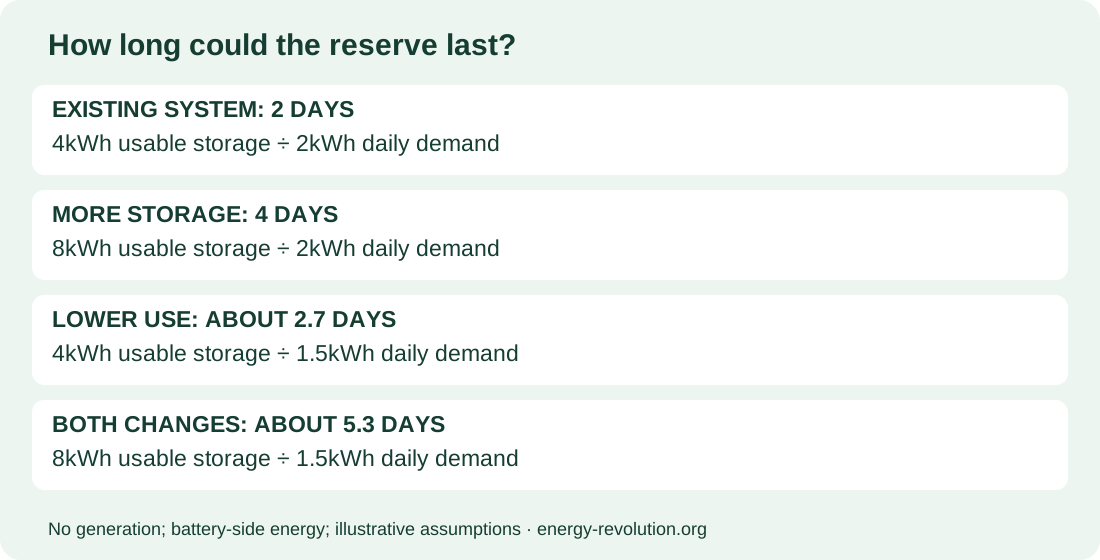
Suppose the home withdraws 2kWh per day at the battery side, including the relevant system losses. Its usable storage is 4kWh. With no generation, a simple energy budget gives two days before reaching the planned lower limit.
Now compare adding 4kWh of usable storage, reducing demand by 0.5kWh daily, or doing both:
| Option | Usable storage | Daily battery-side demand | Calculated duration |
|---|---|---|---|
| Existing system | 4kWh | 2kWh | 2 days |
| Add storage | 8kWh | 2kWh | 4 days |
| Reduce demand | 4kWh | 1.5kWh | About 2.7 days |
| Do both | 8kWh | 1.5kWh | About 5.3 days |
This is energy arithmetic, not guaranteed runtime. It assumes unchanged daily demand and usable capacity. Real systems also face temperature effects, peak loads and variable consumption.
The comparison shows why the options are complementary. Extra storage gives the larger one-off reserve in this example; lower consumption stretches whichever battery you have.
5. Can the system refill the extra battery?
Now consider a poor-weather period delivering an equivalent 1.6kWh per day to the battery-side energy budget after relevant generation and charging losses. At 2kWh daily demand, the deficit is 0.4kWh per day.
More capacity can cover that deficit for longer if it starts charged. It cannot make the deficit disappear. Continued operation eventually needs reduced demand, better generation conditions or another charging source.
If demand falls to 1.5kWh, the same simplified budget has a small 0.1kWh daily surplus. That is a very thin margin, not a robust design target, but it demonstrates how efficiency can change the direction of the energy balance.
Recovery after bad weather matters too. Suppose a better day makes 3kWh available on the same basis. With 2kWh of demand, only 1kWh remains for restoring depleted storage. With 1.5kWh demand, 1.5kWh remains.
Replacing a 4kWh deficit would therefore take four such days in the first case and about 2.7 in the second, assuming the battery and charger can accept the available energy. Actual charge profiles, weather and operating limits may extend this.
Our adding panels or a battery guide explores the difference between producing enough energy and having somewhere to store it.
6. Where can a small home reduce use sensibly?
Start with waste and unnecessary operating hours, while protecting refrigeration, required ventilation, communications and other essential services. A smaller energy budget should remain a workable home, not an exercise in going without essentials.
- Lighting: check for inefficient lamps and lights left on in unused areas.
- Electronics: measure devices that remain awake overnight and use their supported sleep settings.
- Inverter overhead: check measured no-load consumption and whether an approved low-power mode suits the connected loads.
- Water pumping: investigate leaks or unnecessary pump cycling rather than restricting essential water use.
- Heating loads: record electric space heating, hot water and cooking separately; even short periods can dominate a small budget.
As an example, removing an unnecessary 15W load for 16 hours saves 0.24kWh. Reducing another avoidable 65W load by four hours saves 0.26kWh. Together those illustrative changes reach the 0.5kWh daily reduction used above.
Do not assume inverter sleep mode suits every appliance. Victron's guidance shows that energy-saving behaviour is configurable and can interact with particular loads. Check the manual and test essential equipment under the approved setup. Our inverter standby-use article explains the accounting in more detail.
Moving a task into sunny hours is useful load scheduling, but it is not necessarily an energy saving. It may reduce battery cycling and losses without changing the appliance's own consumption. Keep those benefits separate in your calculation.
7. When is more capacity the sensible next step?
Extra storage deserves consideration when logs show the existing bank fills regularly, available generation is then curtailed, and essential demand later exhausts the reserve. It may also provide a deliberate buffer for specified low-generation periods.
However, check the season that matters. A bank that fills early on summer days may remain undercharged in winter. Size against the intended year-round service, or state clearly that the installation is seasonal.
Before expanding, ask the installer to confirm battery compatibility, BMS limits, permitted number of modules, charger capacity, protection, cable ratings, location and commissioning requirements. Matching voltage labels alone is not enough.
Victron's battery guidance makes compatibility and bank configuration model-specific. Do not generalise a permitted arrangement for one product to a different chemistry, age or manufacturer. A portable power station likewise needs an approved expansion arrangement; its ordinary sockets are not instructions for linking batteries.
8. Could temperature or ageing be the real issue?
Cold conditions can affect available capacity and whether charging is permitted. For example, Victron's Lithium Battery Smart manual specifies its own temperature limits and describes reduced capacity at low temperatures. Those limits are product-specific.
If an apparent storage shortage begins with a cold spell, inspect monitoring records and fault messages before buying more capacity. Follow the manufacturer's environmental requirements; do not disable a temperature lockout or improvise a battery heater.
Ageing, incomplete charging or a monitoring problem can also change observed performance. Have the existing system assessed so that the proposed upgrade addresses a known shortfall.
9. Compare spending against the problem solved
Get the fully installed cost of an expansion, including any necessary control or protection changes. For an efficiency purchase, estimate the measured daily reduction, useful life and purchase cost. Behaviour changes may cost little, but replacing a functioning appliance needs a separate justification.
A 0.5kWh daily saving amounts to 182.5kWh over a year if sustained every day. That does not translate automatically into a grid-tariff cash saving off grid. Its value may be fewer backup-generator hours, less battery cycling, avoided system expansion or greater reliability.
Use two practical targets: the essential daily energy requirement and the number of low-generation days you need to cover. Then test whether the generation system can restore the reserve afterwards. Our three-cloudy-days reserve guide helps build that plan.
Frequently asked questions
Will twice the battery capacity give twice the runtime?
Approximately in a simplified comparison with twice the usable energy and unchanged demand. Real limits, temperature, losses and battery condition still matter.
Can a bigger battery fix weak winter solar?
It can bridge a finite gap if charged beforehand. It cannot indefinitely compensate for generation below consumption.
Should I switch off the inverter every night?
Only if the system design and connected loads allow it. Essential appliances may need continuous supply, and supported low-power settings need checking.
What should I do first?
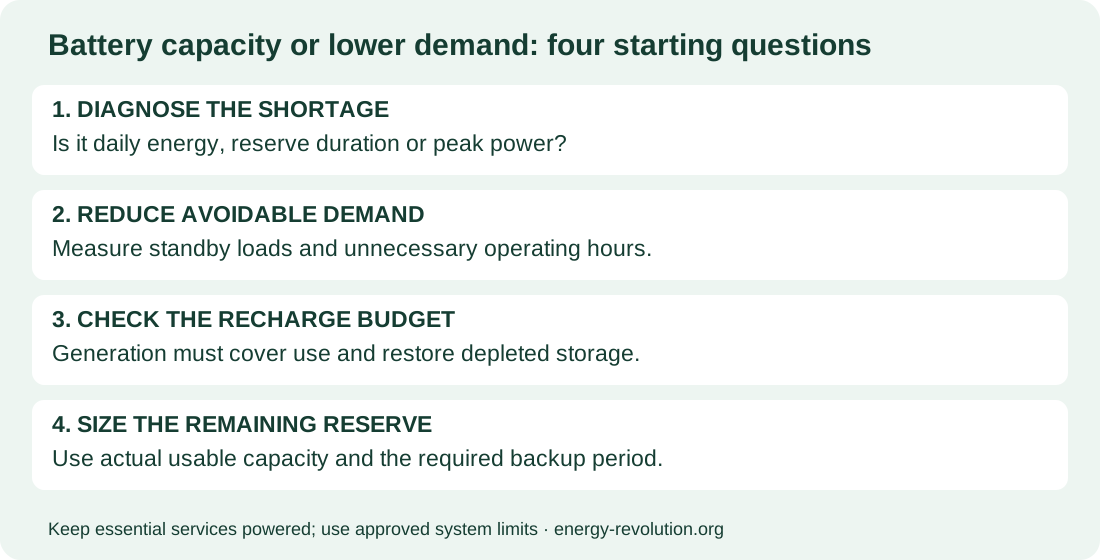
Measure daily use and generation, identify essential loads and confirm usable capacity. Reduce avoidable demand, then assess the remaining storage and recharge requirement.
Sources and project resources
Checked on 1 November 2026:
- US Department of Energy: solar and storage basics.
- US Department of Energy: power, energy and watt-hour arithmetic.
- Victron: inverter power and system matching.
- Victron: inverter settings and energy-saving operation.
- Victron: battery-bank configuration.
- Victron Lithium Battery Smart: operating conditions and capacity.
Browse our Recommended Products for wider comparisons and our DIY Alternative Energy Projects bundle for planning ideas. Confirm compatibility and complete-system sizing before buying storage.
Explore the Energy Revolution offer
Affiliate offer: review the seller's claims and terms independently. We do not guarantee results.