
What is realistically possible?
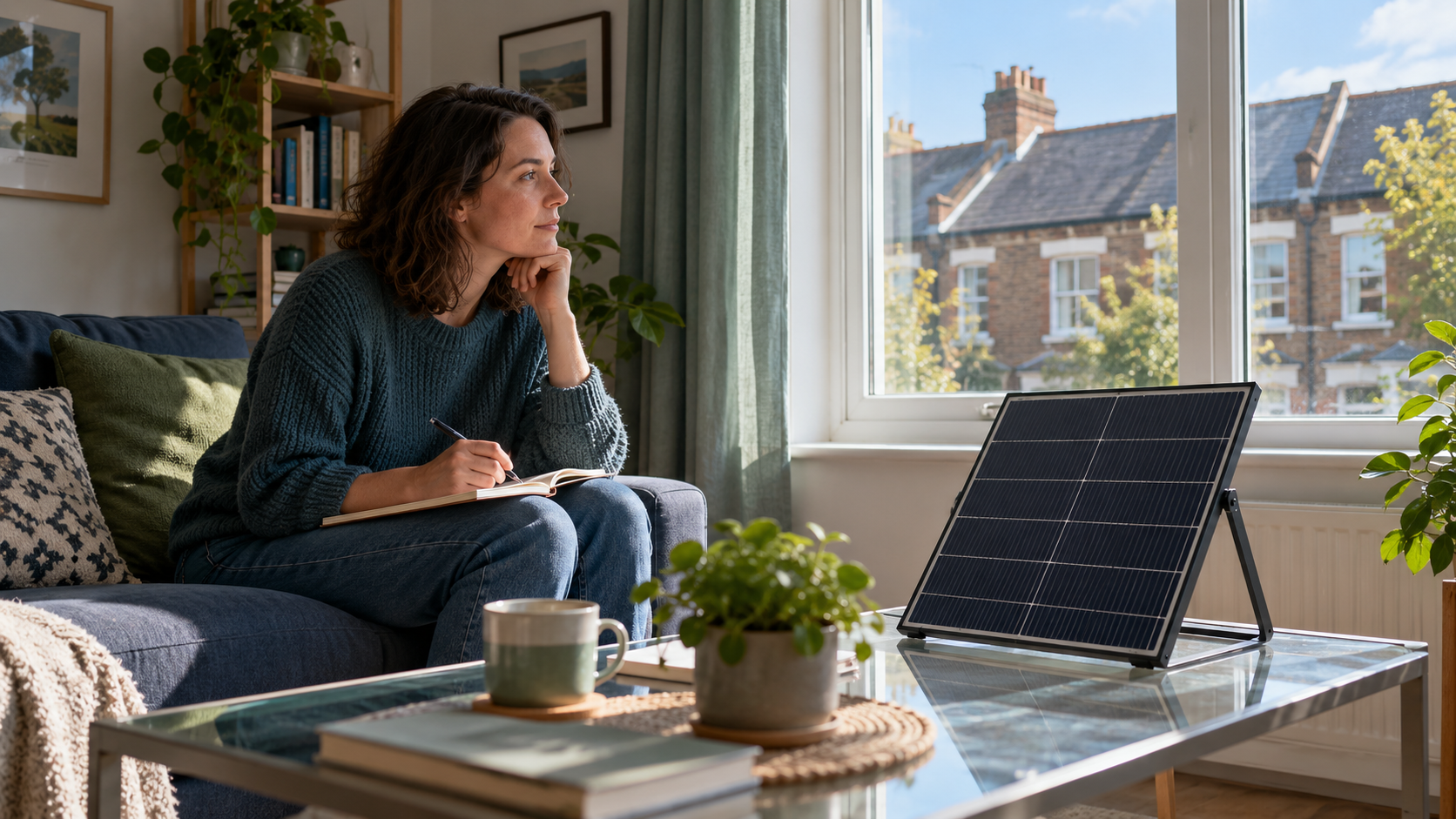
Small-device charging may be possible if you have useful sunlight. A permitted sunny garden or courtyard gives portable solar a better chance than a panel behind glass. With only a shaded window, dependable charging is unlikely. A portable battery can still provide backup when charged from the mains, but that is not solar generation.
No balcony does not automatically rule out solar. It does change the question from “Which kit should I buy?” to “Where can I safely collect enough sunlight?” For a renter, the answer may be occasional phone charging, a useful camping setup, or deciding that solar equipment would spend most of its time in a cupboard.
This guide focuses on portable, standalone equipment for ordinary rental homes. The aim is to assess your space and energy needs before spending money, without assuming access to the roof or permission to alter the building.
1. Start with the sunlight you can actually use
List the spaces you can access: a window, private garden, shared courtyard or outdoor area you visit regularly. For each, record when direct sunshine reaches it, how long you can stay there and whether setting out equipment is permitted. A sunny patch available only while you are at work may have little practical value.
Check your tenancy and ask the landlord or managing agent before using shared space, attaching equipment or routing cables through communal areas. Do not assume a fire escape, external ledge or shared roof is available for solar equipment.
| Your situation | Realistic starting point | Main limitation |
|---|---|---|
| Sunny window only | Borrow a small kit and measure output | Glazing, shadows and restricted angles |
| Permitted sunny outdoor space | Attended portable panel and compatible storage | Weather, access, security and carrying equipment |
| Regular outdoor trips | Charge during those trips | Cannot assume daily generation at home |
| No usable direct sun | Consider ordinary battery backup if needed | Buying a larger panel does not create sunlight |
Use the observation method in our guide to mapping shade. Photograph the proposed position morning, midday and afternoon. Repeat in another season: a summer observation does not establish winter performance.
2. Can a solar panel work through a window?
Some electricity may be produced, but useful charging is not guaranteed. Jackery’s solar-output troubleshooting guidance identifies indoor use, glass and shading as reasons for reduced output. A bright-looking room is not a measurement of the energy reaching a panel.
There is no sensible universal percentage to subtract for every window. Glazing, coatings, orientation, the panel’s angle and shadows all differ. A narrow moving strip of sunshine can also leave much of a folding panel shaded.
If the equipment instructions permit your proposed use, keep the panel securely supported indoors with its active surface facing the incoming sun. Avoid unstable stacks, blocked exits or equipment balanced over an open window. Do not hang a portable panel outside an upper-floor window as an improvised installation.
The practical test is whether your particular panel and charging device deliver useful watt-hours over the available period. A charging symbol that appears briefly is insufficient evidence. Treat window charging as an experiment until you have repeatable results.
3. Choose the simplest equipment that meets the need
A USB solar panel and compatible power bank may suit occasional phone charging. Check that the panel provides a regulated output intended for the device. USB-C describes a connector; it does not by itself guarantee the voltage, power or USB Power Delivery support a laptop requires.
A folding panel and portable power station can store more energy and offer additional outputs, but bring more weight, bulk and cost. Check the unfolded dimensions before buying. As one example, the SolarSaga 100 JS-100F manual lists an unfolded size of about 1.22 by 0.55 metres: substantial space beside a window. This is a size illustration, not a product recommendation.
Read both manuals and confirm the approved combination. Solar input voltage limits, current limits, maximum power, connector type and polarity all matter. A connector fitting physically does not prove electrical compatibility. Ask the manufacturer to confirm an unfamiliar pairing rather than experimenting with adapters.
A plug-in system feeding household wiring is a different project. Electrical Safety First recommends an electrical assessment before buying or using plug-in solar. Do not improvise a connection from a portable power station’s AC outlet into a wall socket. Use its intended device outlets; any connection to building wiring needs a suitable professionally designed arrangement.
Optional paid reading: You can view the linked energy offer while researching broader ideas. It is not a tested recommendation for a renter’s solar kit.
4. Budget in watt-hours, not advertised panel watts
Watts describe power at a moment; watt-hours describe energy collected or used over time. A 100W panel rating is not a promise of 100W throughout daylight. The SolarSaga manual, for example, specifies its peak rating under standard test conditions. Your window is a different environment.
An illustrative three-hour window test
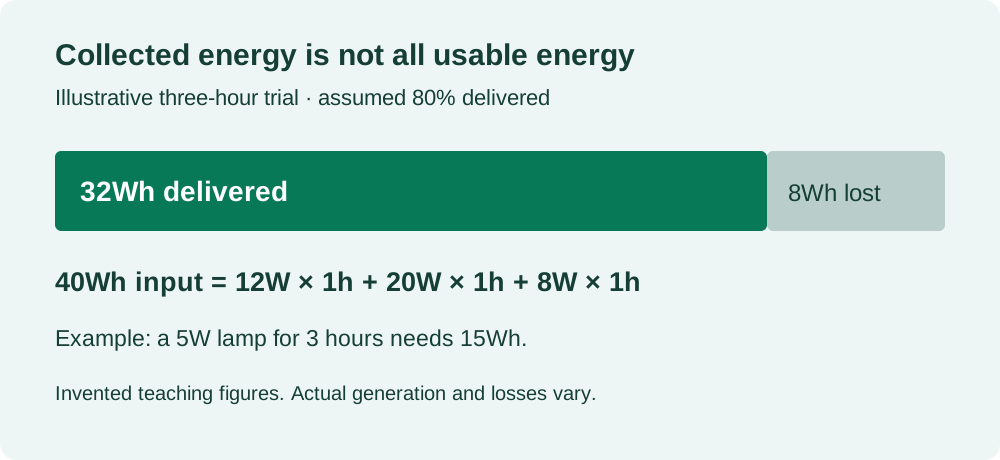
Suppose a compatible system averages 12W during the first hour, 20W during the second and 8W during the third.
Energy entering the charging system = 12 + 20 + 8 = 40Wh.
If, solely for illustration, 80% reaches your device after storage and conversion, you have 32Wh usable. Actual losses vary. These are invented teaching figures, not measured window-panel results or an output forecast.
| Device | Assumed use | Energy needed |
|---|---|---|
| Small LED lamp | 5W for 3 hours | 15Wh |
| Router | 10W for 4 hours | 40Wh |
| Laptop | 30W for 2 hours | 60Wh |
In this example, the collected energy covers the lamp’s assumed use, but falls short of the router or laptop target. These are separate comparisons, not three devices you can run together. Measure actual consumption where possible; a charger’s maximum rating is not necessarily the device’s average demand.
For perspective, 32Wh is 0.032kWh. At an assumed electricity price of 25p per kWh, replacing that much purchased electricity saves only 0.8p. This simple calculation excludes equipment costs and does not predict payback. Portability or learning may be the stronger reason to buy.
5. Run a trial before choosing a bigger battery
Borrow or test a suitable kit if possible. Record daily input energy using the system’s supported monitoring, alongside weather and the time the panel was actually deployed. A single midday wattage reading cannot represent a whole day.
- Choose one goal, such as an evening lamp or a phone top-up.
- Record the device’s energy requirement in Wh where available.
- Log generation on at least several differing days, including a dull day.
- Note shade, charging interruptions and time spent repositioning equipment.
- Compare useful output with both the energy target and the effort involved.
If your display only shows battery percentage, avoid treating the percentage change as a precise solar measurement. Simultaneous device use and the battery’s own consumption complicate the result. Use logged input Wh if provided, or ask the manufacturer how to monitor charging safely.
A larger battery extends storage, not sunshine. If the panel cannot replace what you use, the battery eventually empties. Our cloudy-day reserve guide explains why essential loads need a separate fallback.
6. Make the setup manageable and safe
For outdoor use, choose a stable ground-level position where access is allowed and keep cables out of walking routes. Stay with portable equipment in shared or public spaces. Pack it away when conditions exceed the manufacturer’s limits.
The SolarSaga manual says its portable panel is not intended for permanent fixed installation and should be put away in severe weather. Other models have different instructions. A panel’s water-resistance rating does not establish that the battery, connectors or USB ports can be left in rain.
Follow the battery manufacturer’s charging-temperature, ventilation and placement instructions. Keep it dry and away from concentrated heat; do not leave it baking against sunlit glass or cover it while charging. Do not trap cables in windows or doors. Stop using damaged equipment and seek manufacturer advice.
Consider everyday practicality too. Where will a damp panel dry before storage? Can you carry the battery comfortably? Is the setup blocking the room’s only usable window? These details can decide whether an apparently portable system gets used.
When skipping solar is the sensible choice
If there is no useful sunlight or permitted deployment space, a mains-charged power bank may meet a backup need more simply. It stores purchased electricity; it does not generate renewable energy or automatically reduce consumption.
For reducing bills, the Energy Saving Trust’s renter guidance includes practical changes such as efficient lighting and switching off unnecessary standby loads. Start with the changes relevant to your home, then discuss larger improvements with your landlord.
Our solar advantages and disadvantages guide provides wider context. If you also explore the seller’s energy presentation, check its equipment requirements and evidence before purchasing; a paid guide cannot overcome a lack of sunlight.
Frequently asked questions
Can I charge a phone without a balcony?
Possibly, using a suitable panel in available sunlight. A compatible power bank can store energy for later. Window performance needs testing, and a shaded room may provide no useful charge.
Will a bigger panel solve poor window output?
Not necessarily. It may not fit within the sunlit area, and shading or the charging system’s requirements may still prevent useful output. Test the location first.
Can this run a fridge, kettle or heater?
Do not plan on dependable operation from an untested window setup. Those loads require separate checks of energy, output power and, where relevant, starting demand. See our fridge runtime guide.
Is a portable power station itself a solar generator?
It stores electricity. Solar charging requires a compatible panel and adequate sunlight. The same battery charged from a wall socket is mains-charged storage.
Let the measured result guide the purchase
Without a balcony, portable solar works best when a modest charging goal matches a genuinely usable sunny space. Establish access, test the location and compare delivered energy with your needs. A small useful setup is worthwhile; equipment that cannot meet your goal is not improved by optimistic expectations.
Explore the linked energy offer
Optional paid affiliate resource. We have not tested this product or verified its performance claims. It is not a recommendation for specific solar equipment. Review the seller’s contents, price and terms before buying.
View the energy offer — affiliate linkSources and further reading
Checked 7 October 2026. Energy examples are illustrative calculations, not field tests.