
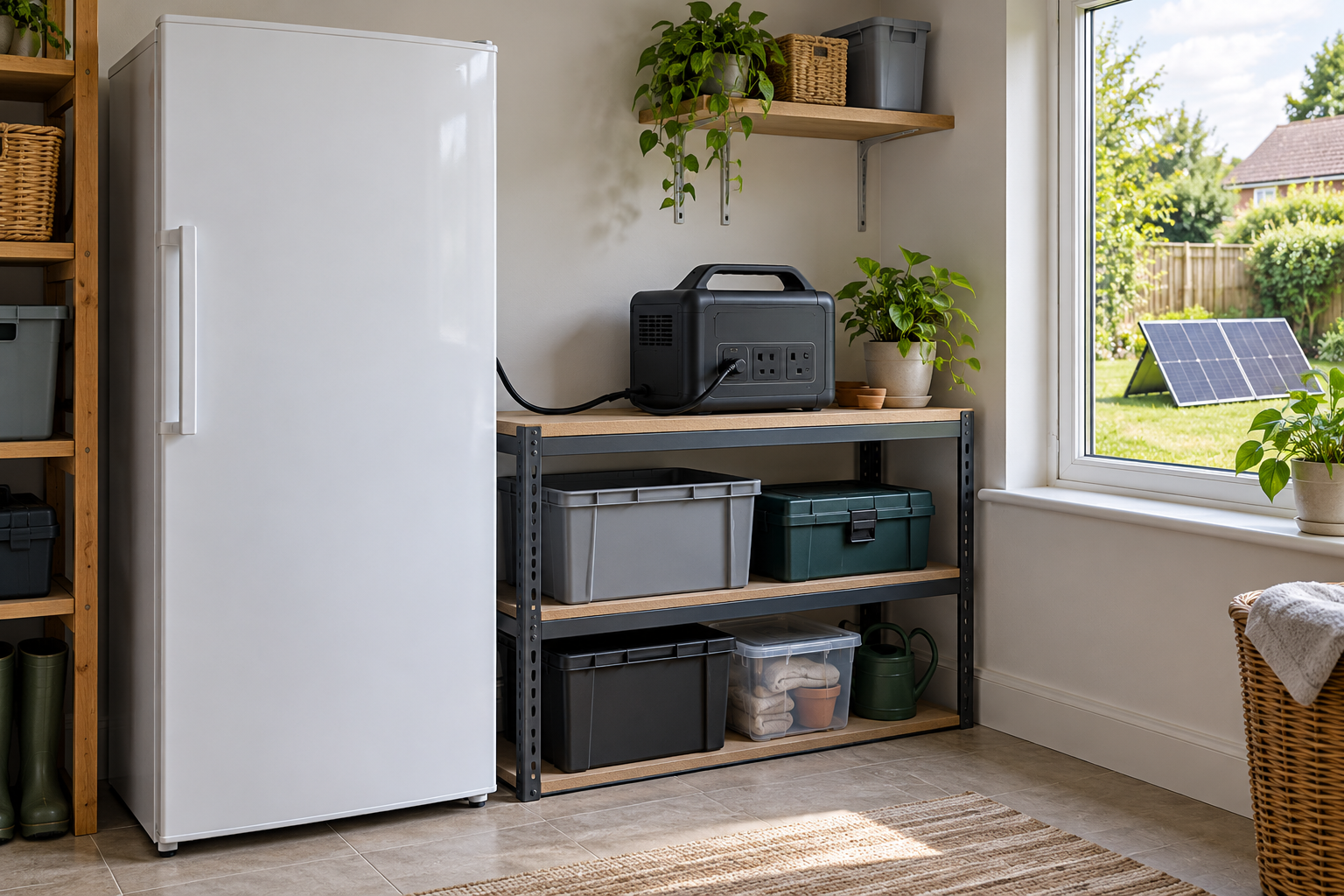
How long will a solar generator run your fridge?
Estimate runtime from usable energy delivered to the fridge ÷ measured daily fridge consumption × 24. Check separately that the inverter can start the compressor and handle every operating mode. Battery capacity determines endurance; output capability determines whether the fridge works at all.
A power station advertised as “1,000W” does not necessarily contain 1,000Wh of battery energy. Nor does a fridge showing 100W on a meter necessarily consume that amount continuously. Confusing these figures is an easy way to buy backup that runs out sooner than expected.
This guide is for a conventional UK mains-powered fridge or fridge-freezer connected directly to a suitable portable power station. All calculations are examples, not product tests or runtime promises. A 12V camping fridge needs a separate calculation using its actual DC consumption and supply losses.
Understand the three numbers before shopping
- Watts (W): power being used or supplied at a moment in time.
- Watt-hours (Wh): energy stored or consumed. One kilowatt-hour equals 1,000Wh.
- Starting demand: the brief load when the compressor starts, which can exceed its normal running demand.
A fridge compressor cycles or varies its speed as cooling is needed. Lights, controls, fans and automatic defrost can add consumption. You need the energy accumulated across those activities, not just a single display reading.
A “solar generator” is usually a battery power station with solar charging capability, sometimes sold with panels. The battery supplies the fridge overnight. Panels can replenish it in suitable daylight; the name does not guarantee a continuous supply.
1. Measure several days of normal use
Use a suitable plug-in energy meter rated for the appliance and local socket supply. Follow its instructions, use a sound socket and keep connections accessible and dry. Do not move a heavy fridge or disturb inaccessible wiring simply to force a measurement; get help if access is unsafe.
Connect the meter between the normal supply and the fridge, reset its energy total, and record the start time. Follow the fridge manufacturer’s restart guidance after any interruption rather than repeatedly switching it off and on.
Measure at least several complete days, preferably a week, with ordinary door openings and loading. Record room temperature, thermostat setting and unusual events. A longer sample improves the chance of capturing defrost cycles, but does not guarantee every seasonal operating condition is represented.
Example: seven days of readings
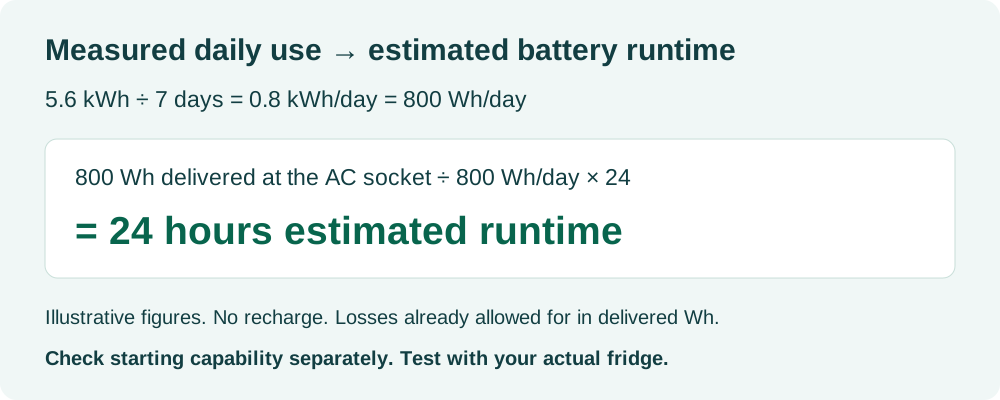
Suppose the meter records 5.6kWh over seven complete days.
5.6 ÷ 7 = 0.8kWh/day, or 800Wh/day.
The equivalent average power is 800 ÷ 24 = 33.3W. That average is useful for energy arithmetic, but it is not the inverter rating needed to start or run the compressor.
If your interval is not a whole number of days, calculate daily use as total Wh divided by elapsed hours, multiplied by 24. Save the readings and conditions so you can repeat the exercise in warmer weather.
2. Use the energy label as a cross-check
If measurement is not yet possible, dividing the label’s annual kWh by 365 gives a provisional daily estimate. A label showing 292kWh/year would imply 0.8kWh/day under the basis of that rating.
The Energy Saving Trust’s appliance guide explains comparing annual energy consumption. Treat that figure as a starting point rather than a prediction for your kitchen. Room temperature, ventilation, door openings, appliance condition and loading can change actual use.
Measure a normally cold fridge for backup planning. Cooling a warm cabinet and its contents is a different task and can require more energy initially. If that is your intended use, test and budget for it separately.
3. Work out how much battery energy reaches the fridge
The advertised battery capacity is not automatically the energy delivered through the AC socket. Reserve settings, protective cutoffs, temperature, battery ageing, conversion losses and the station’s own consumption affect what is available.
For a first estimate, use a clearly labelled overall delivered-energy factor. Suppose a nominal 1,000Wh station delivers 80% of that to a cycling fridge over a relevant test. That would mean 800Wh at the socket.
Runtime = 800Wh ÷ 800Wh/day × 24 = 24 hours.
The 80% here is an illustrative all-in assumption, not a standard efficiency or a specification for a particular brand. A usable-AC-capacity test on a steady high load may not represent a lightly loaded, cycling refrigerator.
| Nominal battery | Assumed energy delivered | At 800Wh/day | At 1,200Wh/day |
|---|---|---|---|
| 500Wh | 400Wh | 12 hours | 8 hours |
| 1,000Wh | 800Wh | 24 hours | 16 hours |
| 2,000Wh | 1,600Wh | 48 hours | 32 hours |
These are arithmetic comparisons, not recommendations. They assume the same delivered fraction across sizes and loads, a full starting charge and compatible inverter output. Real systems will differ.
Optional paid resource: You can view the linked energy offer for broader home-energy ideas. It is separate from the battery equipment discussed; we have not tested it or verified its performance claims.
4. Account for inverter overhead without counting it twice
A station may consume energy while its AC output is enabled even when the compressor is resting. That matters more when the fridge’s average load is small. If you have reliable technical data, use a more detailed model instead of an all-in factor.
Runtime in hours ≈ available battery-side Wh ÷ [(daily fridge Wh ÷ 24 ÷ conversion efficiency) + station overhead W].
For example, assume a 1,000Wh battery has 900Wh available after its operating limits, conversion efficiency is 90%, and additional average overhead is 6W. These are separate illustrative assumptions:
900 ÷ [(800 ÷ 24 ÷ 0.90) + 6] ≈ 20.9 hours.
Do not combine this model with an 80% all-in factor that already includes those losses. Equally, a published efficiency may already include some self-consumption; ask what was measured. If the terms are unclear, a supervised fridge test is more useful than a falsely precise calculation.
5. Check compressor starting and every operating mode
Runtime arithmetic cannot establish compatibility. Check the fridge’s required voltage and frequency, the station’s continuous pure-sine-wave output, and its surge capability and duration. Include defrost heaters and any other appliances sharing the supply.
A basic energy meter may miss a brief starting peak. Ask the fridge and power-station manufacturers about compatibility, or obtain suitable inrush measurement from a competent person. Do not assume a universal multiplier applies to every compressor.
Output “boost” modes are not necessarily equivalent to genuine surge performance. EcoFlow’s DELTA 2 Max manual, for example, warns that X-Boost is unsuitable for some appliances with strict voltage requirements. Use the instructions for your exact regional model.
Our guide to why the inverter matters explains the difference between energy capacity and output capability in more detail.
6. Check sleep settings and backup behaviour
Some stations switch off AC output after a timeout or a period of low demand. A refrigerator may briefly appear almost idle between cooling cycles. EcoFlow’s manual specifically advises setting its AC timeout to “never” for continuous refrigerator supply; other products have different settings.
Check eco modes, low-load detection, automatic restart and what happens after the battery empties. Solar returning in the morning does not necessarily mean the AC socket will restart automatically.
If you want automatic changeover, confirm that the model supports it for your use, including transfer time and pass-through limitations. Do not assume every portable battery is an uninterrupted power supply.
7. Calculate solar recharge separately
First calculate a no-solar runtime. Then estimate charging for the location, season, panel placement and weather. Panel nameplate watts are a test-condition rating, not a promise of that output throughout daylight.
Suppose a 200W panel receives three equivalent peak-sun-hours and an assumed 75% overall yield to the battery. The illustrative daily input is 200 × 3 × 0.75 = 450Wh. Peak-sun-hours express an equivalent energy total; they are not simply hours between sunrise and sunset.
Using the detailed example above, the battery-side daily requirement is 800 ÷ 0.90 + (6 × 24) ≈ 1,033Wh. A 450Wh input would leave about 583Wh to come from stored energy that day. It extends operation but does not support indefinite running.
Even matching daily totals would not guarantee sufficient overnight storage or survival through cloudy days. Check permitted solar voltage, current and connectors, plus whether charging and AC output can operate together. Our shade-mapping guide helps assess placement before buying panels.
8. Run a supervised rehearsal
Fully charge the station, confirm the intended reserve and output settings, then test the fridge while normal power remains available. Monitor fridge temperature and battery decline over several compressor cycles and, where practical, a full day. Include defrost operation if it occurs.
Stop before cooling is compromised. Record starting charge, elapsed time, room temperature, meter energy and other connected loads. Do not extrapolate one short quiet interval into a full-day guarantee. Repeat in conditions closer to the intended outage and keep a practical recharge or food-storage backup.
Plug the appliance directly into the approved station outlet following both manuals. Never feed a wall socket from the power station; supplying fixed household circuits requires a professionally designed changeover arrangement. Keep the station dry, ventilated and within its operating-temperature limits.
Keep food safety separate from the runtime estimate
A battery display cannot confirm food temperature. UK government power-cut guidance recommends a fridge thermometer and keeping doors closed as much as possible. Normal fridge temperature should be 5°C or below.
The guidance estimates that a closed fridge stays cold for up to four hours without power, but actual conditions vary. That is not an extra guaranteed four hours to add to battery runtime. Follow the linked advice if food warms; do not use smell alone to decide whether it is safe.
Frequently asked questions
Is a 1,000W station enough?
That output figure alone cannot answer the question. Check starting compatibility and battery Wh, then calculate against measured consumption.
Can I run the fridge all day from solar?
Possibly with a suitable system, but you need enough seasonal generation, overnight storage and poor-weather backup. One sunny-day test does not prove year-round independence.
What if I also power a router?
Add its measured energy use. A constant 10W load adds 240Wh daily before additional conversion losses, reducing the reserve available to the fridge.
Measure first, then choose the battery
Build the decision around daily Wh, starting compatibility and a tested runtime margin. Our essential-load backup guide helps prioritise other appliances. If you explore a paid energy presentation, verify its equipment requirements and claims independently.
Explore the linked energy offer
Optional paid affiliate resource, separate from the equipment and calculations here. We have not tested the product or verified its performance claims. Check contents, price and terms before purchasing.
View the energy offer — affiliate linkSources and further reading
Checked 4 October 2026. Calculations are illustrative, not product tests. Consult the manuals for your exact appliance and power station.