
The television stops, the lights go out and the fridge falls quiet. Is it a power cut, or has something tripped inside your home? You do not need to become an electrician to gather useful clues. You do need to know where ordinary observations end and professional fault-finding begins.
If you suspect a network power cut, call 105 in England, Scotland or Wales. In Northern Ireland, call NIE Networks on 03457 643643. You can report a suspected interruption without proving its cause first. If the problem appears to be with your wiring, appliances or consumer unit, a registered electrician is the appropriate person to investigate.
This first guide in our Practical Power-Cut Preparedness series helps you decide whom to contact and what to tell them. It is a household observation guide, not instructions for testing live circuits or repairing electrical equipment.
1. Get enough light to move safely
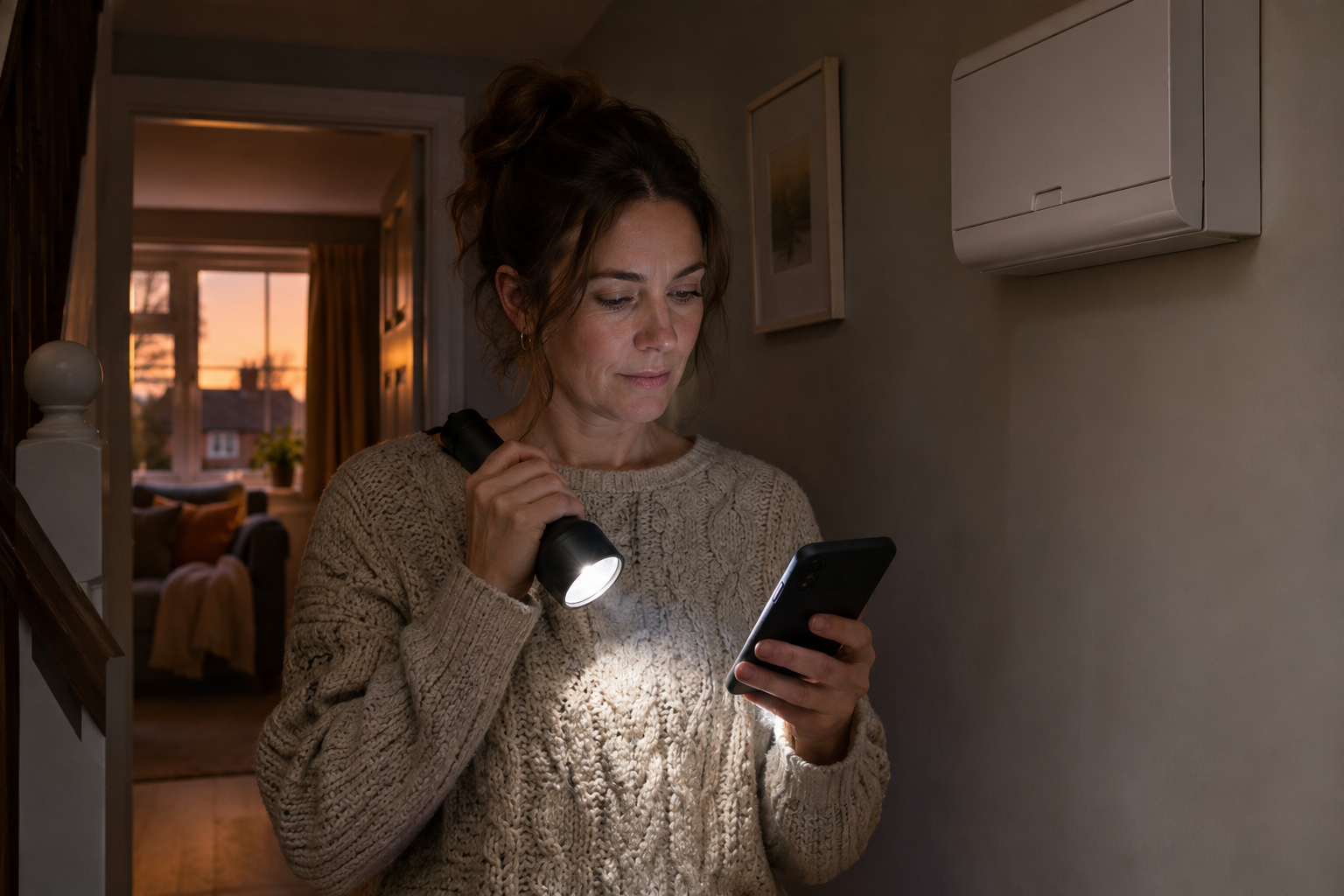
Reach for a battery torch or lantern before walking around. A phone torch can help briefly, but you may need that phone for reporting the outage. Avoid balancing a phone on a cupboard while reaching into a dark space. Keep stairs and exits clear.
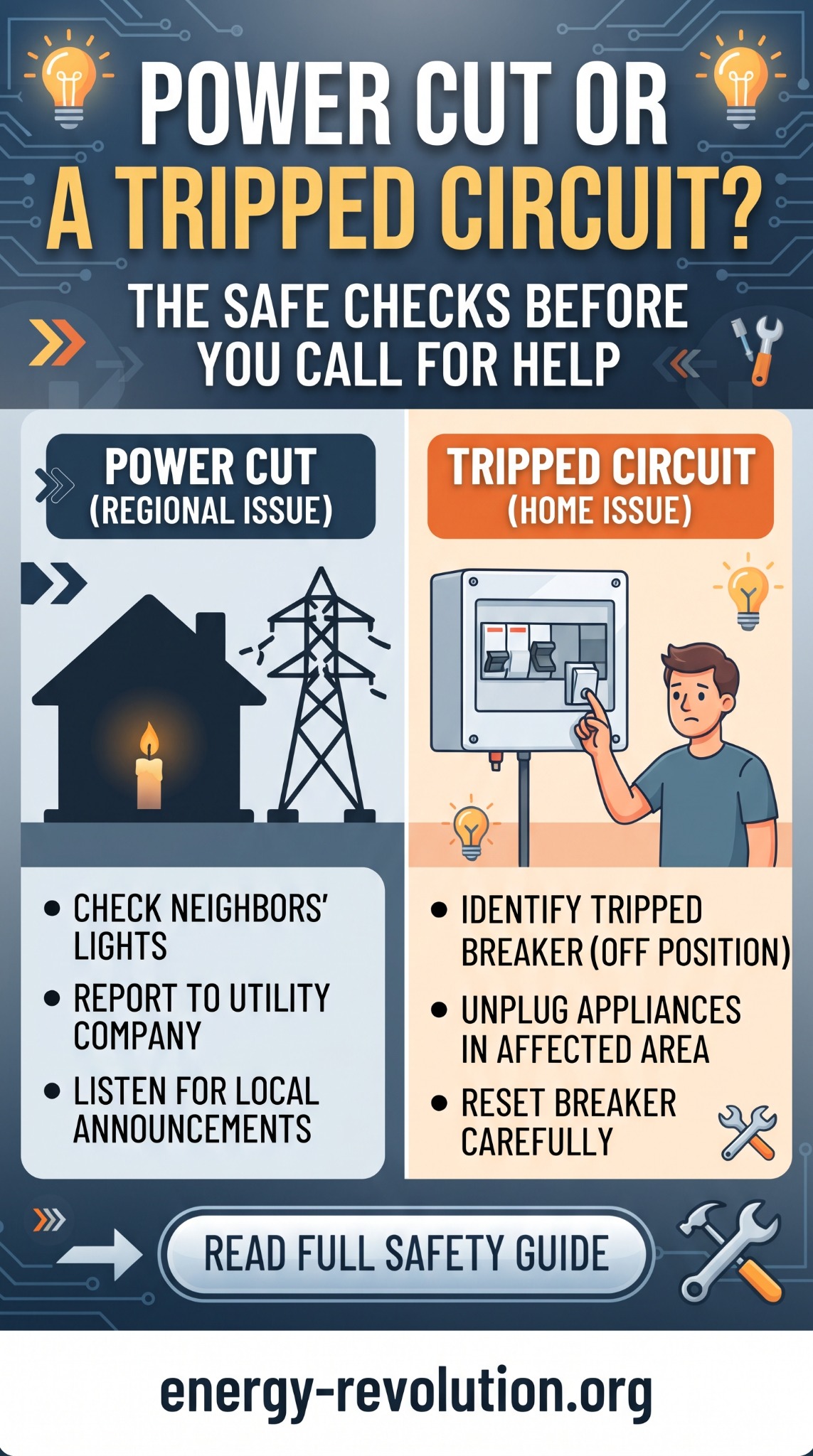
The Pinterest image uses a candle to represent a dark house. For practical lighting, use a torch rather than introducing a naked flame. Do not start a generator or bring a barbecue or outdoor camping stove inside to solve the immediate problem.
If someone depends on powered medical equipment or a personal alarm, follow their existing care-provider or equipment-supplier plan now. Do not delay essential assistance while inspecting the house. A household checklist cannot establish how long that equipment can safely remain without power.
2. Note what has actually stopped working
From safe, normal use of your home, note whether the interruption affects one appliance, one group of sockets or lights, or apparently everything. You do not need to plug in multiple test devices, touch suspect equipment or open covers.
| What you notice | What it may suggest | A useful next step |
|---|---|---|
| One appliance stops; other things work | An appliance, plug, socket or local supply issue | Stop using anything that appears damaged and seek appropriate support |
| Some lights or sockets work, others do not | A circuit or protective device may be involved | Record the affected areas; arrange advice if unsure |
| The whole home appears without power | A network interruption or a household supply issue | Check network information or call the network operator |
| Smoke, sparks, burning smell or water near electrics | A potentially dangerous situation | Keep away and get urgent help; do not attempt a reset |
These are clues, not a diagnosis. A device protecting several circuits can interrupt a large part of the house. Conversely, a network fault can sometimes affect just one property. Solar batteries or other backup arrangements can make the pattern less obvious.
3. Look beyond your home without making assumptions
Are neighbouring homes also dark? Can you safely ask a neighbour whether their power has gone off? Those observations can support a report. However, a lit house might have backup power, and nearby homes may not share exactly the same supply arrangement. Streetlights are not a definitive test either.
Use mobile data, if available, to check your network operator’s outage information. An incident may not yet appear on the map, especially just after it starts. Report your loss of supply even if the website shows nothing.
The company responsible for local cables is the electricity network operator. It may be different from the energy supplier that sends your bill. The 105 service routes callers in Great Britain to the appropriate network operator; Northern Ireland has its own reporting number.
4. Inspect the consumer unit only from the normal user-access area
A consumer unit is often called a fuse box. Modern units may contain several kinds of protective switch. A circuit breaker can interrupt a circuit following certain faults or overloads. An RCD detects an imbalance that can indicate electricity flowing along an unintended path. An RCBO combines these functions.
You do not need to identify every device. If the location is dry, intact, safely accessible and properly lit, you can look at labels and the positions of the normal user controls. A tripped control may look different from its neighbours, but positions vary. Do not assume that “up” always means on.
Do not unscrew panels, remove a cover secured with screws, pull out fuses, break seals or touch wiring. Do not interfere with the electricity meter or the network operator’s service fuse. If reaching the unit requires an unsafe climb, stop.
Burn marks, buzzing, crackling, damage or a burning smell are reasons to keep away and get professional help. You should not touch equipment to find out whether it is hot. If you cannot confidently recognise a safe, ordinary control, describe what you can see to the person helping you.
5. A reset is optional; repeated resets are not a solution
Our pin includes “reset breaker carefully”. That short phrase leaves out important conditions. A protective switch has operated for a reason. Restoring its position does not prove that the wiring or an appliance is healthy.
If there are no danger signs, you are confident using the intact unit’s normal controls, and the manufacturer’s instructions or your housing provider’s guidance permit it, you may be able to make one reset attempt after switching off and unplugging accessible appliances on the affected circuit. Only unplug items where the plug and surroundings are dry and undamaged. Leave fixed or inaccessible equipment to a professional.
Follow the instructions for your exact unit rather than a generic switch sequence. Do not force or hold a switch on. If it will not reset, trips again, or you are uncertain, leave the affected circuit off and contact a registered electrician or your landlord’s repairs service.
Do not repeatedly reconnect a suspect appliance to reproduce the fault. If an appliance appears associated with the trip, leave it unplugged and arrange suitable inspection or repair. Getting the lights back is not a reason to ignore recurring symptoms.
6. Choose the right person to call
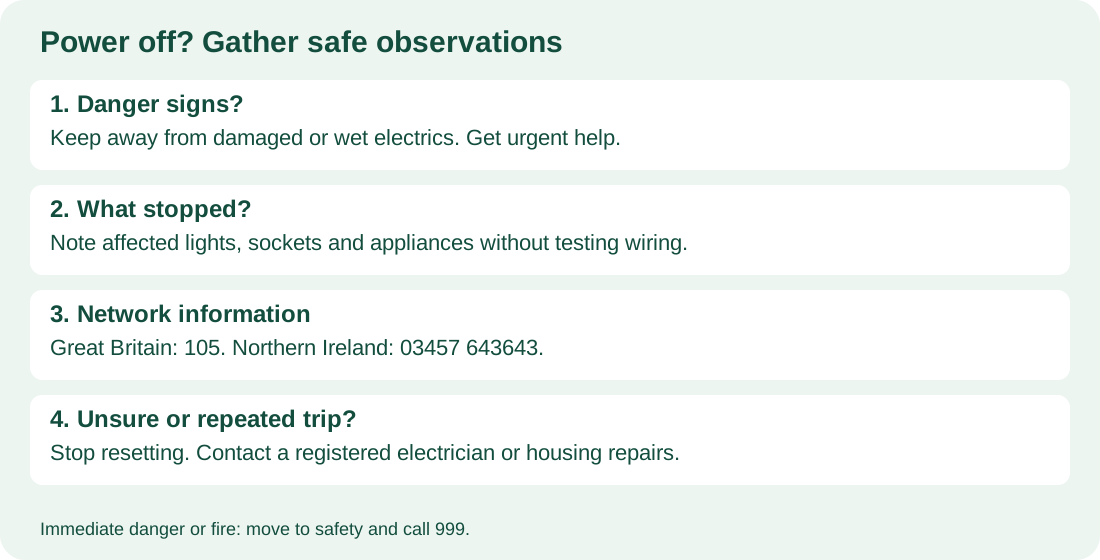
- Suspected network interruption: 105 in England, Scotland and Wales; NIE Networks on 03457 643643 in Northern Ireland.
- Household wiring, repeated trips or a damaged consumer unit: a registered electrician. Tenants should also use their landlord’s or housing provider’s repair procedure.
- A meter display or prepayment-account problem: contact your energy supplier using its published support route. Do not assume every blank display has the same cause.
- Immediate danger, fire or serious injury: move to safety and call 999.
In a block of flats, the managing agent may also need to know about shared-area or building-service problems. Do not enter locked electrical cupboards or investigate communal distribution equipment yourself.
Useful details include your address and postcode, when the interruption started, which areas are affected, any visible switch positions and whether nearby properties seem affected. Mention solar, battery backup or other generation. Tell the operator about anyone needing additional support.
7. While waiting, protect the essentials
Keep fridge and freezer doors closed and consult current food-safety guidance if the interruption continues. Switch off cooking and heating appliances that could become hazardous if they restart unattended, where their normal controls are safe to reach.
Conserve your phone battery and use official updates. A digital landline may also stop working without suitable backup. Contact your provider in advance to understand its arrangements, especially if you rely on the phone for emergency calls.
If you already have a portable power station, follow its instructions for directly connected, compatible appliances. Never attempt to energise household wiring through a wall socket. Our backup-power essentials guide provides background, while our fridge runtime guide explains why measured energy matters.
A power station does not repair a fault, and rooftop solar does not automatically keep the home supplied during a network interruption. Use only the backup arrangements your installer has specified and demonstrated.
Before the next interruption
Keep a torch where it is easy to find, save reporting numbers on paper, and locate your consumer unit in daylight. Ask your electrician or landlord to explain its ordinary user controls and any labels you do not understand. Keep equipment manuals accessible offline.
Record a brief account after the event: what stopped, whom you called and what was resolved. That is more useful than immediately buying extra batteries. For broader preparation, see our home-energy planning checklist and the other guides in this series as they are added.
Frequently asked questions
My neighbours have electricity. Does that prove the fault is inside my home?
No. Supply arrangements vary, and some homes have backup power. Report a suspected interruption if you are unsure.
All the switches appear on. Should I start turning them off and on?
No. Do not guess at controls or repeatedly operate them to hunt for a fault. Check network information and ask for appropriate advice.
Can I replace a fuse myself?
This guide does not cover fuse replacement. Never interfere with sealed equipment or the service fuse. Ask a qualified professional about your exact installation.
The reset worked. Is everything definitely safe?
No. A successful reset does not identify the cause. Recurring trips or signs of damage need investigation, and suspect appliances should stay out of use.
Can I call the network operator before I know the cause?
Yes. Explain what you have observed. You do not need to open equipment or perform electrical tests to make a report.
Sources
Guidance checked 5 November 2026: