

Yes — if the complete system matches your charger
A small shed solar kit can recharge cordless tool batteries. Occasional drill charging is a different proposition from replenishing several large packs daily. Check three things: energy per charge, charger input power and the sunlight available at your shed.
A panel advertised as “100 W” does not promise 100 watts throughout the day. Nor does it tell you whether the kit includes a storage battery or an inverter suitable for your charger. Start with the tools you own, then size the system around them.
How much energy does a tool battery need?
Look for watt-hours (Wh) on the battery label. If only nominal voltage and amp-hours are given, multiply them: volts × amp-hours = nominal watt-hours.
| Battery rating | Calculation | Nominal energy |
|---|---|---|
| 18 V, 2 Ah | 18 × 2 | 36 Wh |
| 18 V, 5 Ah | 18 × 5 | 90 Wh |
| 36 V, 5 Ah | 36 × 5 | 180 Wh |
Use nominal voltage, not a marketing maximum. For example, DEWALT identifies 18 V as the nominal voltage of its 20V MAX platform. Check your own battery’s specification.
Recharging consumes more energy than the pack stores because the charger and inverter have losses. As a deliberately simplified example, assume 75% combined efficiency from the shed battery to the tool battery: replenishing 90 Wh would take about 120 Wh from storage. That percentage is an assumption, not a tested figure for your equipment. Partial top-ups need less; standby consumption adds more.
What equipment connects the panel to the charger?
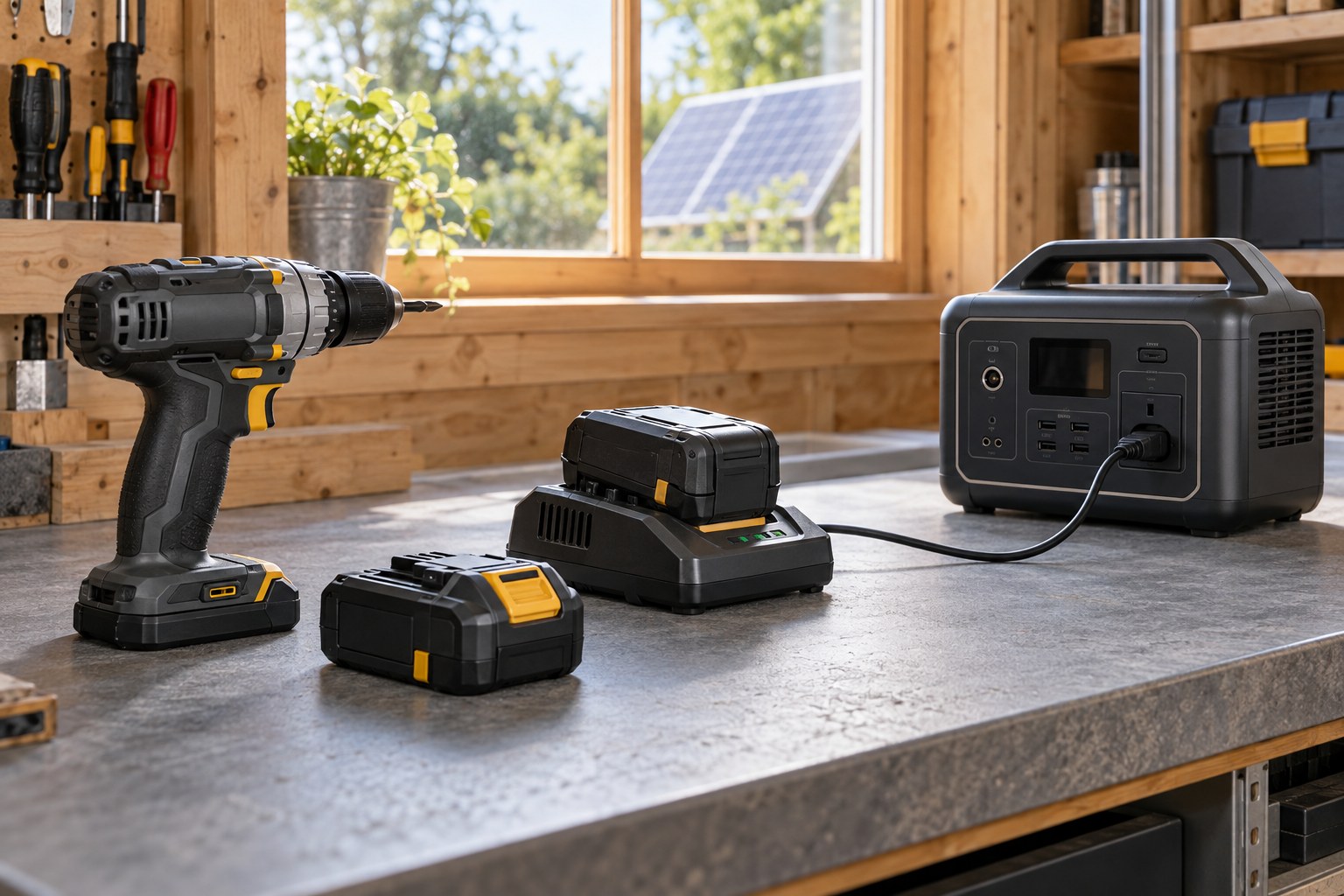
A typical arrangement uses a solar panel, suitable solar charge controller, storage battery and inverter to supply the tool manufacturer’s approved mains charger. A solar-compatible portable power station can combine the middle components, provided its solar input and AC output suit the equipment.
Check voltage, current, polarity and connector compatibility before buying. Never connect a bare panel directly to a tool battery or improvise charging leads. Only consider a DC charging route when the tool manufacturer supplies or explicitly approves a compatible charger and power source.
Will the inverter run your charger?
Watts measure power; watt-hours measure energy. A storage battery may contain enough energy for several charges while its inverter cannot supply the charger’s required power. Our backup-power planning guide explains this distinction.
Read the charger’s AC input specification, not simply the battery’s voltage or the charger’s DC output current. Ask the supplier to confirm continuous power, any starting demand, waveform compatibility and operating-temperature limits. A suitable pure-sine-wave inverter is a common choice, but compatibility still needs checking. Add together the demands of chargers used simultaneously.
Standby matters too. Victron lists zero-load consumption for its inverters; consumption varies by model. An illustrative 5 W idle load running for 24 hours uses 120 Wh — the entire charging allowance in our example. Switch equipment off when appropriate under its instructions.
Can a 100 W panel replace that energy?
For illustration, a 100 W panel receiving the equivalent of three hours at rated output produces 300 Wh before losses. If 75% reaches storage, that becomes 225 Wh. This solar-to-storage allowance is separate from the charger losses above. It could cover one illustrative 120 Wh recharge with some energy remaining.
These are assumed conditions, not a UK daily forecast. Cloud, winter sunlight, orientation and shadows can change the result substantially. Use the European Commission’s PVGIS off-grid calculator to explore local generation and storage, alongside an assessment of nearby obstacles. Our shed shade-mapping guide is a useful starting point.
Size storage by usable capacity, allowing for discharge limits, ageing, other loads and cloudy-day reserve. More storage helps bridge poor weather; it cannot compensate indefinitely for too little generation.
Keep charging safe in a shed
Use the correct charger: Electrical Safety First’s cordless-tool advice stresses using the original or a suitable replacement from the manufacturer or a reputable retailer. Keep equipment dry, ventilation clear and the charging area away from sawdust and flammable materials. Do not charge damaged or swollen packs, or leave charging unattended.
Follow the specific battery and charger temperature limits. A shed can become too hot or too cold; our cold-weather charging guide explains why those limits matter. Have a competent installer assess permanent wiring, electrical protection and roof mounting.
Is it worthwhile for your tools?
For occasional use, a correctly matched system can be convenient. For daily heavy use, demand may exceed a small kit’s output. Measure a normal charging cycle with a suitable plug-in energy meter, record weekly use and ask suppliers for a seasonal estimate. Compare the complete system cost with charging indoors.
If you also want to explore broader energy ideas, view the separate energy product and its full details. This affiliate offer is not a verified shed solar kit or an approved tool-battery charger.
Explore the energy offer
Open the seller’s presentation to examine what is included, the evidence and current terms before deciding. We have not tested the product or verified its performance claims.
View the Energy Product and Full DetailsComparing a small component kit? Our inverter and mini-panel kit introduction sets out the specifications to request. Check your tool charger's requirements against documented inverter output and realistic daily solar energy; we have not verified this kit with particular tool chargers.