
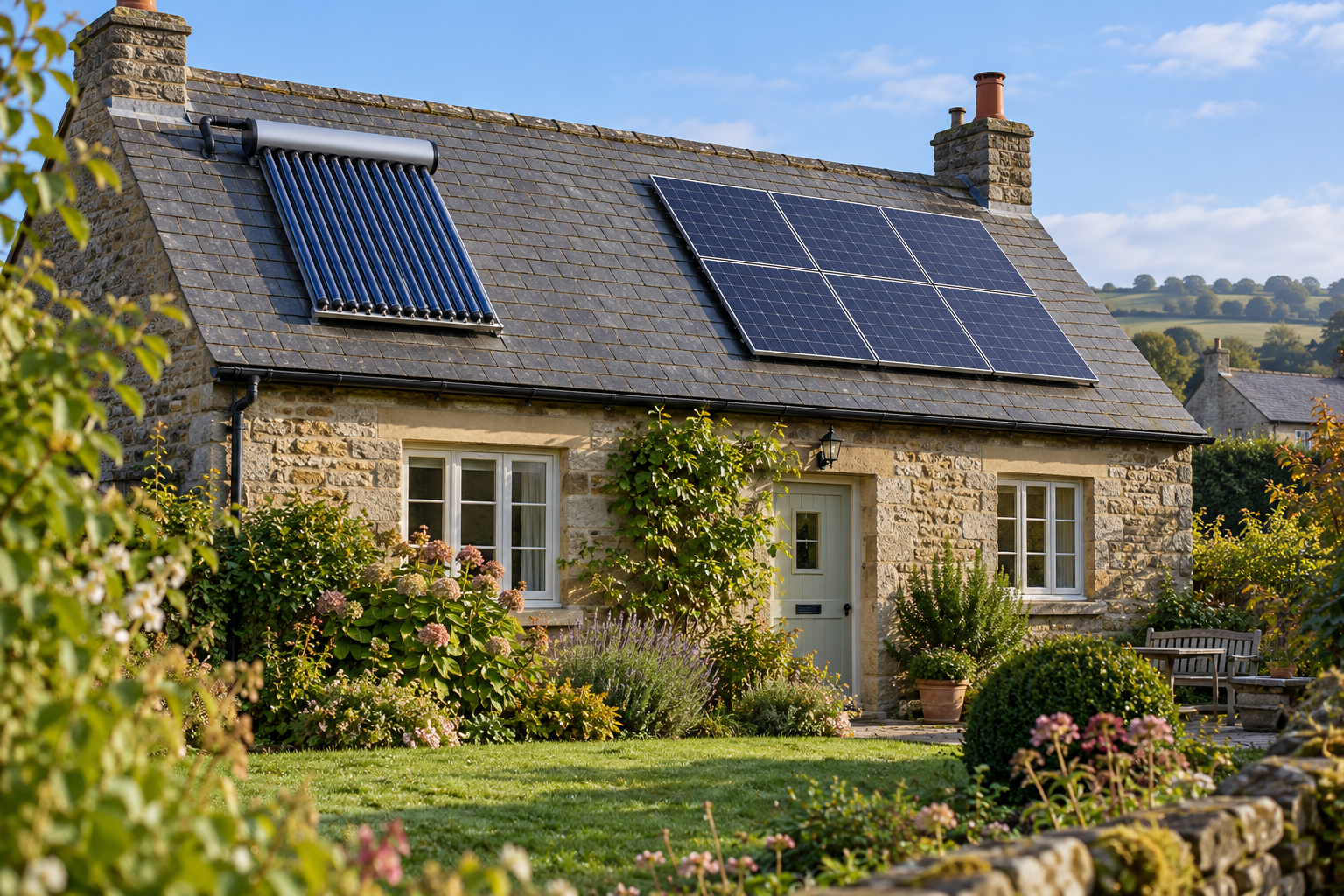
For a one- or two-person household, choosing solar can begin with a surprisingly practical question: what do you actually need more of—hot water, or electricity that can serve several jobs?
Solar water heating, also called solar thermal, collects heat. Solar photovoltaic panels, or PV, generate electricity. Either may contribute to hot water, but they do so through different equipment. A small household should compare useful output, existing plumbing, roof space and full installed cost before choosing.
There is no automatic winner for every home. A modest hot-water requirement may limit the benefit of a dedicated thermal installation. Equally, a well-matched thermal system can be worth investigating where hot-water use is consistent and the cylinder and roof arrangements suit it.
1. Are you trying to reduce the hot-water bill or the electricity bill?
Start by separating three uses: hot tap water, space heating and electrical appliances. Standard domestic solar water heating mainly supports baths, showers and hot taps; it is not normally a complete radiator-heating system.
A solar thermal collector transfers heat to a suitable hot-water cylinder or thermal store. PV produces electricity for loads such as lighting and appliances, with surplus potentially exported or stored. PV can also contribute to water heating through a compatible immersion heater or heat pump.
| Starting question | Solar thermal | Solar PV |
|---|---|---|
| What does the roof equipment produce? | Heat for a connected thermal system | Electricity |
| What stores the energy? | Usually a suitable hot-water cylinder or thermal store | A battery is optional; water can also store heat made from electricity |
| What if hot water is already hot enough? | The design must manage periods of low heat demand | Electricity may serve other loads or be exported, subject to the system |
| What is the key household question? | Will you use enough of the available heat? | How much generation will you use, store or export? |
If you are new to the electrical side, our beginner's guide to solar power at home explains the main components.
2. How much hot water do you actually use?
Household size is a starting clue, not a sizing method. Two people taking short showers may use far less than two people taking frequent baths. An electric shower often heats its own cold-water supply, so it may not use the cylinder at all.
Make a seven-day record of showers, baths and significant hot-tap use. Note which appliances heat water internally. A cold-fill washing machine or dishwasher should not automatically be counted as demand for solar-heated water from a cylinder.
A simple heat calculation helps show the scale. Suppose a household uses 80 litres of mixed water at 40°C each day, with incoming cold water at 10°C:
Heat required ≈ litres × temperature rise × 0.001163kWh.
That gives 80 × 30 × 0.001163 = about 2.79kWh of heat per day, or roughly 1,019kWh over 365 identical days. These are illustrative assumptions, not a recommended allowance per person.
This is heat delivered in the used water. The heating system must also cover relevant cylinder and pipe losses. Nor does “80 litres at 40°C” specify an 80-litre cylinder: stored water may be hotter and mixed at the outlet. Do not treat the example as a storage-temperature setting or a cylinder specification.
The useful insight is the ceiling on savings. If the hot-water demand is modest, a system cannot save the cost of heating water you never needed.
3. Do you have a cylinder, and is it suitable?
Look at the existing heating arrangement before discussing collectors. Record the boiler or heat-pump model, cylinder model and volume, any immersion heater, and the available cupboard space.
A cylinder already being present does not establish solar-thermal compatibility. It may need replacement or a separate arrangement. Vaillant's solar-cylinder documentation illustrates why the heat exchanger, controls and safety equipment belong to a coordinated system rather than an improvised extra connection.
With a combi boiler and no cylinder, adding storage may become a significant part of the project. Energy Saving Trust notes that few combi boilers are compatible with solar thermal. Have the exact model checked; do not assume it accepts preheated water.
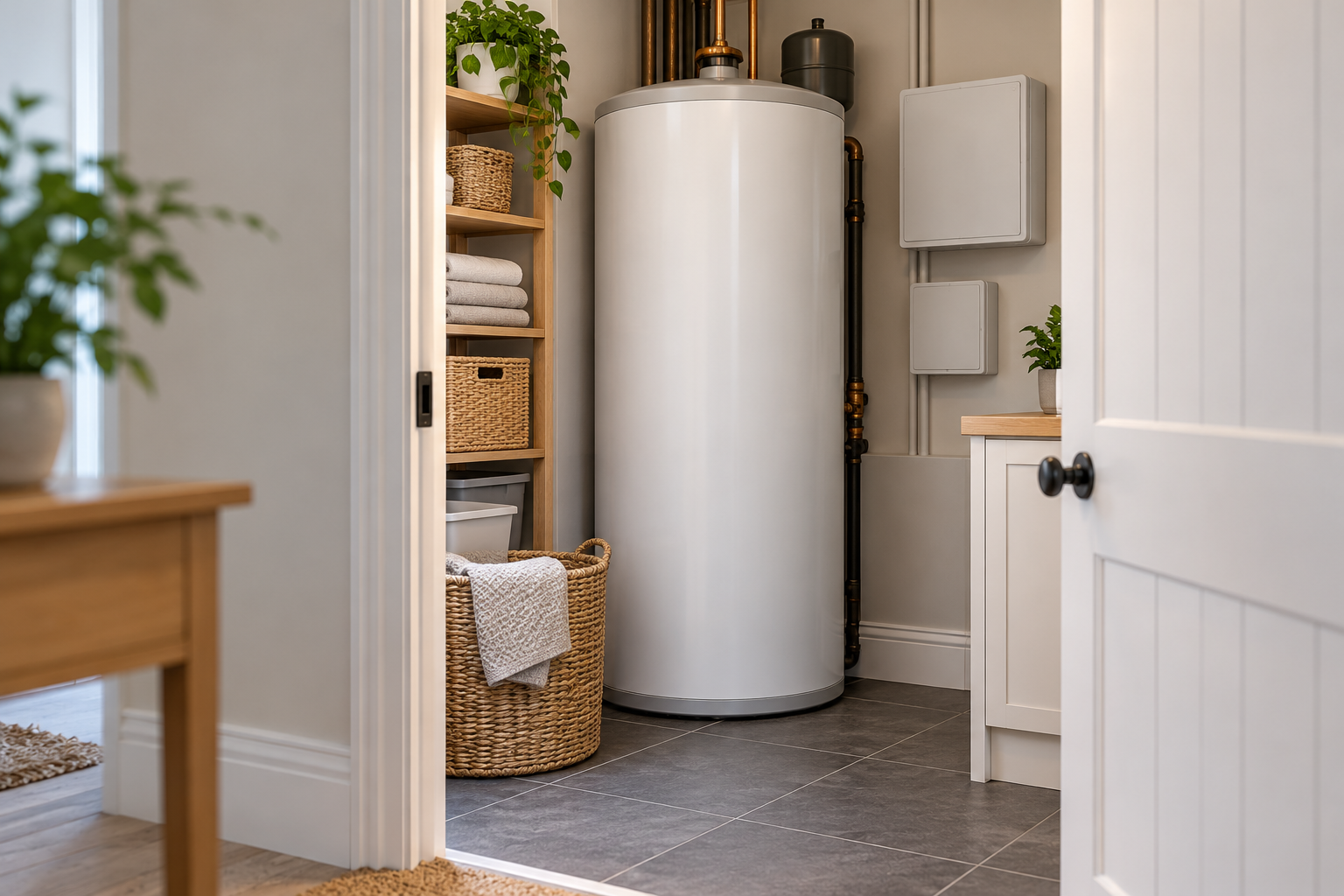
PV supplying ordinary electrical loads does not require a hot-water cylinder. However, diverting surplus PV to an immersion heater does require a suitable water-heating arrangement. Include the cost and space if that arrangement does not already exist.
4. What can the roof support, and what is shading it?
Ask for a roof assessment covering condition, structure, orientation, shade, safe access and the proposed layout. For thermal, include the pipe route to the cylinder. For PV, include cable routes and inverter location.
Compare predicted useful output from the actual available area. A collector's conversion efficiency alone does not tell you which complete installation will save more money. Unused summer heat has little household value, while electricity serving several loads has a different pattern of usefulness.
Shade changes with the season. Our shade-mapping guide explains a useful observation habit, although a house-roof design still needs its own professional assessment.
If roof repairs are approaching, ask whether doing them first avoids paying for removal and refitting later. Check relevant installation permissions and approvals for your property with the installer and local authority.
5. What happens in winter and when you are away?
Request monthly estimates, not only an attractive annual total. Solar availability and hot-water demand do not necessarily rise and fall together. Energy Saving Trust explains that solar thermal normally needs supplementary heating, particularly during winter.
For a small household, summer holidays matter too. Ask the thermal installer how the design deals with strong sunshine when little hot water is being drawn. The Pacific Northwest National Laboratory's guidance identifies overheating protection as a system-design issue.
With PV, ask what happens to electricity when you are out: daytime loads, export, a battery or hot-water diversion may be options. A standard grid-connected PV installation need not include a battery. Storage should earn its place in the calculation rather than being treated as compulsory.
Our UK winter panel-angle guide explores seasonal production, but changing angle cannot remove the seasonal shortage of sunshine.
6. Could PV heat your water as well?
A PV diverter can send surplus generation to a compatible immersion heater instead of exporting it. Manufacturer myenergi describes this approach in its eddi guidance. The device needs appropriate installation and control settings; it does not create extra solar energy.
An immersion heater converts electricity into heat at approximately one unit of heat per unit of electricity at the element. A heat pump can deliver more heat per unit of electricity, with performance depending on conditions and required water temperature. If you already have or plan a heat pump, ask how its hot-water schedule could use PV before assuming an immersion diverter is the best route.
Keep hygiene cycles, temperature controls and scald protection within the manufacturer's requirements. Solar availability is not a reason to disable them.
A battery, electric vehicle and diverter can compete for the same surplus. Ask the installer to explain the priority settings and show that the savings estimate counts each generated kilowatt-hour only once.
7. Is diverted electricity worth more than exported electricity?
Surplus solar has an alternative value if you can sell it. Compare the export payment you would forgo with the cost of the water heating you would replace.
Here is a deliberately simplified example, using assumed prices rather than current tariffs:
- Gas costs 7p/kWh.
- The effective efficiency for delivering the relevant heat is assumed to be 85%.
- One kWh of useful heat therefore costs approximately 7 ÷ 0.85 = 8.2p in gas.
- Exporting one kWh would earn an assumed 15p.
In that example, diverting one kWh to an immersion saves roughly 8.2p of gas but gives up 15p of export income. It would be about 6.8p worse financially before any additional differences in losses. Change the tariff, displaced heater or efficiency and the conclusion can change.
This is a way to ask a better question, not a universal instruction to export. Use your own marginal costs, and do not count standing-charge savings unless those charges would actually disappear.
8. What is included in each quotation?
Ask for comparable written scopes. A thermal quote should identify collectors, cylinder work, pipework, controls, supplementary heating integration, access costs and commissioning. A PV quote should identify the array, inverter, electrical work and any separately priced storage or diverter.
For both, request expected maintenance, major replacement assumptions, warranties and ongoing support. PNNL recommends maintenance planning for solar water heating; PV also has components and electrical equipment whose condition and warranties need attention.
Ask each installer to show the assumptions behind annual savings: useful heat delivered, electricity used in the home, export, tariffs and system losses. Solar thermal heat and PV electrical generation are not interchangeable headline numbers.
Keep two comparisons separate: the cost of the whole new installation, and the extra cost of adding hot-water diversion to PV you were going to install anyway. Charging all PV costs to the hot-water benefit—or none of them when comparing whole systems—can distort the answer.
Three small-household situations
One person, combi boiler, little hot-water demand: investigate whether the cylinder and plumbing changes make solar thermal hard to justify. PV may offer broader uses, but the electricity and export calculation still needs checking.
Two people, regular hot-water use, suitable storage and roof: obtain both designs. Consistent demand makes a thermal assessment more relevant; compare its usable seasonal heat against PV's combined electricity and hot-water benefits.
A household planning a heat pump or electric car: consider the whole future energy plan. PV may serve those additional loads, while storage, controls and roof allocation need coordinated design. Avoid buying today's add-on without considering next year's heating changes.
Frequently asked questions
Is solar water heating the same as solar panels?
Solar thermal collectors produce heat. Solar PV panels produce electricity. People sometimes call both “solar panels”, so confirm which technology a quote describes.
Can either option provide all my winter hot water?
Do not assume so. Ask for a winter production estimate and a dependable supplementary heating arrangement.
Must PV include a battery?
No, not for a conventional grid-connected installation. Compare the additional cost and benefit of storage separately.
Can I install both?
Potentially, if the roof, demand, budget and system design support it. Having both is not automatically better value for a small household.
Sources and project resources
Checked on 31 October 2026:
- Energy Saving Trust: solar water heating and compatibility.
- Energy Saving Trust: solar PV.
- Energy Saving Trust: storing energy, including heat.
- Vaillant: solar-cylinder installation and maintenance.
- PNNL: solar water-heating operation and maintenance.
- myenergi: surplus-electricity diversion.
- Energy Saving Trust: heat-pump operation.
For broader planning, explore our Recommended Products and DIY Alternative Energy Projects bundle. Portable and small off-grid kits are not substitutes for a professionally designed household roof or hot-water installation.
Explore the Energy Revolution offer
Affiliate offer: review the seller's claims and terms independently. We do not guarantee results.