
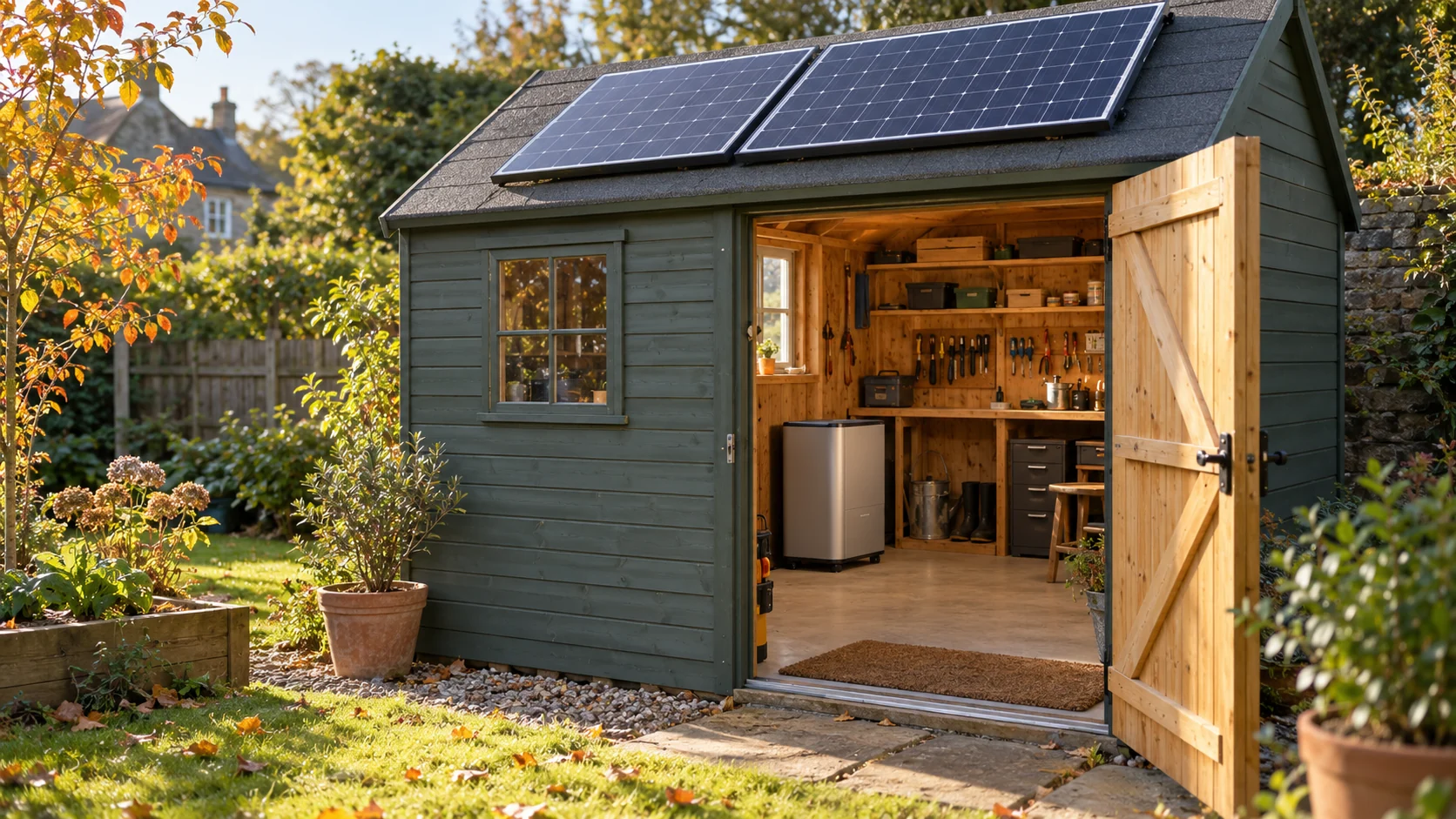
Should you add panels or more battery capacity?
Add generation when the system cannot collect enough energy; consider storage when it regularly has unused solar energy but runs short later. If an appliance causes an immediate shutdown, investigate power limits or a fault first. The right upgrade depends on when and why the existing system falls short.
Your shed lights work, the drill charger usually behaves, and the battery monitor looks reassuring on sunny afternoons. Then a longer workshop session ends in darkness. It is tempting to order another panel or a bigger battery, but either purchase can disappoint if it addresses the wrong problem.
This guide focuses on small, stand-alone shed systems. It helps you collect evidence for an installer or supplier before expanding the equipment. Systems connected to a house supply or electricity network also need an assessment of those connections.
1. Separate energy, storage and power
Solar panels collect energy when conditions allow. A battery keeps some of that energy for later. An inverter converts battery electricity into a supply for compatible mains appliances, within its own limits.
Watts describe the rate of electricity use; watt-hours describe the amount used over time. An assumed 100W load operating for four hours uses 400Wh. A 1,500W appliance operating for five minutes uses 125Wh, but demands much more power while it is running. A system can have enough stored energy for that short task and still be unable to run the appliance.
Energy Saving Trust explains the basic benefit of storing electricity for use later. Storage changes when available energy can be used; it does not create extra solar generation. Keeping those roles separate makes the upgrade decision much clearer.
| What happens? | What to investigate | Possible next step |
|---|---|---|
| Charge trends down across ordinary days | Energy collected versus total demand | Improve generation or reduce consumption |
| Battery fills early, but evening use exhausts it | Unused daylight energy and usable battery capacity | Consider more storage or move loads into daylight |
| A tool trips the system immediately | Inverter rating, starting demand, battery discharge limits and alarms | Resolve the power limit or fault |
| A previously adequate system suddenly struggles | New loads, shade, temperature restrictions or equipment deterioration | Diagnose the change before expanding |
2. Keep a short operating log
Record a representative week, including busy and quiet days. Repeat during the season when you need dependable power: a good July week tells you little about a shaded November shed.
Use existing displays, monitoring apps and a suitable plug-in energy meter. Note morning and evening battery state of charge, daily solar yield, appliance energy, charging stages, weather, shading and any alarms. Record when the battery becomes full and when the shortage occurs.
Label where each measurement comes from. Solar-controller yield, battery energy and AC socket consumption are different quantities. Account for conversion losses rather than comparing them as though every watt-hour reaches the appliance.
Battery percentages are estimates. Ask whether the monitor is correctly configured and synchronised; a display reading alone does not prove usable capacity or battery health. Do not bypass protections or run a battery flat to “test” it.

3. Add panels when energy collection is the shortage
Suppose your equipment takes 600Wh per day from the battery, including inverter overhead and losses, while solar replenishment contributes only 400Wh of usable battery energy. That is an illustrative 200Wh daily deficit. An extra 1,000Wh of usable storage could bridge roughly five such days if it started full, but the shortfall would continue.
More panels may help, provided the site and controller can use their output. First check whether the existing array is being shaded, whether demand has increased, and whether the charger is operating normally. Our shed shade-mapping guide helps identify obstacles that another panel in the same location might not overcome.
A low yield number is not automatically a generation problem. Victron’s troubleshooting guidance lists several possible reasons for reduced charging, including a full battery, insufficient sunlight and control restrictions. Interpret the reading alongside battery status and demand.
For seasonal planning, compare local scenarios in the European Commission’s PVGIS off-grid tool. Its modelling helps explore different array and battery sizes; nearby trees and buildings still need a site assessment. Plan for the months you will actually use the shed.
4. Add storage when useful sunlight is going unused
A different pattern is a battery that reaches full charge by lunchtime, remains full while sunshine continues, then runs short during evening use. That suggests a possible mismatch between when energy is available and when you need it.
The key word is possible. A charger reducing output because the battery is full does not measure exactly how much extra energy a larger bank could capture. Ask the supplier to estimate that potential using operating records, local solar conditions and system limits.
Here is a simple capacity example. If your evening appliances need 600Wh and inverter efficiency is assumed to be 90%, they require about 667Wh from the battery. Add an assumed 40Wh of separate overnight overhead and the requirement becomes approximately 707Wh. With only 500Wh available above your chosen reserve, the usable-capacity gap is about 207Wh.
Those are planning assumptions, not equipment specifications. Extra nameplate capacity must allow for the permitted discharge range, temperature, ageing and reserve. There must also be enough charging opportunity to replace the energy used.
Moving tool charging or other flexible tasks into sunny hours may reduce the need for expansion. For a weekend workshop, compare the whole weekly cycle using our weekend shed battery-sizing guide: several quiet charging days can matter more than one daily average.
5. Treat immediate shutdowns as a separate question
If the lights work but a saw or pump trips the inverter as it starts, more panel wattage is not the first answer. Check the recorded alarm, the appliance’s starting demand and the inverter’s continuous and surge ratings.
Victron’s inverter operating guidance distinguishes overload, low-voltage and temperature-related conditions. Those require different responses. A battery-management system can also impose discharge limits; a cable or connection problem may cause voltage drop under load.
A competent installer should assess the complete power path. A larger inverter alone may simply demand more current than the battery or wiring can safely provide. Our guide to shed inverter selection explains the questions to ask. Do not raise protection thresholds to keep an overloaded system running.
If the system used to handle the same tasks, tell the installer what changed and when. A deteriorating battery or new winter charging restriction may call for maintenance, replacement or an operating change rather than extra capacity.
6. Check what the system can safely accept
Before adding panels, ask for a compatibility check covering maximum PV open-circuit voltage in cold conditions, allowable input current, charging output and the proposed panel arrangement. Manufacturer limits are model-specific. Victron’s installation manual illustrates why panel count alone is not a sufficient check.
The assessment should also cover mounting, roof condition, cable sizing, isolation and protection. Different panel models or orientations may need a different design or another controller. Do not assume that spare-looking terminals mean spare capacity.
For battery expansion, confirm approved models, chemistry, voltage, age and capacity combinations, charging settings, communications and battery-management compatibility. Rules differ: Victron’s Lithium NG manual, for example, gives different rules for different bank arrangements. Those permissions do not apply to unrelated batteries.
Portable power stations may accept only specified expansion modules. An external battery is not automatically compatible because its voltage appears similar. Installation and environmental requirements also matter in a damp or unheated shed.
7. Compare upgrades against one clear target
Give the supplier a practical goal: “Run my existing lights and charger until 9pm on a typical October Saturday” is more useful than “Make the system bigger”. Include your load records, equipment models and acceptable reserve.
Ask each proposal to show expected usable energy, seasonal recharge time and maximum appliance demand. Include any required controller, inverter, mounting or wiring changes in the comparison. A panel upgrade can create a new storage bottleneck; a larger battery can expose inadequate weekday recharge.
Compare a smaller demand change too. Shorter router hours, reduced inverter idle time or daytime charging may solve the shortage cheaply. Keep a fallback plan for prolonged poor weather, even after upgrading.
If you are also researching broader energy ideas, you can review the separate energy offer and its full details. It is not a verified component upgrade or a substitute for diagnosing your shed system.
Frequently asked questions
Will a bigger battery charge faster?
Not automatically. With the same charging power, replenishing more missing watt-hours generally takes longer. Compare the amount of energy being replaced, not just the displayed percentage.
Can I add a new battery beside an old one?
Only when the manufacturer permits that combination and the installation meets its requirements. Ask about condition, matching, commissioning and warranty before buying.
Should I double the panels to double daily output?
No fixed doubling can be promised. Shade, orientation, controller limits, battery acceptance and seasonal conditions affect usable output. Compare an assessed design against your measured demand.
What if I only run short in winter?
Review winter generation, shading, battery temperature limits and extra loads together. More storage helps only when it can be recharged; occasional winter use may suit a different operating or backup plan.
Buy the upgrade that solves the recorded problem
Use your log to identify the limiting factor. Improve generation when energy is missing, consider storage when surplus arrives at the wrong time, and investigate power trips separately. A useful upgrade has a measurable purpose and a realistic recharge plan.
Our solar inverter and two-mini-panel kit overview is another starting point for comparing equipment. Confirm panel wattage and whether a suitable battery is included. Adding an inverter does not increase the energy that small panels can collect.
For a worked shopping comparison, see our ECO-WORTHY 400W panel-and-battery kit overview. Its panel rating and battery capacity describe different jobs: collecting energy and storing it. Check which job your existing system actually needs to improve.
Explore the linked energy offer
Open the seller’s presentation to review the contents, supporting evidence, price and current terms. We have not tested the product or verified its performance claims; check suitability before purchasing.
View the Energy Product and Full Details