
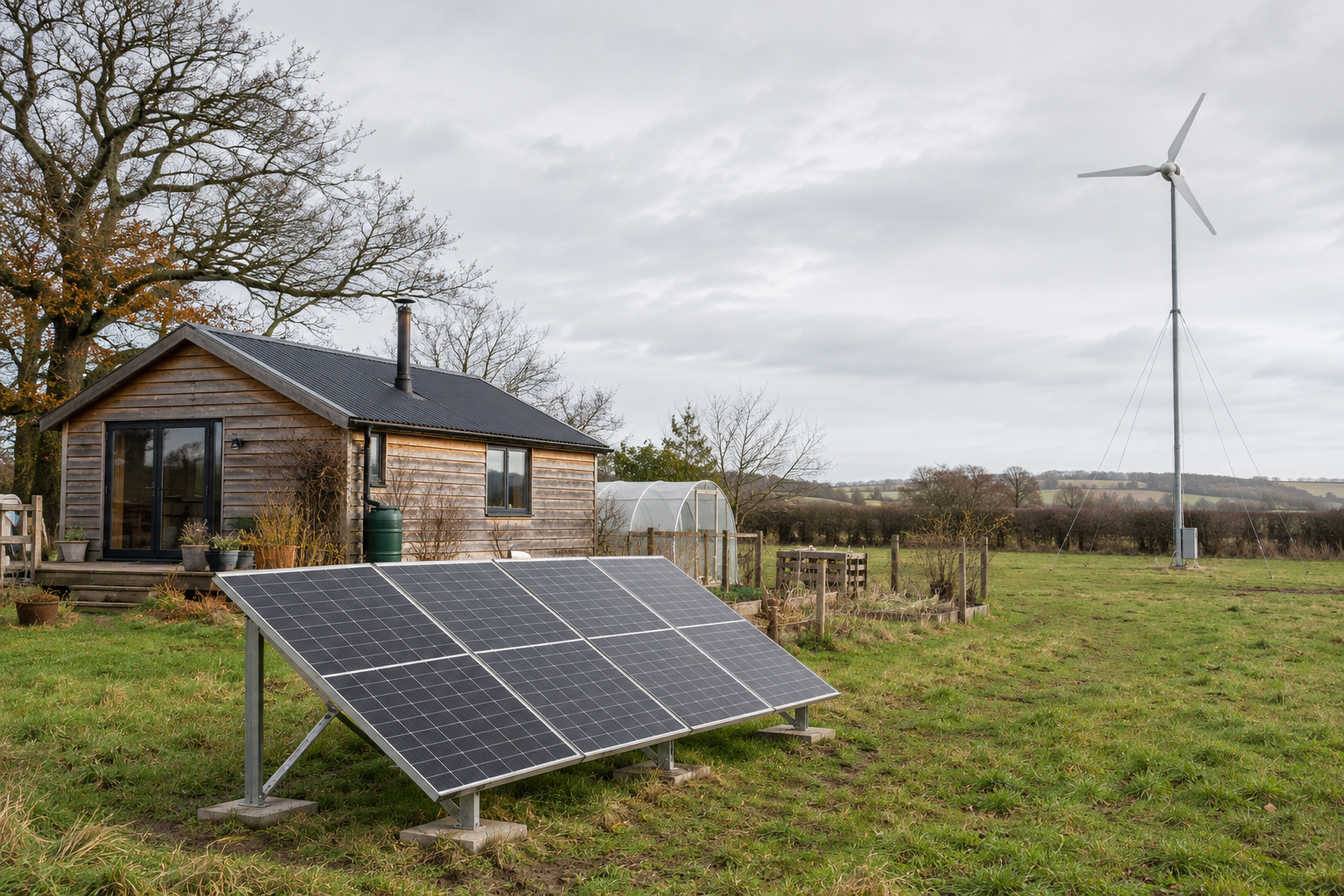
By December, a solar system that felt generous in July can start asking awkward questions. The battery reaches bedtime with less charge, the inverter still needs power overnight, and another cloudy forecast appears. A small wind turbine sounds like a sensible partner: it can generate after sunset and sometimes during dull weather.
That can work on a suitable site. However, a windy walk across your garden does not prove that a turbine will cover your winter shortfall. Before buying, check the energy gap, the wind at the proposed rotor height, and how the equipment will work safely with your existing battery system.
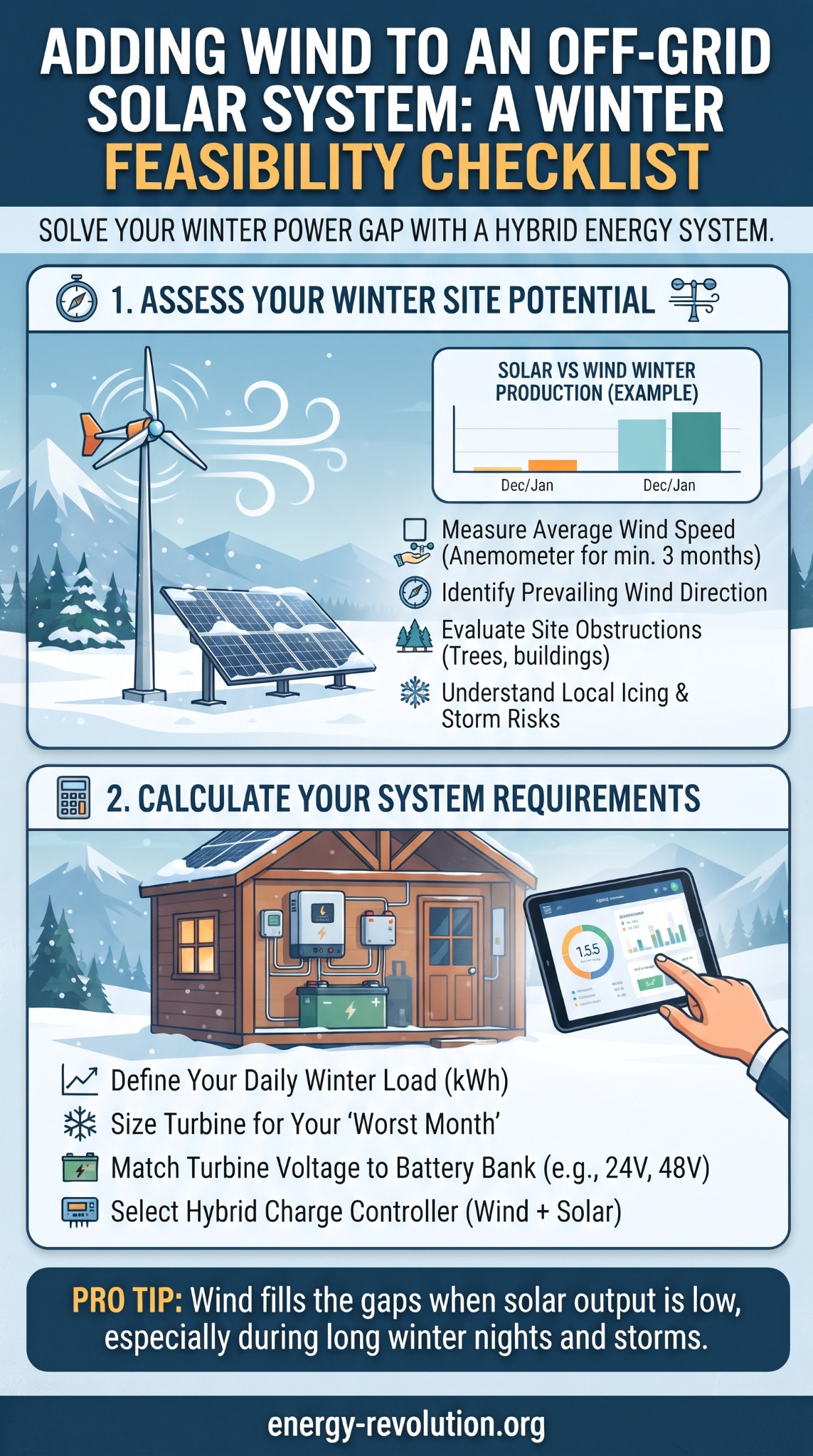
This checklist follows the two useful starting points in our Pinterest image: assess the site, then calculate the system requirements. We also unpack its shortcuts. Three months of measurements are an initial sample, a hybrid controller is not always necessary, and storms do not guarantee useful charging.
1. Write down the winter problem you want to solve
Start with a sentence such as: “We need to keep the fridge, lights and communications running through a dull winter evening.” That is more useful than “We want a 1kW turbine”. The first describes a need; the second describes a label.
Use your battery monitor and generation records to collect daily figures for a representative winter period. Record consumption, solar energy delivered, battery state of charge and any backup charging. Include inverter standby use and system losses consistently. If your appliance figures are measured on the AC side, allow for conversion losses before comparing them with battery-side generation.
- Which loads are essential, and which can wait?
- How much energy does the system use over 24 hours?
- How much does solar supply during the difficult month?
- Is the problem a daily energy shortage, a brief high-power load, or both?
A kettle demanding too much instantaneous power may require a different appliance or inverter assessment. A turbine that supplies useful energy slowly does not automatically solve that peak-load problem. Read our guide to more battery capacity versus lower energy use before choosing extra equipment.
2. Turn the shortfall into a simple energy target
Here is an illustrative calculation, using all figures at the battery side. These are invented planning assumptions, not a forecast for any turbine.
| Winter planning item | Example |
|---|---|
| Daily demand, including system overheads | 2.4kWh |
| Solar energy delivered to the battery system | 0.9kWh/day |
| Daily energy gap | 2.4 − 0.9 = 1.5kWh |
| Equivalent average wind contribution over 24 hours | 1,500Wh ÷ 24h = 62.5W |
The last number is an average delivered contribution. It does not mean that a turbine rated at 62.5W would do the job, or that a larger one will deliver steadily. Actual output varies with wind, controller behaviour, losses and availability.
Across seven days the example gap is 10.5kWh. Producing that much in one windy weekend would still leave difficult nights if the battery cannot store it. Ask for daily or hourly modelling where practical, including calm periods and usable battery capacity. Monthly totals help with screening; they do not establish reliability.
3. Check the wind where the rotor would actually sit
Exposed land with clean airflow is a much stronger starting point than a sheltered garden surrounded by houses. Trees, buildings and terrain can disturb the airflow. A low turbine may spin enthusiastically in gusts while delivering disappointing energy.
Draw a simple site plan showing possible mast positions, nearby obstacles, boundaries, overhead services and maintenance access. Note prevailing wind directions and which directions are obstructed. Nearby weather data and wind maps help screen a location, but they cannot fully describe airflow around your own buildings.
For a substantial purchase, ask a qualified assessor about measurements near the proposed hub height, safe sensor installation and comparison with longer-term records. The US Department of Energy guide recommends running on-site measurements for at least a year. A winter-only sample can help investigate your winter question, but may capture an unusually windy or calm season.
The pin suggests a minimum three months. Treat that as an initial investigation, not a universal proof of feasibility. Ask what uncertainty remains and how it affects the purchase decision. Do not climb a roof or improvise a tall sensor mast to gather the data.
4. Ask for energy estimates from the power curve
A turbine’s rated power is output at specified conditions. Cut-in speed describes when generation starts; it does not say how much worthwhile energy follows. Ask for the exact model’s documented power curve, its measurement basis and an energy estimate using the wind-speed distribution at your intended location.
Two sites can share an average wind speed while spending very different amounts of time at useful generating speeds. Applying a turbine power curve to one average speed misses that variation. An installer should also explain allowances for turbulence, electrical losses, shutdowns and maintenance.
Request a winter estimate with a cautious case alongside the central estimate. Be wary of a calculation that simply multiplies the advertised watts by 24 hours. Also ask whether quoted energy is measured at the generator, controller output or battery connection. Compare figures at the same point in the system.
5. Check whether windy hours match your shortage
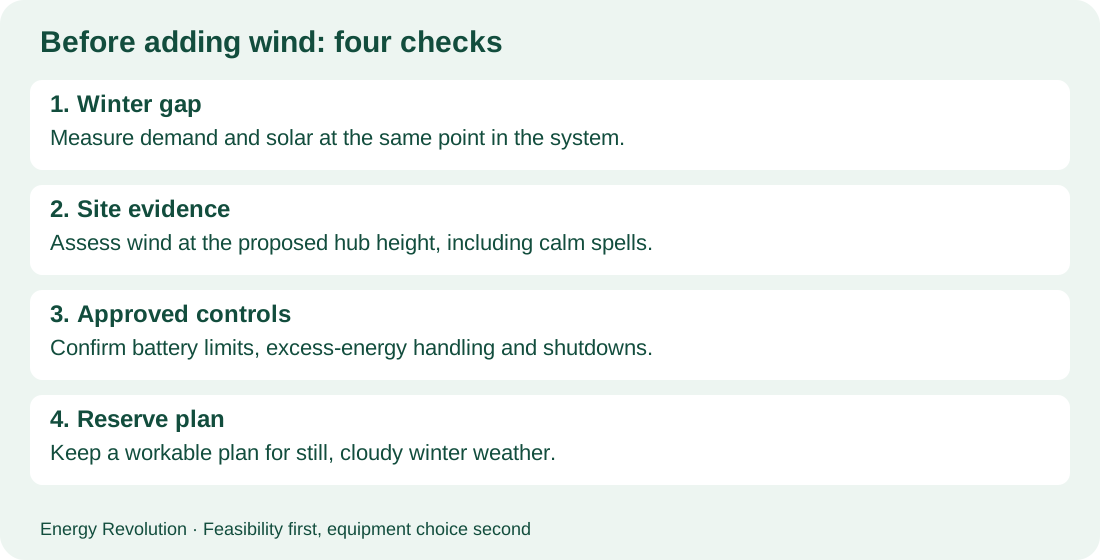
Wind can generate at night and during some periods of weak sunshine. That makes a hybrid system worth investigating. It does not mean every dark day is windy, or that every UK location has a useful winter wind resource.
Compare wind and solar across the same dates. Do they genuinely support each other when the battery is low? Does much of the wind generation arrive when solar has already filled the battery? Energy that cannot be used or stored will not reduce your shortage.
Keep a reserve plan for a cold, still, overcast spell. Our three-cloudy-days reserve guide helps you prioritise essential appliances. Wind may reduce backup use; establish the evidence before removing that backup.
6. Get written confirmation of charging compatibility
Matching “24V” or “48V” on two labels is only a starting point. The installer needs the exact turbine, controller, battery chemistry, battery-management system, inverter and existing solar-controller details.
Ask for confirmation of charge-voltage settings, total permitted charging current, cable and protection requirements, and what happens when the battery refuses charge. Lithium batteries may stop charging because they are full, too cold or protecting themselves. The turbine system must handle those conditions safely.
Do not connect a turbine to a solar-only MPPT input or a portable power station’s solar socket unless the manufacturers explicitly approve the complete arrangement. Wind equipment can need rectification, dedicated controls and a means of controlling excess energy or rotor speed.
A combined wind-and-solar controller is one possible design. Separate compatible controllers charging a shared battery can also be appropriate. The important question is whether the whole design is supported, rather than whether the box says “hybrid”.
Some systems use a diversion or dump load to absorb excess energy. Others use manufacturer-specific regulation and braking arrangements. Request the specified design and a clear explanation of behaviour during battery disconnection, controller faults and high winds. Do not improvise a dump load or disconnect a running turbine as an experiment.
7. Plan for storms, icing and maintenance access
The pin mentions useful charging during storms. In practice, strong winds can trigger braking, furling, power limiting or shutdown, depending on the model. Survival wind speed is a structural limit under stated conditions, not a promise of generation at that speed.
Ask about operating limits, overspeed protection, restart behaviour and any icing restrictions. Keep people away from an iced or damaged turbine and follow the supplier’s shutdown procedure. Maintenance needs safe isolation and trained access; a windy evening is no time to investigate an unusual noise beside moving blades.
Include mast foundations or anchors, corrosion exposure, inspection intervals, replacement parts and a safe lowering or servicing method in the quotation. A cheap turbine with expensive access requirements may be a poor long-term fit.
8. Check neighbours, permissions and the complete cost
Confirm the planning position with your local planning authority before ordering. Rules vary across the UK and depend on the installation and location. Being off grid does not by itself remove planning requirements. Ask about noise at nearby homes, vibration, boundaries, landscape constraints and any ecological assessment required.
Obtain an itemised installed quotation covering the turbine, mast, groundworks, controls, protection, cabling, commissioning and servicing. Compare it with other ways to reduce the same winter shortage: lower standby consumption, more suitably positioned PV, or a retained backup arrangement.
More battery capacity stores energy; it does not create missing winter generation. Equally, extra generation needs somewhere useful to go. Ask suppliers to compare complete systems against the same winter demand rather than comparing the price of individual boxes.
Your final go, investigate or pause checklist
- Go to detailed design: you have a measured winter gap, credible site evidence, a realistic energy estimate, an approved charging design and a complete quotation.
- Investigate further: the site looks promising, but the measurements, permissions or battery compatibility are incomplete.
- Pause: the rotor would sit in disturbed airflow, the supplier cannot explain winter yield, or safety depends on unsupported connections.
A good outcome may be deciding to measure first. You can still improve the existing system while gathering evidence. Our inverter standby guide is a useful place to look for demand that continues through every winter night.
Frequently asked questions
Will a small turbine charge my battery every night?
Only when wind conditions and the charging system allow it. Night-time generation is possible, but calm nights still require stored energy or backup.
Can I choose the turbine from my solar panel wattage?
No. Start with the winter energy gap and site wind evidence, then check the whole system’s electrical limits. There is no universal wind-to-solar wattage ratio.
Does the turbine need its own battery?
Not necessarily. A properly designed hybrid system can share storage. The equipment manufacturers and installer must support the charging arrangement and protective behaviour.
Is a roof-mounted turbine the easiest answer?
Installation convenience does not establish good airflow. Turbulence, vibration, noise and structural requirements need assessment. Compare suitable freestanding options with a qualified installer.
Sources and useful next steps
Sources checked 5 November 2026. This guide uses general technical principles; your exact equipment manuals govern installation and operation.
- US Department of Energy: Small Wind Guidebook — site assessment, measurement and energy estimates.
- Energy Saving Trust: wind turbines — UK suitability and planning considerations.
- Morningstar: diversion controllers — excess-energy regulation.
- Marlec: wind and solar controllers — examples of manufacturer-specific controls.
Browse our Recommended Products for existing energy equipment links. Inclusion there does not establish suitability for your wind installation. For broader planning ideas, explore our DIY Alternative Energy Projects bundle; it does not replace an engineered design.
Explore the Energy Revolution offer
Affiliate offer: review the seller’s claims and terms independently. No guaranteed output or savings.