
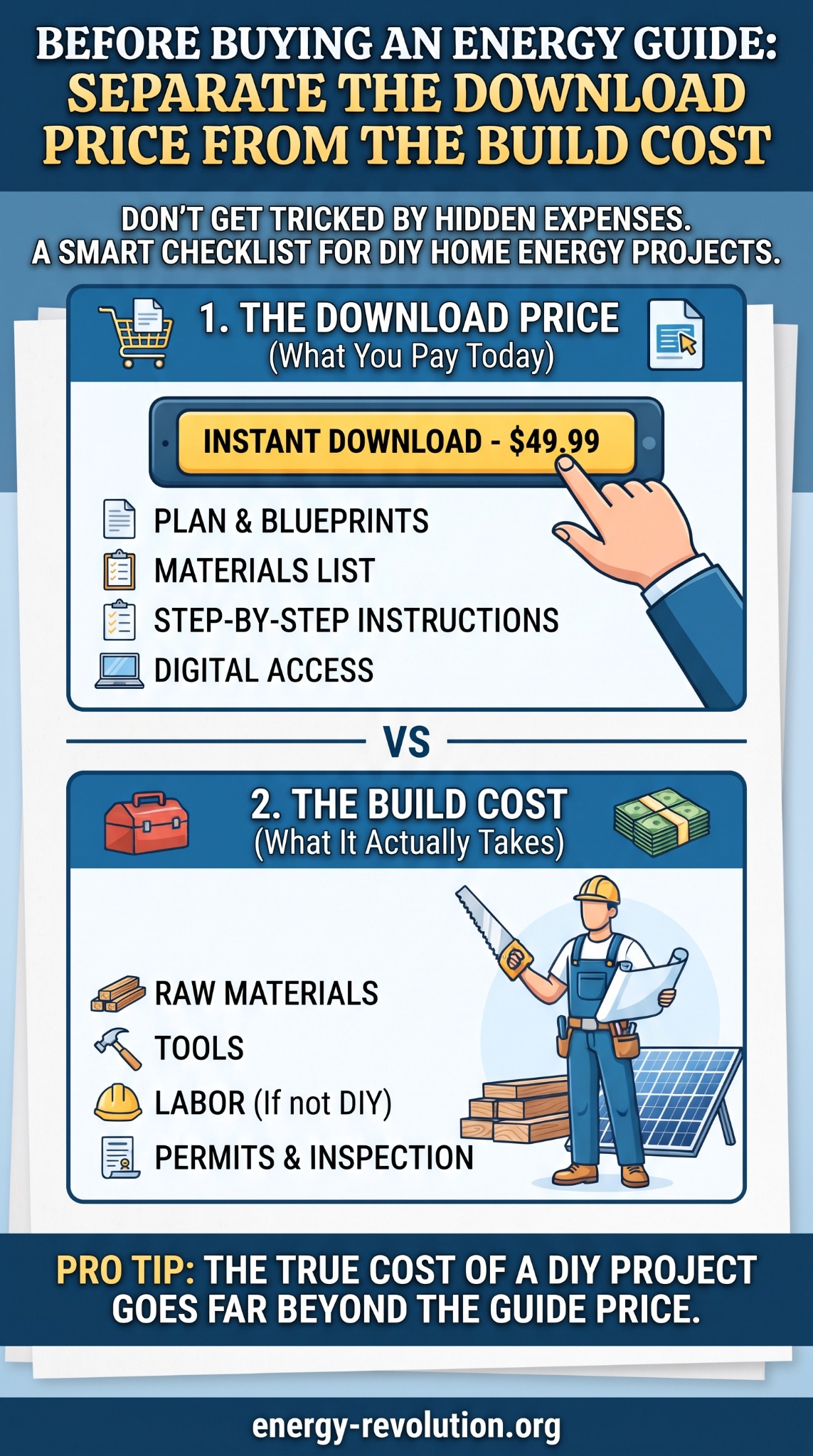
A downloadable energy guide can look like an affordable first step towards a solar-powered shed, a small wind system or a more self-sufficient home. That is perfectly reasonable: learning before buying equipment can prevent expensive mistakes. The difficulty starts when the price of the information gets confused with the price of the project.
A download gives you whatever digital content its seller promises. Unless the offer explicitly includes physical equipment or services, it does not buy panels, batteries, tools, delivery or an installer. Even a detailed materials list needs checking against current prices, local conditions and your actual energy needs.
Our Pinterest image separates these two purchases neatly. Its $49.99 button is an illustration, not a verified current offer or a complete-build budget. Here is how to make the same distinction before paying for any energy guide, including one linked from this website.
1. Ask what arrives after payment
Start with the contents, not the headline promise. Is the purchase a PDF ebook, a set of drawings, videos, worksheets, software access or a combination? Can you save the files, or do you need an account and an internet connection to use them?
Look for a contents page, sample pages and a clear description of the intended reader. “Step-by-step” could describe a simple educational demonstration or a substantial electrical installation. Those are very different projects. Check whether the instructions assume previous electrical knowledge, a workshop full of tools or access to specialist help.
- Which files, formats and projects are included?
- Are equipment specifications and component quantities provided?
- When was the guide last revised?
- Are updates included, and for how long?
- What support is offered, by whom and through which channel?
- Are there subscriptions, optional extras or later purchases?
Save the product description and order confirmation. A long list of bonuses is less useful than a clear explanation of what the main guide helps you do. If the description leaves an important question unanswered, ask before buying.
2. Define the result you actually need
“Generate your own energy” is too broad to budget accurately. Charging a phone, running a fridge and supplying an entire household require different levels of equipment, storage and design.
Write a simple project brief: the appliances, their measured energy use, when you need them and where the equipment will go. Include the difficult season. A shed that only needs lighting on summer weekends is a different challenge from a cabin that needs reliable winter refrigeration.
Our beginner’s guide to solar power explains the basic parts of a system. Use that background to identify what a download covers and what it leaves for you or an installer to specify.
Also separate power from energy. Watts describe the rate at which electricity is supplied or used. Watt-hours and kilowatt-hours describe an amount over time. A guide that mentions a powerful inverter has not necessarily shown how the battery will keep it supplied, or how that battery will recharge.
3. Build three separate budget lines
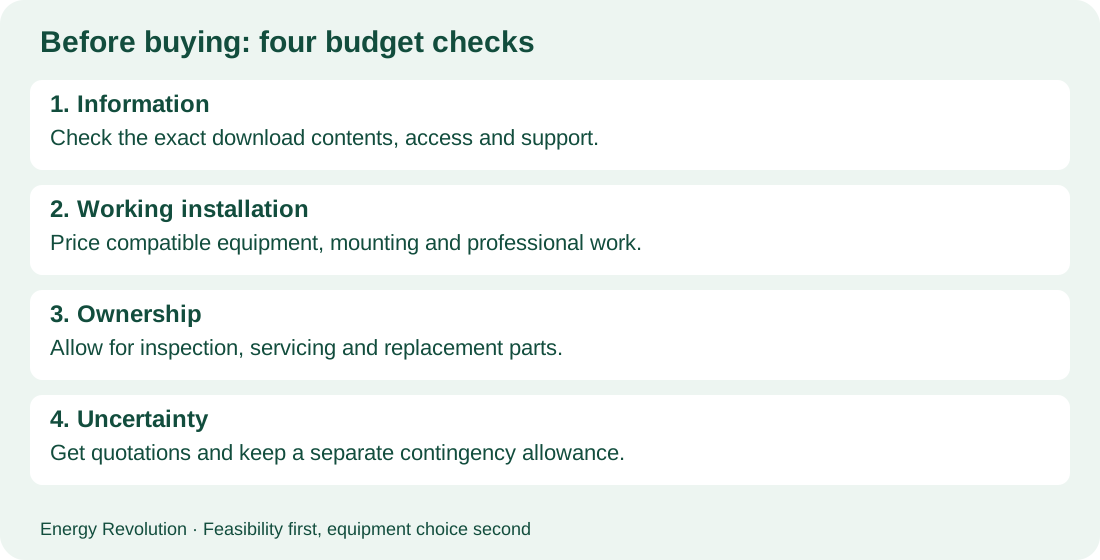
A useful budget has three headings: information, a working installation and ongoing ownership. Keeping them separate makes omissions easier to spot.
| Budget heading | What belongs here? |
|---|---|
| Information and planning | Download, printing, surveys and design advice |
| Getting the system working | Compatible equipment, mounting, protection, cables, delivery, labour and commissioning |
| Keeping it useful | Inspection, maintenance, replacement parts and eventual disposal |
You may not need every item for every project. A small portable kit and a permanent roof installation have different requirements. The point is to ask which costs apply, rather than assuming an absent price means an absent cost.
If you already own tools or suitable equipment, record that separately. “No new cash needed” can be true for you while being untrue for someone starting from scratch. Reused equipment also needs to be suitable and safe; ownership alone does not establish compatibility.
4. See how a small download can sit inside a larger budget
The following is a made-up budgeting exercise. It is not a shopping list, an engineered system, a typical UK installation price or a quotation. The allowances do not establish that the components would work together.
| Illustrative allowance | Amount |
|---|---|
| Digital guide | £20 |
| Generation equipment | £300 |
| Battery storage | £400 |
| Charging and power-conversion equipment | £250 |
| Mounting, cables and protection | £180 |
| Tools and delivery | £100 |
| Professional advice or work allowance | £300 |
| Subtotal | £1,550 |
| Illustrative contingency: 15% of subtotal | £232.50 |
| Total initial budget | £1,782.50 |
Here the £20 guide is only about 1.1% of the total initial budget. The rest has not vanished because the checkout page only collected £20. You would still need real specifications and current quotations before using any of these allowances.
A contingency is money held for uncertainty, not a substitute for missing essentials. If you know a foundation, inspection or extra controller is required, give it its own line. For a larger or less certain project, a simple percentage may be inadequate.
5. Look for the parts that rarely make the headline
A panel or turbine is often the most visible item. The supporting equipment can be less exciting but essential. Ask about mounting suitability, cable lengths, connectors, protective devices, isolators and any weatherproof enclosures specified by the designer.
Then consider the site. A roof may require access equipment and structural assessment. A turbine may need a mast, groundworks and a safe servicing arrangement. A hydro project may involve intake works and environmental constraints. These costs cannot be settled by a generic ebook.
Our winter wind feasibility checklist shows why site evidence and the complete charging arrangement matter before choosing a turbine. A low-priced component can still be an expensive solution if the location cannot supply useful energy.
Ask which permissions, professional work and commissioning checks apply to your exact project and location. Confirm those with the relevant authority or qualified professional. Reading instructions does not itself provide permission, qualifications or approval to connect equipment.
6. Check the evidence behind performance claims
A useful guide should distinguish a worked example from a measured result. If it promises savings, ask what equipment, weather, energy demand and prices were assumed. If it shows a successful build, ask whether the result applies to the version and site you are considering.
For electricity generation, look for energy produced over a stated period, not just a momentary wattage. For battery runtime, look for usable capacity, load, losses and operating conditions. For “free energy”, ask where the energy physically comes from. Solar radiation, moving air and flowing water are resources; a clever arrangement does not remove the need for a real energy source.
Photographs, testimonials and diagrams can help explain a project, but they are not independent proof of output. Neither is an affiliate recommendation. Be especially cautious when guaranteed household savings are offered without a site assessment or a realistic account of seasonal variation.
7. Include maintenance and replacement
The purchase day is only the beginning of ownership. Ask what will need inspection, cleaning, servicing or replacement, who can do that work and whether parts remain available. Energy Saving Trust notes that solar systems can need inverter replacement during their lifetime; the exact timing and cost depend on the equipment and circumstances.
For batteries, check warranty conditions, permitted temperatures and the way cycle-life figures are defined. For wind, consider access as well as parts. A component that is inexpensive on a bench can cost much more to replace at height.
Keep a separate annual ownership allowance. You can then compare options over a chosen period, including expected replacements and uncertainty. Avoid calling that a guaranteed payback calculation: future prices, actual generation and equipment life can change the result.
8. Compare the project with a simpler alternative
The best next purchase may be a meter, an assessment or nothing at all until you understand the problem. If your system struggles because consumption is high overnight, reducing unnecessary demand may help before adding generation.
Our guide to more battery capacity or lower energy use offers a practical way to compare those choices. A larger battery can store more energy, but it cannot create the generation needed to refill it.
Compare alternatives against the same job. A portable kit for occasional charging should not be judged as though it replaces a permanent household installation. Ask how reliably each option meets your needs, what work is involved and what the complete cost includes.
9. Read checkout and support terms calmly
Check the seller’s identity, contact details, currency, final payable price and whether payment is one-off or recurring. Establish what a refund promise covers and how to request help. A voluntary money-back offer and your statutory rights are different things.
For UK digital purchases, GOV.UK explains that immediate downloads involve specific consent and acknowledgement rules affecting cancellation rights. Do not assume you can always download, read everything and then cancel simply because you changed your mind. Faulty or misdescribed digital content raises separate rights; consult current official guidance for your circumstances.
Pause if you feel rushed. A countdown or an attractive discount does not answer questions about equipment compatibility, ongoing fees or the real build budget.
A final checklist before you buy
- I know exactly what the download contains.
- I have defined the result I need and the season that matters.
- I can separate examples from verified performance evidence.
- I have listed equipment, installation and ownership costs.
- I know which costs still need quotations or professional advice.
- I understand the payment, access, support and cancellation terms.
A good guide can be worth buying even if you decide against the build. Helping you recognise an unsuitable project is useful information. The sensible aim is to buy clearer understanding, then make a separate, informed decision about equipment.
Frequently asked questions
Does buying a guide include the equipment?
Only if the seller explicitly says physical equipment is included. A digital download usually supplies information, so check the exact offer.
Is a cheap guide necessarily poor quality?
No. Price alone does not establish usefulness. Look at the scope, clarity, revision date, evidence and suitability for your experience.
Can I use the materials list as my final shopping list?
Treat it as a starting point. Verify specifications, compatibility, availability and site requirements before ordering.
Should I include my own time?
Yes, record it even if you do not give it a cash value. Learning, sourcing parts and arranging inspections all take time.
Sources and project resources
Sources checked 5 November 2026:
- Energy Saving Trust: solar panels, costs and practical considerations.
- Energy Saving Trust: solar maintenance and inverter replacement.
- GOV.UK: online selling and digital-download consent.
- Citizens Advice: digital content consumer rights.
Browse our Recommended Products when you are ready to compare equipment. Our own DIY Alternative Energy Projects bundle is a digital learning resource: check its current contents and checkout price. Physical equipment, installation and project approvals are separate.
View the Energy Revolution offer and terms
Affiliate link. Apply the same checklist to this offer; we do not guarantee the seller’s claims, output or savings.