

Quick answer
Micro hydro does not always need batteries. A suitably designed grid-connected system can operate without them, and an off-grid AC-direct system can do so when its regulated supply can support the required loads and starting demands. For a small off-grid turbine whose output is below occasional appliance demand, batteries and a suitable inverter can store surplus energy and supply the difference. They can also provide a limited reserve when generation stops.
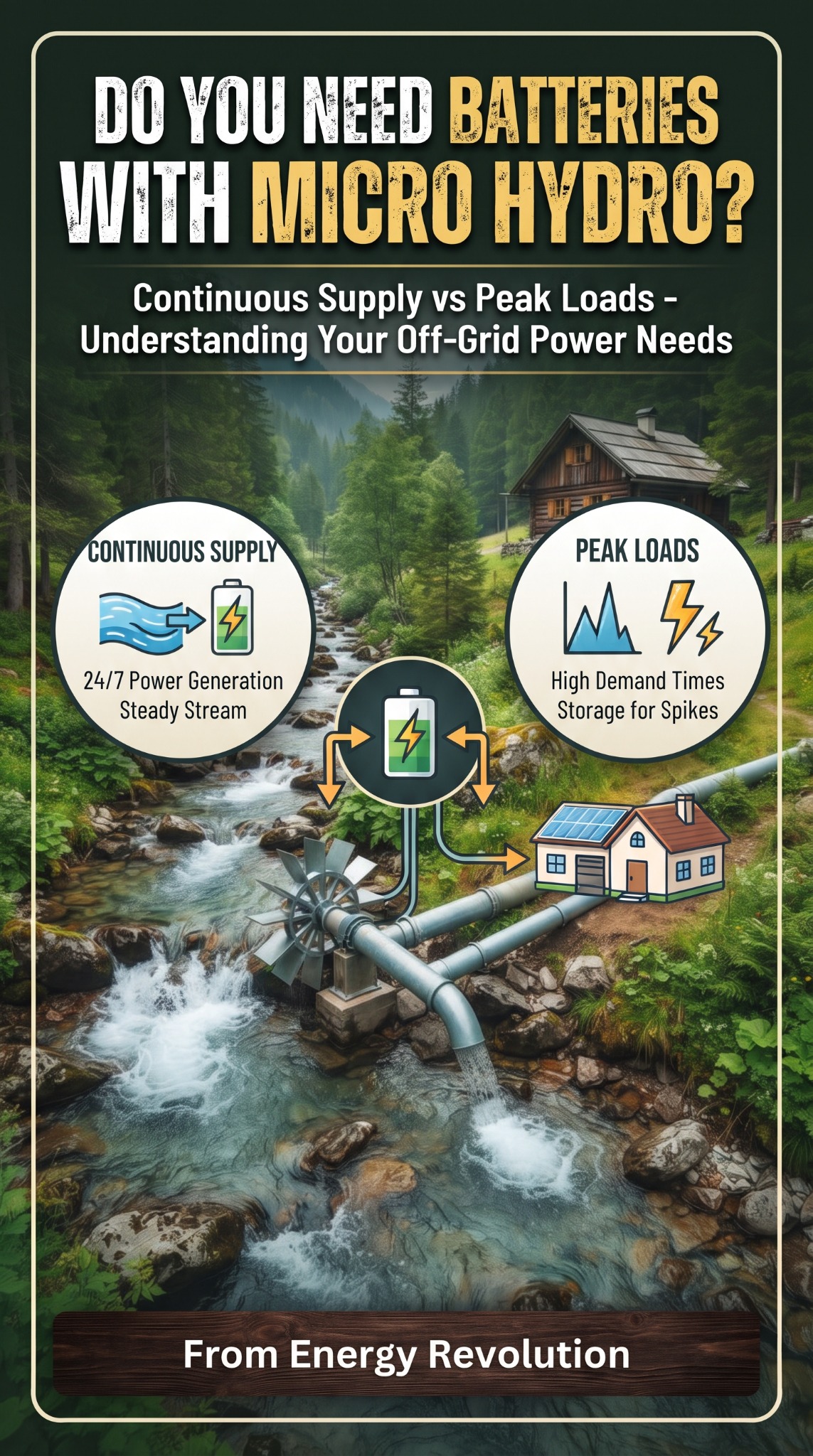
Our Pinterest pin contrasts continuous supply with peak loads. That is exactly the right starting point: water may keep flowing while your electricity demand rises and falls. A fridge starts, a pump switches on, or somebody uses a power tool. The stream does not automatically produce more electricity at that moment.
But “continuous” is an operating assumption, not a guarantee. Flow, permitted water use, debris, maintenance and equipment faults all affect availability. A useful design answers three separate questions: how much energy arrives each day, how much power appliances need at once, and what must keep working during an interruption.
Affiliate disclosure: We may earn a commission from purchases through affiliate links, at no extra cost to you. We also link to our own digital bundle. Calculations below are illustrative and are not a specification for an installation.
Continuous generation is valuable, but it is not unlimited power
Power, measured in watts, describes the rate of energy delivery. Energy, measured in watt-hours, describes the amount delivered over time. A turbine supplying 300W for 24 hours produces 7,200Wh, or 7.2kWh, at the point where that output is measured.
That can be useful daily energy. It does not mean the generator can directly supply a 2,000W appliance. Compare both the daily total and the largest simultaneous demand, including motor starts.
Hydro manufacturer Energy Systems & Design describes battery-based systems that collect steady generation and use an inverter where AC electricity is required. Head and usable flow determine the available resource; the turbine’s advertised maximum is not a prediction for your stream.
For a smaller worked example, read what a continuous 100W stream could actually support. The same distinction between watts and watt-hours applies whatever the size.
Three arrangements to discuss with an installer
| Arrangement | Are batteries essential? | What needs checking? |
|---|---|---|
| Grid-connected hydro | Not necessarily | Approved grid interface, import/export arrangements and outage behaviour |
| Off-grid AC-direct | Not necessarily | Regulated voltage and frequency, available generation, load steps and motor starts |
| Off-grid battery-backed | Yes, for this architecture | Charging controls, usable capacity, discharge power, inverter and recovery time |
The manufacturer's micro-hydro FAQ distinguishes grid-connected, battery-based and AC-direct arrangements. Its product-specific discussion is useful background, but household demand varies too much to adopt a universal minimum wattage.
With a grid connection, the network can cover a shortfall and may accept surplus under the agreed connection arrangements. Do not assume hydro keeps your house powered during a grid outage: ordinary grid-connected equipment generally stops exporting when the network fails. Backup operation requires equipment and isolation arrangements designed for it.
When can an off-grid system work without batteries?
A battery-free supply can be practical when generation comfortably supports the intended loads and the system controls maintain suitable electrical output as demand changes. This needs a generator and control package designed for AC-direct operation; raw output from a battery-charging turbine is not automatically suitable for household sockets.
Ask the designer to assess the largest load step and motor-starting requirement, not just steady running watts. A pump may need substantially more power briefly when starting. Scheduling appliances can reduce overlapping demand, but it does not remove that individual starting requirement.
A battery-free arrangement also needs a plan for changing household demand and surplus generation. If the turbine stops, there is no battery reserve unless a separate backup supply is provided. For a simple nonessential application that may be acceptable; for refrigeration, communications or water supply, it deserves careful thought.
How batteries bridge a short power gap
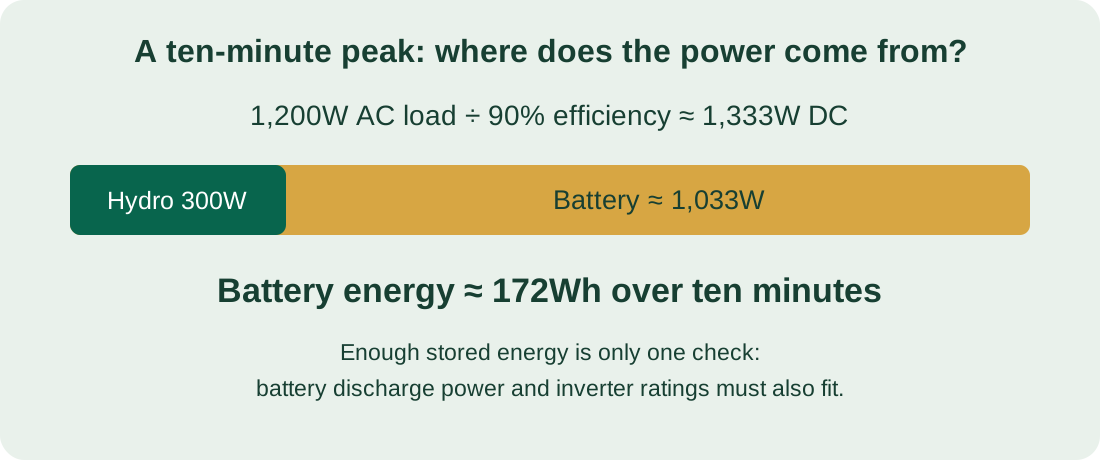
Imagine a system with 300W available at the DC bus after upstream losses. The AC appliances require 1,200W for ten minutes. At an assumed 90% inverter efficiency at that operating point, the inverter needs approximately 1,200 ÷ 0.90 = 1,333W from the DC side.
The turbine contributes 300W, leaving the battery to provide approximately 1,033W. Over one-sixth of an hour, that is roughly 172Wh supplied by the battery, before any additional losses not included in this simplified example.
The calculation reveals why power and capacity are different checks. The event needs a fairly modest amount of stored energy, but the battery still has to deliver more than 1kW during it. Its discharge rating, battery-management system, cables and protective devices must support that demand. The inverter must support the full AC load and any surge.
Check whether the battery can recover afterwards
Once the large load stops, suppose all remaining consumption and system overheads total 100W at the same DC bus. With 300W arriving, about 200W is available before battery charging losses.
If 90% of that surplus is stored, the battery gains approximately 180Wh per hour. Replacing the illustrative 172Wh withdrawal would take about 172 ÷ 180 = 0.96 hours, assuming those conditions continue and charging limits do not intervene.
Repeated peaks can arrive faster than the battery recovers. Plot a representative day: morning pump use, daytime appliances and evening cooking may overlap with other loads. A larger battery can delay a shortage, but if daily demand consistently exceeds generation, stored energy still trends down.
Keep measurement boundaries consistent. Do not subtract cable losses twice or add a full idle allowance when the measured total already includes it. Our inverter standby guide explains how small continuous overheads accumulate.
Size the reserve for a stated interruption
Peak support and outage backup are different jobs. A battery that comfortably handles a ten-minute event may offer little protection through a lengthy intake blockage.
Suppose essential appliances and system overheads together draw an average 100W at the battery side during a complete hydro interruption. Twelve hours require 1,200Wh of usable battery energy. If the selected battery allows 80% of nominal capacity for that planned operating window, the arithmetic suggests 1,500Wh nominal before further design margins.
The 80% assumption is not a recommendation for every battery. Use the permitted discharge window, temperature limits, ageing allowance and reserve agreed for the actual equipment. If your 100W figure is measured at the AC appliances instead, conversion losses must also be included.
Ask how long a repair could realistically take and whether someone can reach the intake safely. Our essential-load reserve guide helps separate equipment that must keep running from tasks that can wait.
A battery does not solve a dry-season energy shortage
If your stream cannot supply usable water for weeks, overnight storage is not a substitute for generation. Even a small 1kWh daily requirement adds up to 30kWh over 30 days, before losses and reserve.
Investigate low-flow periods and downtime before relying on a wet-weather measurement. A complementary source, reduced demand or a suitable backup supply may be more practical than trying to store an entire season’s needs.
Our article Can a Seasonal Stream Power an Off-Grid Cabin? explores that resource question. Also compare the solar, wind and hydro opportunities on your plot rather than assuming any one source will always be available.
What happens when the battery is full?
A full battery cannot accept unlimited incoming energy. The design needs an approved way to regulate generation or handle surplus, including when the household switches off its loads.
Morningstar’s diversion-control guidance explains the importance of correctly matching the controller and diversion load. A diversion load absorbs surplus energy in systems designed to use one. It is not extra storage, and an improvised heater is not a substitute for a properly specified arrangement.
Lithium batteries introduce another important question: what happens if the battery-management system disconnects? Morningstar flags compatibility and disconnection issues in diversion-based charging. Have the turbine, controller and battery suppliers agree the response to full charge, faults and disconnection.
Do not simply attach a hydro generator to a solar controller or portable power station because the connector fits. Hydro output and control requirements can differ. Electrical design, protection, earthing and commissioning belong with appropriately qualified specialists.
Questions worth taking to the installer
- What output is expected during the leanest operating period, and where is it measured?
- Which simultaneous loads and starting surges have been included?
- Would AC-direct operation be practical for these loads?
- What usable storage and discharge power are required, and why?
- How long does recovery take after the busiest period?
- What happens when storage is full, disconnected or too cold to charge?
- Which essential loads remain supported during maintenance?
Request an itemised whole-system proposal, not just turbine and battery prices. Controls, pipework, electrical works, maintenance access and replacement costs can change the comparison.
Our Recommended Products page includes portable storage options for exploring separate backup needs. Treat them as products to investigate, not automatically compatible hydro batteries. Obtain explicit approval for any proposed charging interface.
Frequently asked questions
Does 24-hour hydro mean I can skip batteries?
Only if the chosen architecture can support demand and interruptions acceptably. Continuous generation does not guarantee sufficient instantaneous power.
Can a small turbine run a larger appliance through batteries?
Potentially, for a limited time. Check battery discharge power, usable energy, inverter capability and subsequent recharge together.
Will a larger inverter make more energy available?
No. It may support greater AC demand if the battery and installation can supply it, but it does not increase hydro generation.
Do I need a whole night’s storage if hydro runs overnight?
Not automatically. Base capacity on the energy deficit across time and the interruption reserve you require, rather than importing a solar-only sizing rule.
Can hydro and solar charge the same battery?
Yes, in a system designed with compatible controls, coordinated charging limits and protection. Do not combine sources using improvised connections.
Choose storage for the job it must do
First establish dependable generation, then map your loads and choose a reserve. Batteries are valuable when they bridge a genuine timing or power mismatch. If a regulated battery-free system already meets your needs, storage may be optional rather than essential.
For broader energy research, you can view this separate affiliate energy offer. Check the seller’s information and terms; it is not a hydro design service or evidence of equipment performance.
Explore more practical energy projects
Our DIY Alternative Energy Projects bundle includes the ebook and additional project pack. Explore the listing for ideas to investigate alongside professional advice where needed.
Explore the DIY Alternative Energy Bundle on Payhip