

This site includes affiliate links. As an Amazon Associate I earn from qualifying purchases. Product introductions are separate from the physics explained here.
Quick answer
No: a pond pump and turbine cannot keep themselves running in a closed loop without an outside energy supply. The pump gives the water energy; the turbine recovers only part of it. Motor, pipe, turbine and generator losses leave less electricity coming back than the pump needs. A battery can conceal that shortfall temporarily, but it cannot eliminate it.
The idea is appealing: pump pond water up to a tank, let it fall through a turbine, then use the electricity to run the pump again. Once started, could the same water keep circulating and produce spare electricity for a shed?
Following the energy through one complete circuit answers the question. This is also a useful way to judge demonstrations, understand real micro hydro and decide whether a solar-powered pond pump would meet your actual needs.
Follow the energy, not just the water
Water returns to the pond, but energy does not return unchanged. Electrical energy drives a motor. The pump transfers some of that energy into the water, raising its pressure and lifting it. Water then loses energy through pipe friction and turbulence before turning a turbine. A generator converts some of the turbine's mechanical output back into electricity.
At each stage, some useful energy becomes heat, sound or turbulent motion. Energy is conserved overall, but the energy available to drive the pump again is smaller. Recovering warm pond water or the sound of a waterfall is not a practical way to restore that missing electrical input.
Even an imaginary loss-free circuit would only return what went in. It would provide no spare output for a light, battery charger or other load. Real equipment has losses, so an isolated circuit slows, drains its stored energy and eventually stops.
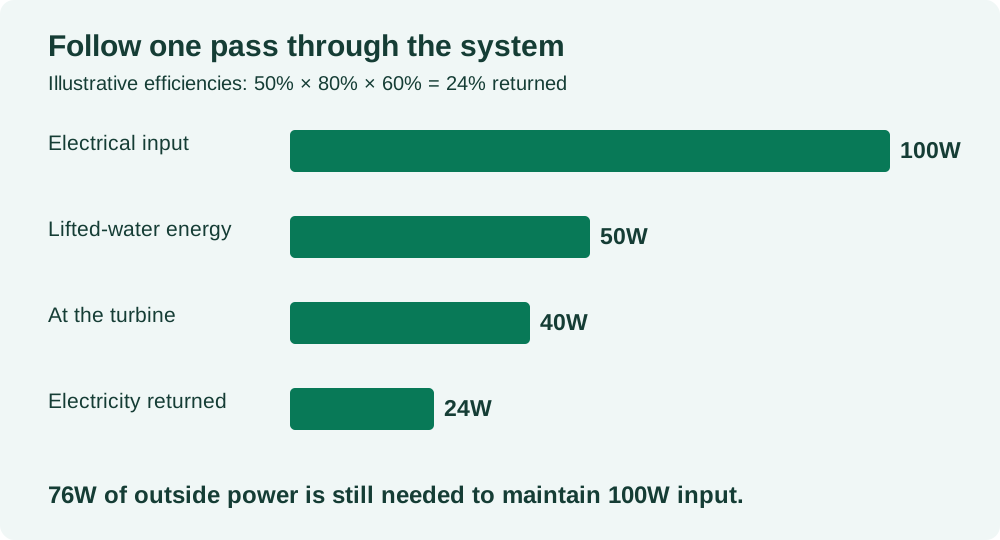
A 100-watt example
Suppose a pump system draws 100W from its electrical supply. For a deliberately simple example, assume its motor and pump together transfer 50% into useful lifted-water energy. Assume 80% of that reaches the turbine after losses along the water route, and the turbine-generator returns 60% of its input as electricity.
| Stage | Calculation | Useful power remaining |
|---|---|---|
| Electrical input | Starting supply | 100W |
| Motor and pump | 100 × 0.50 | 50W |
| Water route | 50 × 0.80 | 40W |
| Turbine and generator | 40 × 0.60 | 24W |
The return is 24W against a 100W requirement. Maintaining those conditions needs at least another 76W from outside, before any extra electrical conversion losses. A suitable controller would be needed even to use the recovered output; simply joining a generator to a pump supply is not a workable control strategy.
Over one hour, the system takes 100Wh and returns 24Wh. Watts describe power at a moment; watt-hours describe energy over time. Comparing a pump's watts with a battery's watt-hours without accounting for time is a common source of misleading claims.
Better components improve the percentage returned, but cannot take it above 100%. The assumed figures here explain the arithmetic; they are not predicted efficiencies for your pond equipment.
Head and flow: what falling water can actually provide
For water falling between two open water levels, the ideal gravitational power is:
Hydraulic power in watts ≈ 9.81 × flow in litres per second × vertical head in metres.
Electrical output is this value multiplied by the relevant conversion efficiency. Use net head at the turbine when pipe losses have already been deducted; do not subtract the same loss twice.
At a flow of one litre per second and a two-metre head, the ideal power is only 19.62W. If a turbine-generator converted 50% of that into electricity, the output would be about 9.81W. A pump lifting that same flow through that same height needs at least 19.62W of hydraulic output, and more electrical input because it is not perfectly efficient.
This comparison assumes steady flow and equivalent start and end conditions. A forceful-looking jet can be visually impressive while containing little total power. A long pipe does not create extra head simply because it is long: vertical level difference matters, and pipe length can increase resistance.
Read a pump curve at the intended operating head. A pump's maximum flow and maximum head usually describe different operating conditions, so multiplying those two advertised limits can produce an impossible estimate.
Why adding a turbine can change the pump's flow
A turbine extracts energy from water. Put one in a pumped pipe and it introduces a pressure drop. The pump and pipe system settle at a new operating point; you cannot assume that the previous flow remains unchanged while the turbine adds “free” electrical output.
On a free-falling return, a turbine may recover some energy that would otherwise dissipate in a splash. That can be an interesting demonstration, but the energy originally came from the pump. Recovery does not make the overall loop self-sufficient.
If the pond depends on circulation, filtration or aeration, the required water service comes first. Restricting flow to chase a tiny electrical return can undermine the purpose of the pump.
Does a raised tank make it work?
A filled tank can drive a turbine after the pump stops because it contains stored gravitational energy. That is a genuine energy reserve, but it decreases as the water runs downhill. To repeat the cycle, someone or something must refill the tank.
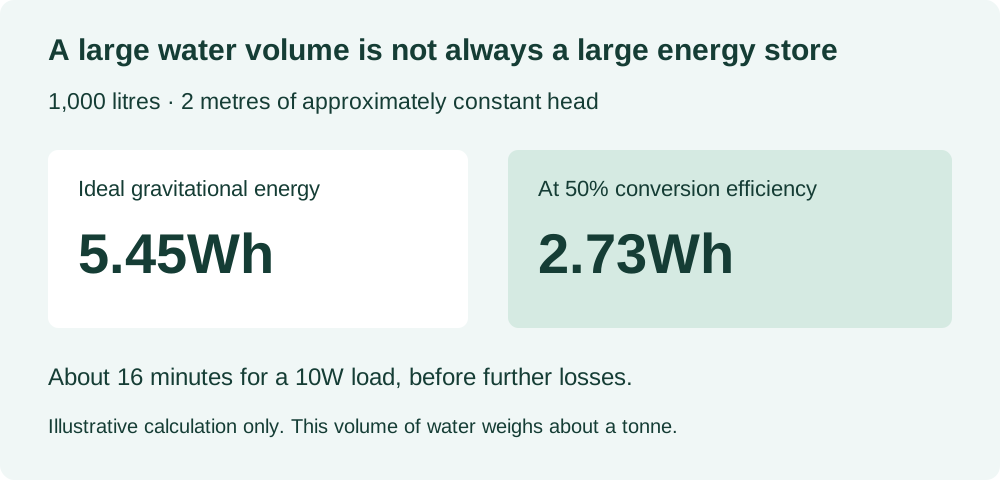
Consider 1,000 litres of water falling through an approximately constant two-metre head. Its ideal stored energy is about 19,620 joules, or 5.45Wh. At an assumed 50% turbine-generator efficiency, the electrical recovery would be around 2.73Wh: roughly 16 minutes for a 10W load, before additional losses.
If the upper water level falls significantly or the lower level rises, use the changing head or a suitable average rather than assuming two metres throughout. The calculation also shows why a large-looking garden tank is not automatically a large electrical store.
That 1,000 litres weighs about a tonne before including its container. The example is an energy calculation, not a recommendation to build an elevated tank. Our gravity-fed water and pressure-pump guide explains why height, volume and usable pressure must be considered separately.
Why commercial pumped storage is still useful
Pumped-storage plants move water uphill using electricity, then generate electricity when it flows back down. The US Department of Energy describes this as energy storage. Its usefulness comes from moving energy to a more useful time, not creating extra energy in the circuit.
For context, the US Energy Information Administration reported an average monthly round-trip efficiency of 79% for US pumped storage in 2019. That is a historical utility-scale figure, not an efficiency to assume for a garden experiment. Even those large installations returned less energy than they consumed.
What could power a pond system?
Solar electricity: panels can supply fresh energy from sunlight to a suitable pump system. If a turbine is also present, the whole arrangement is still solar-powered. For a water feature, using solar electricity directly for the pump usually avoids an unnecessary conversion stage.
Decide whether the pump may stop in poor light or whether continuous operation matters. Our solar water pump and battery backup guide compares storing electricity with storing water. Those options serve different needs; an elevated tank does not automatically replace overnight pond aeration.
A natural stream: water arriving from higher ground brings energy from outside the circuit. It can pass through a turbine without your pump having to lift that same water back upstream. Our guide to seasonal streams and off-grid cabins looks at the practical importance of reliable flow.
A charged battery: this can run a pump for a limited period. It is storage, not generation. Our FOSSiBOT F2400 introduction explains battery capacity and output ratings; it is not a recommendation to leave a power station beside a pond or a guarantee of compatibility with a particular pump.
How to assess a self-powering demonstration
Draw a boundary around the whole arrangement. Include batteries, chargers, solar panels, pressurised supplies, raised tanks and every electrical connection. Ask what crosses that boundary and what stored energy changes during the demonstration.
A generator showing voltage with no load does not demonstrate useful output power. Measurements must be taken under the intended load. For AC equipment, multiplying nominal volts and amps alone may not give real watts; use suitable real-power measurements rather than guessing from labels.
A meaningful comparison covers the same period for input and output and starts and finishes with equivalent stored energy. An upper tank emptying or a battery discharging is an input being consumed, even if no wall socket is visible. A short video of flowing water and a glowing lamp cannot establish a continuous surplus.
Frequently asked questions
Could a more efficient pump solve the problem?
It reduces losses and running costs, but cannot remove the need for outside energy. Every real complete loop returns less useful energy than it receives.
What if I add a second turbine?
Both turbines share the available energy. Dividing the drop or pressure across more machines does not multiply the total energy in the water.
Would a siphon keep the circuit running?
A siphon can transfer water to a lower discharge under suitable conditions. It does not lift the discharged water back to the original level without an energy input.
Can recovered electricity charge a battery?
Yes, with compatible equipment and enough output. However, a pump-driven turbine recovers only part of the pumping energy. Check the complete balance before treating recovery as a saving.
Choose the useful outcome first
If you want a healthy pond or an attractive waterfall, choose efficient pumping and sensible operation. If you want electricity, identify a genuine outside resource such as sunlight or naturally descending water. If you want a learning project, a pump-and-turbine loop can demonstrate losses beautifully—as long as its energy supply is honestly accounted for.
Plan your next energy step
Compare the resources you actually have before buying equipment.
Compare Solar, Wind and Micro Hydro