
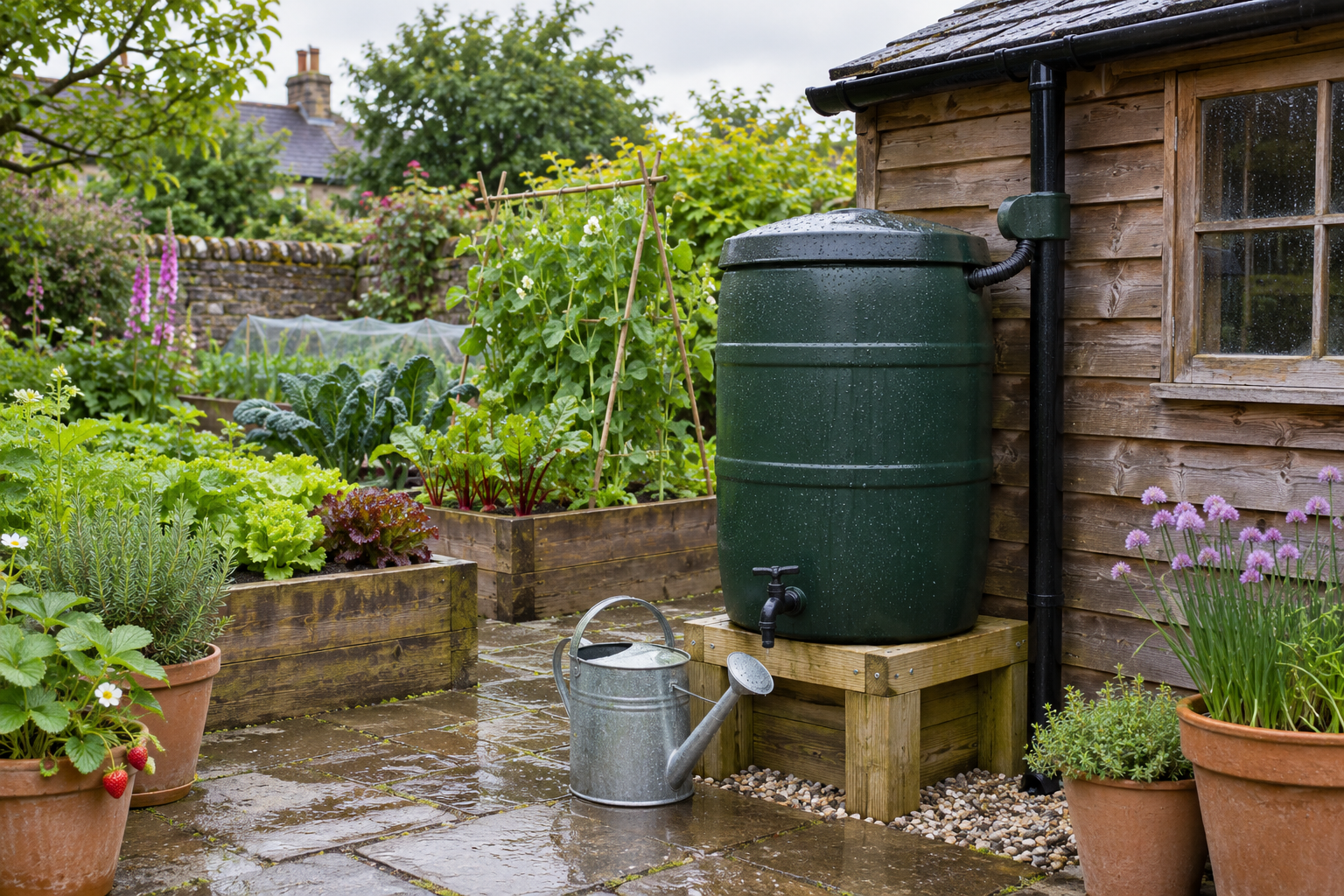
A row of thirsty pots can empty a watering can surprisingly quickly. If you want to use less mains water, two ideas might catch your eye: collecting rain from a roof, or using a machine that extracts moisture from the air. Both provide water from the local environment, but they ask very different things of your garden, budget and electricity supply.
For an ordinary UK garden with a suitable roof and room for storage, rainwater collection is usually the sensible option to investigate first. It can supply useful volumes without using electricity to make the water. An atmospheric water generator, or AWG, needs a much closer check of daily output and energy use before it makes sense for watering plants.
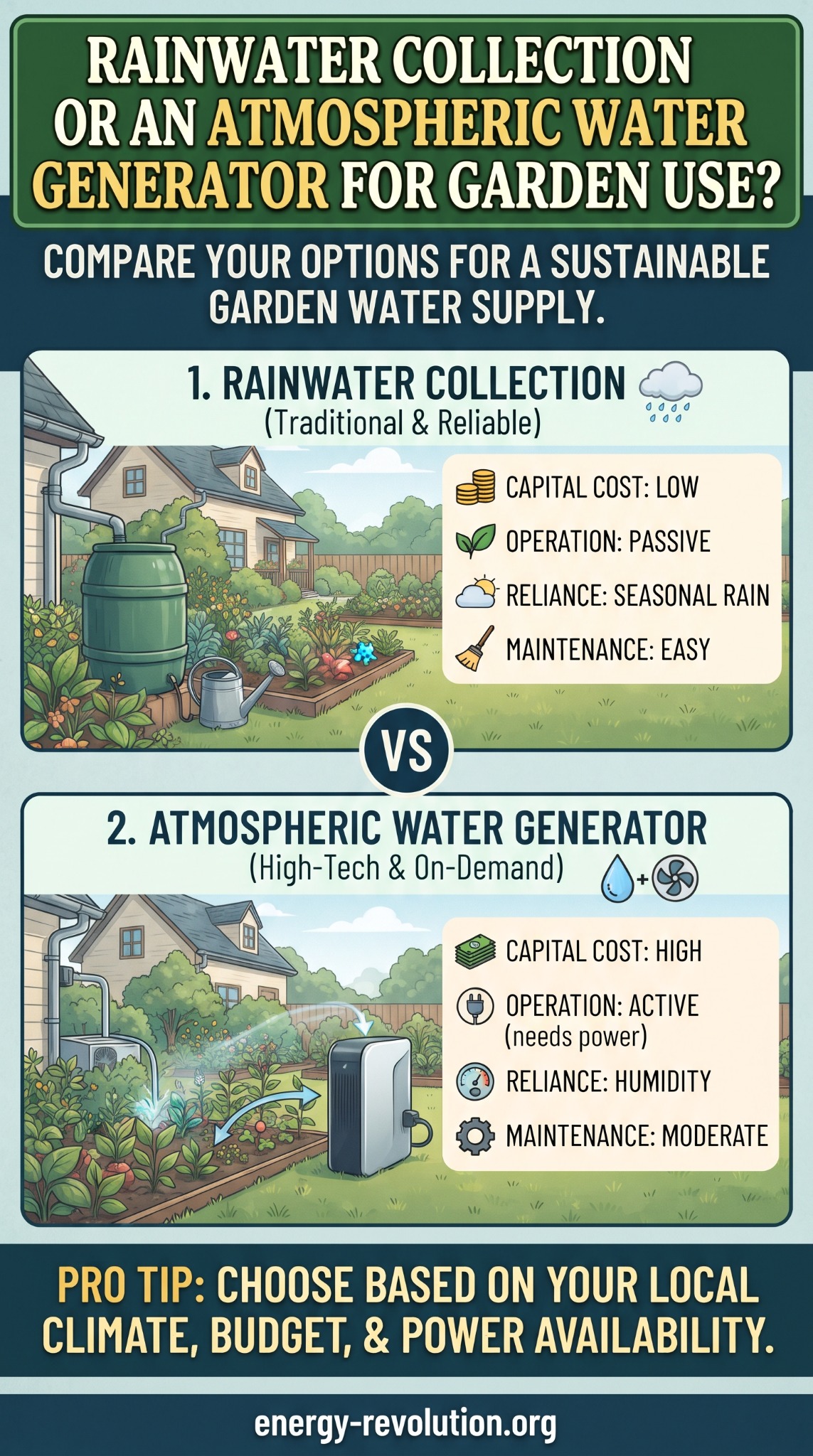
Our Pinterest image highlights cost, climate, maintenance and power. Those are useful headings. Its description of AWG water as “on-demand”, however, needs a qualification: turning a machine on does not guarantee the amount you need, especially in cool or dry conditions.
Start with how many litres your garden actually needs
Before choosing a supply, measure the job. For a few days, count the watering cans you use and note which plants receive them. Separate containers, new planting and productive crops from established areas that may need less intervention. Record the weather too: a cool week will not represent peak demand.
Suppose you use four 10-litre cans on a dry day. That is 40 litres a day. Over a 14-day rainless spell, the same demand would be 560 litres. These are example figures, not a recommended watering rate. Plant size, soil, compost, wind and exposure all change what is needed.
That simple exercise gives you something concrete to compare with a water butt’s usable volume or an AWG’s measured output. A machine supplying five litres a day might help a small group of pots, but it would supply only one-eighth of this example garden’s demand.
How rainwater collection works
A basic setup directs roof runoff through gutters and a diverter into a covered container. You draw water through a tap into a can, or use a suitable distribution system. Once installed, gravity does the collecting; a pump, if needed for delivery, adds a separate electricity requirement.
The RHS recommends rainwater for garden watering and advises covered storage on a firm, level support. Collection still depends on rainfall, roof suitability and available space. A small butt may overflow during a wet week and run empty during a dry one.
Budget for the whole arrangement: container, suitable support, diverter, fittings, overflow route and any pump. A simple butt can be modest in cost, while a large installed tank with groundwork is a different purchase. “Rainwater is free” does not mean every collection system is inexpensive.
How much could your roof collect?
One millimetre of rain falling on one square metre represents one litre of water. For an initial estimate, use the roof’s horizontal catchment area, rainfall depth and an allowance for water that does not reach storage.
Collected litres ≈ catchment area in m² × rainfall in mm × collection factor.
For a hypothetical 12m² shed catchment and 20mm of rain, using an assumed collection factor of 0.8 gives:
12 × 20 × 0.8 = 192 litres.
The factor is an assumption, not a universal efficiency. Losses depend on the roof, gutters, diverter and other conditions. If the tank has only 100 litres of spare space, it cannot retain all 192 litres from that event. The rest needs a safe overflow route.
Annual rainfall totals are useful background, but watering is a timing problem. Winter rain cannot water August pots unless enough of it remains stored. Our guide to sizing rainwater storage around dry spells explores that mismatch.
What an atmospheric water generator does differently
Many household AWGs move air over a cooled surface so water vapour condenses, then collect and treat the water. Other designs use different moisture-capture methods. In every case, ask about the exact model rather than assuming all machines behave alike.
The US EPA and Department of Energy explain that temperature and humidity influence production. A rated litres-per-day figure belongs to stated test conditions. It is not automatically a year-round yield for a British shed or patio.
Relative humidity alone is insufficient. Cool air with a high relative humidity can contain less water vapour than warmer air. A humid winter morning therefore does not establish that a machine will produce its advertised volume efficiently.
Ask for output and electricity measurements at conditions representative of your proposed location, including dry spells when watering demand rises. Our cool UK weather buying guide explains the questions to put to a supplier.
Compare the two options against the same job
| Question | Rainwater collection | Atmospheric water generator |
|---|---|---|
| Where does the water come from? | Rain reaching a suitable catchment | Water vapour in the air |
| What controls supply? | Rainfall, roof area and spare storage | Air conditions, machine capacity, operating hours and electricity |
| Does collection need power? | Usually not for a simple gravity-fed butt; pumping may | A powered machine needs energy to extract water |
| What should you price? | Tank, support, fittings, overflow and delivery equipment | Machine, installation, energy, servicing and storage |
| What happens during a dry spell? | Stored water runs down without replenishment | Output may change with air conditions; a trial is needed |
| What is the useful comparison? | Litres actually available when needed | Litres actually delivered at measured kWh per litre |
Put electricity into the AWG calculation
Here is a deliberately hypothetical example. Assume a machine uses 0.5kWh per litre at your site and electricity costs 30p per kWh. These are arithmetic inputs, not a tariff quotation or a typical performance claim.
0.5kWh/L × £0.30/kWh = £0.15 per litre for electricity alone.
At the example garden demand of 40 litres daily, that would mean 20kWh and £6 a day. Across 14 days it becomes 280kWh and £84. This assumes the machine can actually produce 40 litres daily; the energy calculation does not prove it can.
You would still add purchase cost, consumables, servicing and any water lost during cleaning or treatment. Count useful litres reaching the garden, rather than just the number displayed on a machine. Our water-from-air cost-per-litre guide shows how ownership costs change the answer.
Does spare solar electricity make an AWG worthwhile?
It can reduce the cash paid for electricity, but it does not remove the energy requirement. In the example above, producing 40 litres still takes 20kWh. Your solar system would need to supply that energy after other priorities, allowing for any conversion or storage losses.
Check when the surplus exists and whether the machine can operate during those hours. Shortening operating time can also reduce water production. Off grid, an AWG competes with appliances for generation and battery reserve. A machine running overnight may use energy you intended to save for essentials.
For comparison, a gravity-fed water butt does not need electricity for extraction. If rainwater delivery requires a pump, measure that pump’s consumption too. Compare actual systems rather than assuming one has no costs and the other has unlimited renewable power.
Check maintenance, water quality and where the equipment will live
Rainwater storage needs routine attention. The RHS advises annual cleaning, keeping debris out and avoiding fine mist from stored water. Treat garden rainwater as non-drinking water. For edible crops, use a suitable watering method and wash produce with drinking-quality water.
For an AWG, request the service schedule and consumable costs. Do not bypass specified treatment just because the intended use is irrigation. Ask whether additives or remineralisation are used and whether the resulting water suits your plants. Hydroponics and specialist plants need their own water-quality checks.
The outdoor machine shown in the pin is conceptual. Confirm the manufacturer permits outdoor use and the expected temperatures, rain exposure and ventilation. An indoor appliance is not made weatherproof by placing it beside a bed. Have outdoor electrical arrangements assessed appropriately.
Secure tank lids, provide adequate support for the full weight and keep access safe for children and animals. Never connect stored non-potable water directly to a drinking-water supply without a professionally designed arrangement and appropriate protection.
When could an AWG deserve a closer look?
It may warrant investigation where there is no usable roof catchment, demand is small, local conditions suit a particular model and power is readily available. An existing maintained machine producing genuinely surplus water could also present a different decision from buying one solely for irrigation.
Ask for a representative trial before relying on it. Record temperature, humidity, electricity at the socket, usable litres and cleaning downtime. A warm showroom demonstration is not a garden supply plan.
For many gardens, the stronger first steps are reducing avoidable demand, improving collection and storing more of the rain already arriving. That conclusion can change with your site, but it should change because of evidence rather than the appeal of new technology.
A practical decision checklist
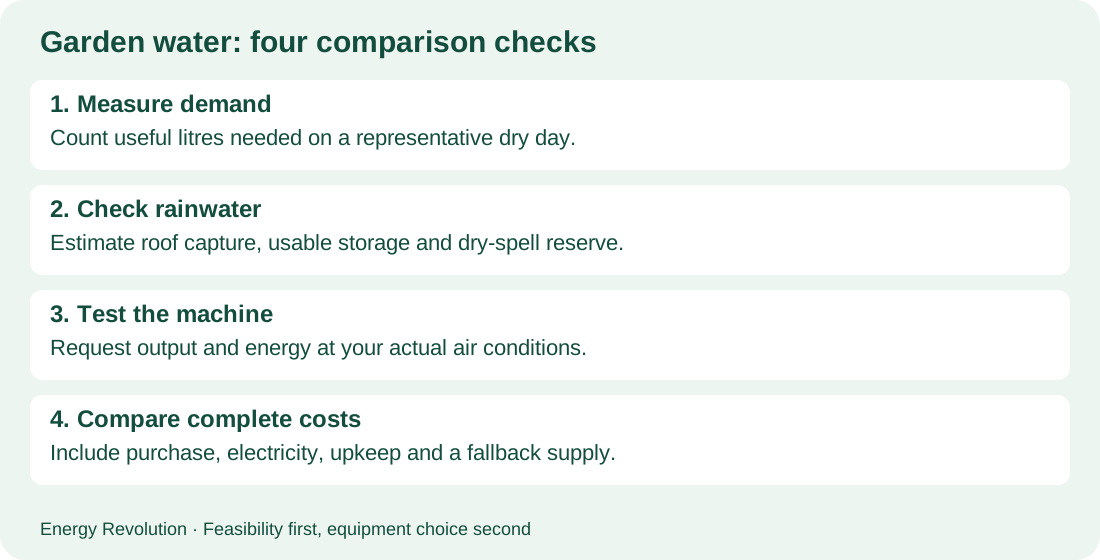
- Measure daily demand during a representative dry period.
- Check the roof catchment, storage space and safe overflow route.
- Work out how long usable stored water would last.
- If considering an AWG, obtain site-relevant yield and energy evidence.
- Compare complete costs, upkeep and a backup plan for shortfalls.
The aim is dependable water for the plants you value, with a budget and workload you can manage. Start with the simplest suitable supply, then add complexity only when it solves a measured problem.
Frequently asked questions
Will one water butt cover a whole summer?
Not necessarily. Divide its usable litres by your dry-day demand, then consider how often rainfall is likely to refill it.
Can an AWG keep producing when it does not rain?
Potentially, because it uses water vapour rather than falling rain. Production still depends on suitable air conditions, power and operating limits.
Is an ordinary dehumidifier the same purchase?
No. Its primary job is removing indoor moisture, and its collected water is not automatically drinking-quality or suitable for every plant use. Check the appliance guidance and contamination risks.
Does collected water replace plant feed?
No. Water supply and plant nutrition are separate questions. Follow the requirements of the plants and growing medium.
Sources and project resources
Sources checked 5 November 2026:
- RHS: collecting, storing and reusing water.
- RHS: watering plants wisely.
- US EPA: atmospheric water generation technology.
- US Department of Energy: alternative water sources.
Browse our Recommended Products for related energy equipment, checking suitability before purchase. Our DIY Alternative Energy Projects bundle offers broader learning ideas; it is a digital resource, with equipment and installation purchased separately.
View the Energy Revolution offer and terms
Affiliate link. Review the seller’s claims and complete project costs independently. No guaranteed output or savings.