
“Water from air” sounds as though the main ingredient is free. The moisture is available in the atmosphere, but collecting it, treating it and keeping the equipment running all have costs. For a household, the useful question is how much each litre you actually use will cost over time.
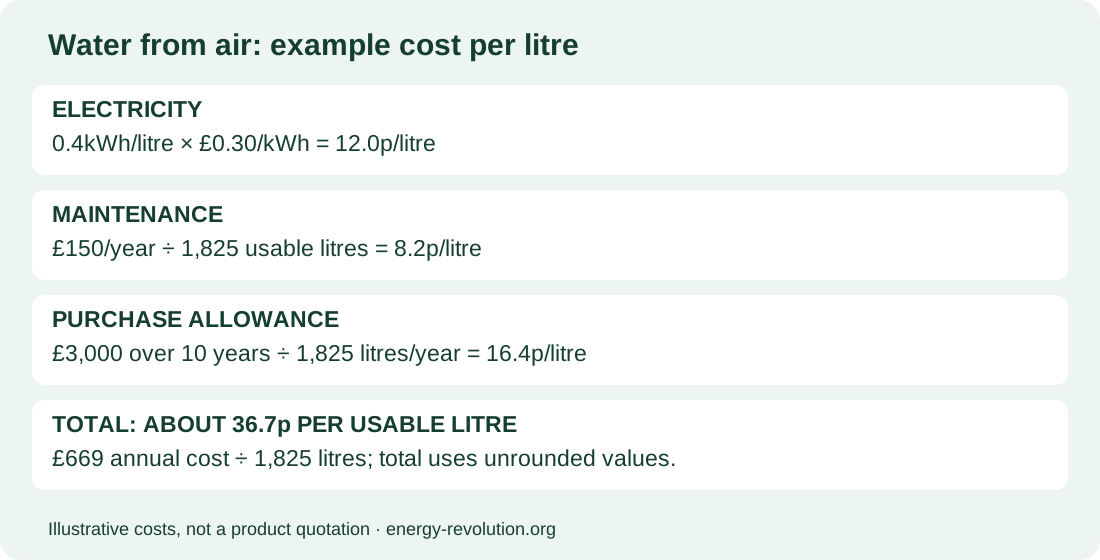
Calculate electricity cost first, then add maintenance and a share of the purchase price. Divide by realistic usable output, not the biggest litres-per-day figure in an advert. In our worked example, electricity costs 12p per litre, while the fuller estimate is about 37p per litre.
Those are example results, not a market-wide price promise. Your tariff, room conditions, machine, servicing requirements and daily consumption can produce a very different answer.
What is an atmospheric water generator?
An atmospheric water generator, or AWG, collects moisture from surrounding air. Many commercial designs cool air so that water condenses, then use a treatment and storage system before dispensing it. This article focuses on electrically powered household condensation units, rather than every emerging water-harvesting technology.
The US Environmental Protection Agency explains that production depends strongly on air temperature and humidity. That matters when translating a manufacturer's favourable test result into a British kitchen, utility room or outbuilding.
A purpose-designed drinking-water AWG is also different from an ordinary dehumidifier. Do not treat the contents of a dehumidifier tank as drinking water; manufacturer Meaco explicitly advises against drinking its collected water.
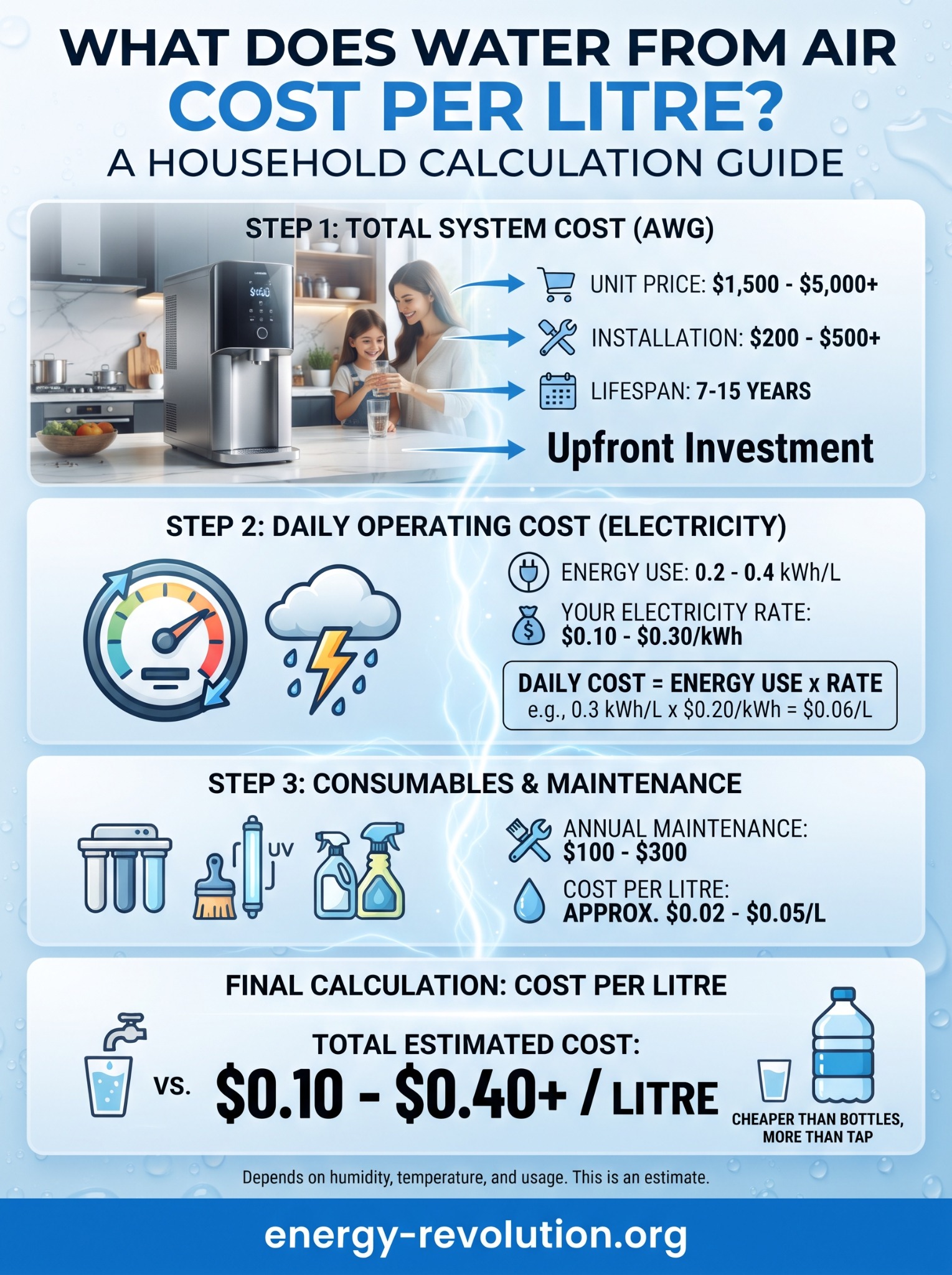
Use the pin as a checklist, not a price guarantee
Your pin groups the costs into equipment, electricity and maintenance. That is a useful structure. Its dollar prices, lifespan range and energy figures should, however, be treated as illustrative claims rather than verified UK quotations or guaranteed performance.
There is also a units correction: kWh/litre × price/kWh = electricity cost/litre. It only becomes a daily cost after multiplying by the litres associated with that day's energy use. The pin's example of 0.3kWh/litre at $0.20/kWh gives $0.06 per litre, not $0.06 for the whole day.
Step 1: estimate the litres you will actually use
Decide what you want the machine to replace. Drinking water for a few people is a different project from supplying showers, washing machines or the whole house.
Write down a realistic daily demand and compare it with expected production in your conditions. If a machine could make 20 litres but your household uses only five, do not spread its purchase cost across 20 litres every day. Unused capacity does not save you money.
For a first estimate:
Annual usable litres = average usable litres per day × operating days per year.
Five litres a day for 365 days gives 1,825 litres per year. If the unit is used seasonally, or is off during holidays or servicing, adjust the days. Account for discarded water and required flushing rather than counting every collected drop as a useful litre.
Step 2: work out electricity cost per litre
Use your own electricity unit rate, including applicable taxes. The following example uses 30p/kWh purely as an assumption; it is not a claim about today's UK average tariff.
Suppose the complete operating energy requirement is 0.4kWh per usable litre:
- Electricity cost: 0.4 × £0.30 = £0.12 per litre.
- At five litres daily: 2kWh/day, costing 60p/day.
- Over a year: 730kWh, costing £219.
There is a real-world reason to pay attention to conditions. Watergen's GENNY Home page lists 400Wh/litre, equivalent to 0.4kWh/litre, at standard conditions of 26.7°C and 60% relative humidity. That is a manufacturer specification at stated conditions, not our measurement, and it should not be assumed to apply in a cooler room. The page was marked “Coming soon” when checked.
Ask whether a quoted efficiency figure includes treatment, standby, chilled storage and hot-water functions. Do not combine a favourable production-only figure with a whole-appliance cost claim. Likewise, multiplying the maximum wattage by 24 hours can overstate consumption if that maximum is only reached briefly.
Step 3: add consumables and servicing
Obtain a written maintenance schedule and prices for the exact model. Possible costs include air and water filters, treatment components, cleaning supplies, servicing and any recommended water-quality checks. Do not assume all machines use the same treatment system.
For our illustration, set aside £150 a year. At 1,825 usable litres, that is £150 ÷ 1,825 = about 8.2p per litre.
Some replacements are required by time as well as usage. A low-use household may therefore pay more per litre for upkeep than a busy household using the same appliance. Ask about spare-part availability, service visits and what the warranty excludes.
Step 4: spread the purchase cost over a realistic life
Add the machine, delivery, installation and any necessary accessories to get your upfront total. Then choose an explicit service-life assumption.
Suppose the installed total is £3,000 and you model 10 years of use. A simple straight-line allowance is £300 per year, or 16.4p per litre at 1,825 litres annually.
This is budgeting arithmetic, not a prediction that the machine will last ten years. A warranty and a service-life estimate are different things. This simplified method excludes finance costs, inflation and resale value; include those separately if they matter to your purchase decision.
Test a shorter life too. At five years, the purchase allowance becomes £600 annually. With the same electricity and upkeep assumptions, total cost rises to about 53.1p per litre.
The complete household example
| Cost item | Annual amount | Cost per usable litre |
|---|---|---|
| Electricity: 730kWh at 30p/kWh | £219 | 12.0p |
| Maintenance assumption | £150 | 8.2p |
| £3,000 purchase spread over 10 years | £300 | 16.4p |
| Total | £669 | 36.7p, rounded |
Full estimated cost/litre = (annual electricity + annual upkeep + annualised purchase cost) ÷ annual usable litres.
Your cash outlay differs from this average: buying outright means paying £3,000 upfront, not £300 each year. On these assumptions, first-year cash spending would be £3,369. Keep both the upfront affordability and the long-run cost visible.
Why output changes the answer so much
Keep the £450 combined annual maintenance and purchase allowance, with electricity at 12p per litre. The following scenarios change only daily usable volume; they do not predict how a particular machine performs.
| Usable litres/day | Annual litres | Total annual cost | Total cost/litre |
|---|---|---|---|
| 2 | 730 | £537.60 | 73.6p |
| 5 | 1,825 | £669.00 | 36.7p |
| 10 | 3,650 | £888.00 | 24.3p |
Low output can bring a second penalty if energy per litre also increases. At five usable litres daily but 0.8kWh/litre, electricity would cost £438 annually and the total would be 48.7p per litre. This is a sensitivity test, not a forecast for winter.
Measure the whole appliance over representative days
If you can trial the machine, log total electricity and usable water over the same period. Use a suitably rated energy meter only where the manufacturer permits one; higher-load or fixed installations may need an electrician's metering arrangement.
Record room temperature, relative humidity, operating hours, hot/chilled settings, cleaning water and any downtime. Keep starting and ending tank levels comparable so that stored water from before the test does not inflate the result.
Measured kWh per usable litre = total metered kWh ÷ usable litres over the test. For example, 21kWh for 35 usable litres gives 0.6kWh/litre. At 30p/kWh, that is 18p per litre for electricity alone.
Include standby time in the meter total rather than adding it twice. Our guide to inverter standby use explains why small continuous loads deserve attention. Repeat measurements in different seasons before assuming that one good week represents a year.
Compare fairly with tap water, bottles and solar
For metered tap water, convert your supplier's relevant volumetric charges from cubic metres: £/m³ ÷ 1,000 = £/litre. An illustrative £3/m³ is £0.003 per litre, or 0.3p. Check water and wastewater charging separately and exclude fixed charges that would remain unchanged. With an unmetered bill, using fewer litres may not reduce the bill.
For bottles, divide the actual price paid by the litres bought, including delivery where relevant. Compare equivalent drinking-water use. The pin's “cheaper than bottles” statement is not universal; bottle prices and AWG utilisation vary.
Solar electricity does not automatically make the water free. Account for the generation and storage arrangement, losses and any export income forgone. At our illustrative five litres and 0.4kWh/litre, the appliance needs 2kWh daily before any extra system losses. Our cloudy-day reserve guide helps with reliability planning.
If the goal is garden watering, compare a suitable non-potable alternative such as rainwater collection. Our dry-spell storage guide addresses that different use; collected rainwater is not automatically drinking water.
Water quality belongs in the budget
EPA research emphasises that atmospheric condensate is not sterile and needs adequate treatment before drinking. That does not establish that every AWG is unsafe, or validate every product's claims. Ask for water-quality evidence for the exact model, required maintenance and suitability for the intended installation. Do not remove treatment costs to make the calculation look attractive.
Frequently asked questions
Does 0.4kWh/litre mean 0.4kW?
No. kWh measures energy; kW measures power. Cost calculations need energy used over time.
Can I use a dehumidifier instead?
Not as a drinking-water substitute. An ordinary dehumidifier does not provide a verified potable-water treatment and storage system.
Will a household unit supply all my water?
Check actual demand against demonstrated seasonal output. Drinking-water production figures should not be read as whole-house supply capacity.
What should I ask before buying?
Request output and energy data at your conditions, installed price, maintenance costs, warranty terms and water-quality evidence. Then calculate cost per litre you expect to use.
Sources and project resources
Checked on 30 October 2026:
- US EPA: atmospheric water generation technology.
- US EPA: evaluation of AWG microbial water quality.
- Watergen: GENNY Home specifications and test conditions.
- Meaco: dehumidifier water is not drinking water.
Explore our Recommended Products for wider energy projects and our DIY Alternative Energy Projects bundle for project inspiration. Neither is a certification of an AWG or a promise of cheaper water.
Explore the Energy Revolution offer
Affiliate offer: review the seller's claims and terms independently. We do not guarantee results.