
Quick answer
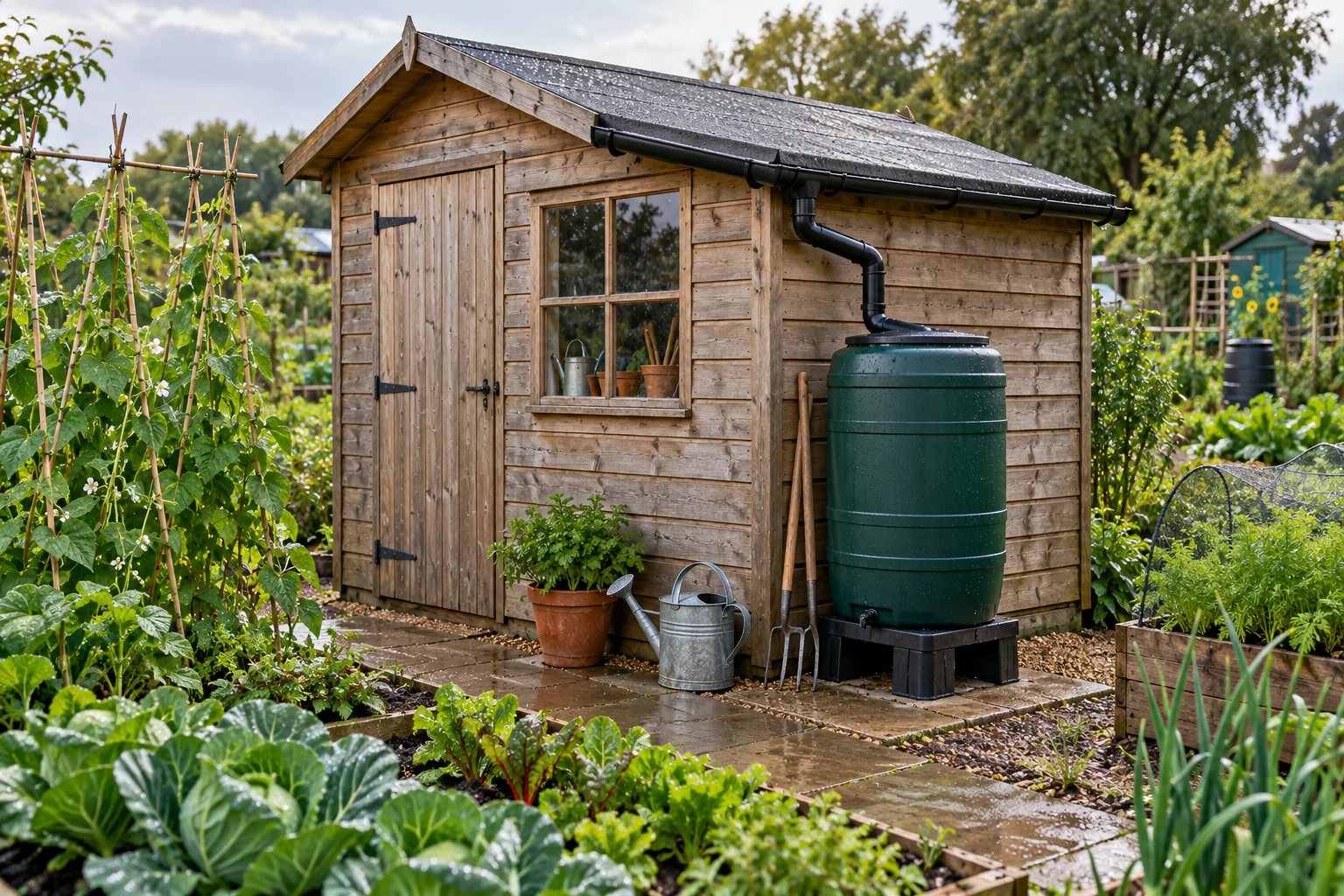
Each millimetre of rain falling on one square metre of roof represents one litre of water before losses. A shed with a connected roof footprint of 6m² receives 60 litres in a 10mm shower. Using an illustrative 80% collection allowance, around 48 litres could reach storage—provided the tank has room. The amount you can use depends on rainfall timing, connected roof area, losses and storage capacity.
A shed roof can make a useful contribution to allotment watering, especially when the nearest tap is a long walk away. But “thousands of litres a year” does not necessarily mean enough water during a hot fortnight.
The most useful estimate answers three questions: how much rain can the roof collect, how much can the tank retain, and how quickly will your crops use it? Here is a practical way to work through them.
Affiliate disclosure: This page includes affiliate links. We may earn a commission if you buy through them, at no extra cost to you. The separate energy offer linked below is not a water-butt or allotment irrigation recommendation.
1. Measure the roof area that actually drains into storage
For a simple rainfall calculation, use the roof's horizontal footprint: its length multiplied by its width as seen from above. Do not multiply rainfall by the larger sloping surface area of a pitched roof.
For example, a roof measuring 3m by 2m horizontally has a collection footprint of 6m². Include the relevant roof overhangs if measuring accurately; the shed's advertised floor dimensions may differ from its roof dimensions.
Now check the gutters. If a symmetrical pitched roof drains to two opposite sides but only one side feeds your water butt, the connected area is approximately half: 3m² in this example. Collecting from both sides could double that connected catchment, if the layout and allotment rules allow it.
A single-slope roof normally drains towards one lower edge. Irregular roofs need dividing into the portions that actually feed each gutter. Count each portion once, and measure from a safe position without climbing onto a shed roof.
2. Calculate the rain falling on that area
The basic relationship is:
Gross rainwater in litres = connected roof footprint in m² × rainfall in mm.
The units work because a layer of water 1mm deep over 1m² has a volume of one litre. You can use the same calculation for a shower, a month or a year, as long as you use rainfall for that period.
| Connected roof footprint | 5mm rain | 10mm rain | 25mm rain |
|---|---|---|---|
| 3m² | 15 litres | 30 litres | 75 litres |
| 6m² | 30 litres | 60 litres | 150 litres |
| 10m² | 50 litres | 100 litres | 250 litres |
These are gross volumes, before collection losses or overflow. They are not guaranteed tank refills. A forecast saying there is a high chance of rain does not tell you how many millimetres your plot will receive.
3. Allow for collection losses
Some rain wets the roof and evaporates; some misses the gutter or escapes through joints. Filters and any deliberate first-flush diversion can reduce the water reaching the tank. A leaf screen catches debris, but it does not make stored rainwater drinking water.
The Environment Agency's rainwater-harvesting information guide separates roof runoff and filter efficiency in yield estimates. It is a useful explanation of the calculation principles, rather than a current installation standard.
For the examples here, we use 80% overall collection efficiency as an assumption. This is not a universal rating for shed roofs. Rough or absorbent coverings, poor gutters and small showers may perform differently.
Our 6m² connected roof receiving 10mm of rain therefore gives:
6 × 10 × 0.8 = 48 litres arriving at storage.
At an assumed 60% efficiency, the same event gives 36 litres; at 90%, it gives 54 litres. Testing a range shows how much your estimate depends on the collection system.
4. Use local rainfall, especially in the growing season
The Met Office's location-specific climate averages provide monthly and annual rainfall figures. Choose a representative nearby location and check the averaging period. These describe historical conditions, not a promise for next summer.
If our example roof received 700mm in a year, the calculation would be 6 × 700 × 0.8 = 3,360 litres potentially reaching storage before overflow. Here, 700mm is an illustrative input, not a UK-wide rainfall figure.
That sounds generous, but dividing it by 365 would hide the very problem you need to plan for: water arriving when demand is low and failing to arrive during dry weather.
A hypothetical growing-season month with 40mm rain gives 192 litres from the same roof. A 10mm month gives just 48 litres. Neither monthly total tells you whether the rain fell steadily or in one storm followed by weeks without rain.
5. Separate collection potential from tank capacity
A 200-litre butt cannot keep 200 new litres if it already contains 170 litres. Only 30 litres of spare capacity remain. If 48 litres arrive during a shower and you draw none out, 30 litres stay and 18 litres overflow.
Equally, a larger tank does not increase the amount of rain falling on the roof. It helps when the smaller tank repeatedly fills and spills water you could use later.
With our 6m² roof and assumed 80% efficiency, filling an empty 200-litre store takes approximately 200 ÷ (6 × 0.8) = 41.7mm of rain. If only half the roof is connected, the requirement rises to about 83.3mm. Both estimates assume no water is taken out during filling.
For storage choices, see two linked water butts or one larger tank. Connection height and tap position affect how much of the stored water you can actually withdraw.
6. Translate stored litres into allotment watering
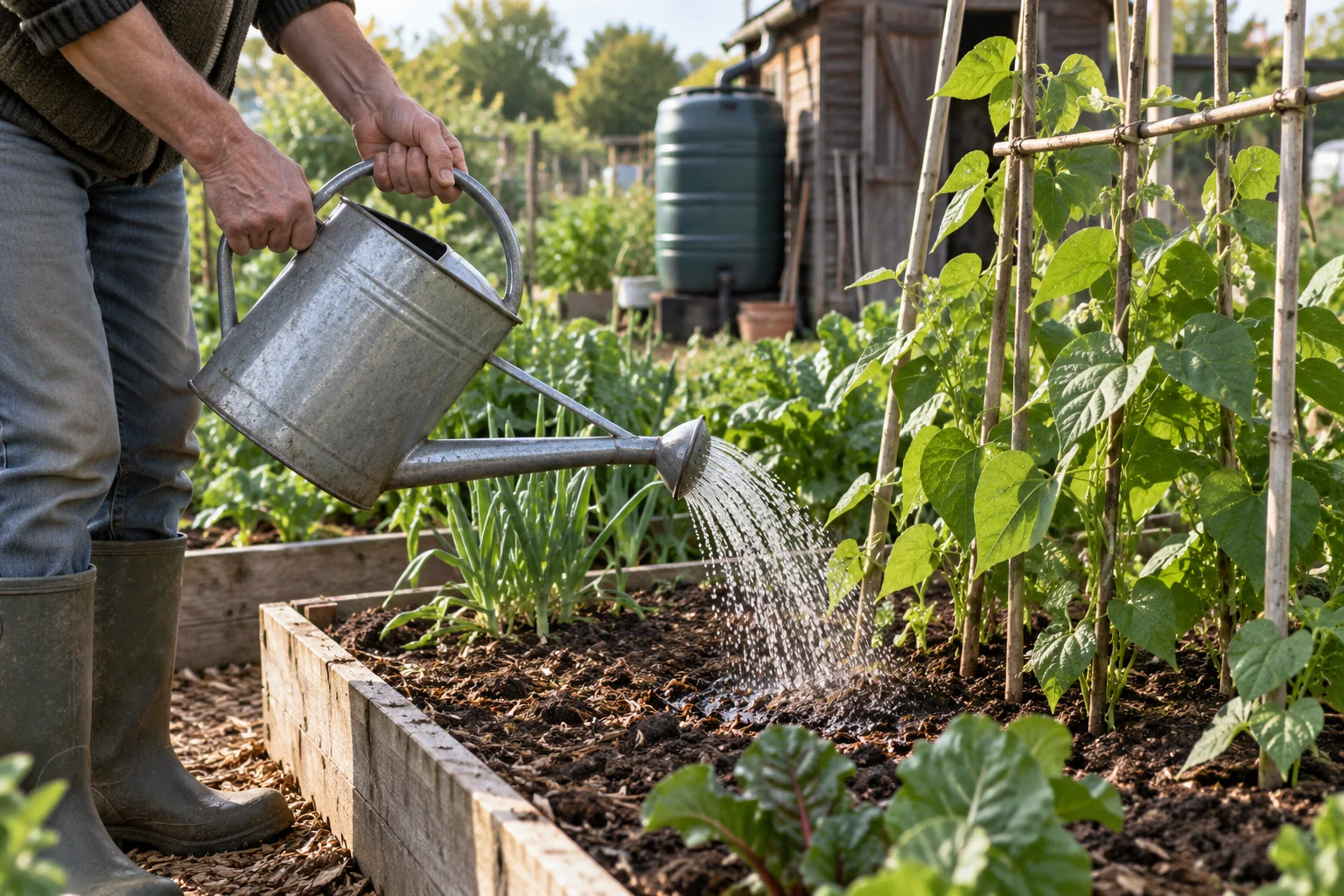
Count watering-can fills during a representative dry visit. Use the volume you actually put in the can, not automatically its maximum capacity. Two full 10-litre cans equal 20 litres; four equal 40 litres.
If you have 180 usable litres after allowing for inaccessible water below the outlet, that covers nine 20-litre visits or four complete 40-litre visits with 20 litres left. It covers nine days only if you visit and use that amount every day.
Another useful scale check: applying the equivalent of 10mm of water across a 10m² bed requires 100 litres before watering losses. Across 100m², it requires 1,000 litres. This is a volume illustration, not a watering prescription.
A small shed roof can therefore be valuable for selected beds or established crops without supplying the entire allotment. Rain falling directly on the soil also contributes; your stored supply is supplementary.
The RHS vegetable-watering guide stresses that demand varies with crop, growth stage and soil. Check moisture below the surface and prioritise watering when shortages would affect the crop you harvest. Avoid treating a fixed number of litres as suitable for every plant in every week.
7. Size storage around the dry spell you want to cover
Start with a modest target. If priority watering uses 20 litres a day and you want a seven-day reserve, you need 140 usable litres. Fourteen days require 280 usable litres, assuming no replenishment.
Then ask whether your roof and rainfall can refill that reserve in practice. Buying a large tank that rarely fills may bring less benefit than repairing a leaking gutter or connecting the unused roof slope.
Our guide to sizing rainwater storage around dry spells explores this balance. Keep a fallback plan for unusually dry weather rather than assuming a yearly collection total guarantees summer independence.
Interested in wider home energy ideas? You can view this separate affiliate energy offer. Read the seller's description and terms; it is unrelated to the rainwater collection calculations above.
Make the collection setup practical to use
Check the allotment tenancy rules before changing sheds, gutters or storage. Plan where excess water will go so it does not soak the shed base, flood a path or run onto another plot.
A full 200-litre butt contains about 200kg of water before adding the vessel and stand. Use a stable, level base and supports specified for the container, with room to fill and carry a watering can. Keep lids secure and access routes clear.
The RHS rainwater-storage guidance recommends clear gutters, debris filtration, close-fitting lids and annual cleaning. It advises using stored rainwater on established plants and avoiding it for seedlings because plant pathogens may be present. Keep a suitable clean-water supply for propagation.
Check that the roof covering and any treatment are suitable for the intended collection use. If the surface is deteriorating or its composition is unknown, establish that before using the runoff. Do not use collected water for drinking or washing harvested produce.
For automatic watering, check filtration and operating pressure rather than assuming a butt tap will run any kit. Our solar drip irrigation guide covers lift, pressure and flow.
A simple record for your first season
Note rainfall, tank level before and after rain, watering-can fills and any overflow. A straight-sided rain gauge in a suitable open position helps track rainfall at the plot. Avoid interpreting tank level changes as collection efficiency when water has been drawn off or overflowed.
After several events, you can identify the limiting factor: too little connected roof, poor collection, insufficient storage or higher demand than expected. Improve that part first.
Frequently asked questions
How much does a 6m² shed roof collect in 10mm of rain?
60 litres before losses, or 48 litres using our illustrative 80% collection assumption. Storage must have room to retain it.
Should I use the sloping roof measurements?
Use the horizontal footprint of the connected roof section for this rainfall calculation. Count only the area draining into your collection system.
Will a second water butt double collection?
It increases storage capacity, not roof catchment. It helps retain water that would otherwise overflow when the first butt is full.
Can shed rainwater supply my whole allotment?
Possibly for a small, low-demand growing area, but do not assume it. Compare measured use with growing-season collection and the longest dry period you want to cover.
Start with the roof, then match the reserve
Measure the connected footprint, apply local rainfall and an explicit loss allowance, then check storage space and actual watering use. Even a modest supply can save repeated trips to the tap when you reserve it for the jobs where it is most useful.
Explore a separate energy offer
If you are also researching home energy products, the link below provides the seller's full details. Check the price, claims and terms before deciding; this is not a recommendation for rainwater equipment.
View the Energy Product and Full Details