
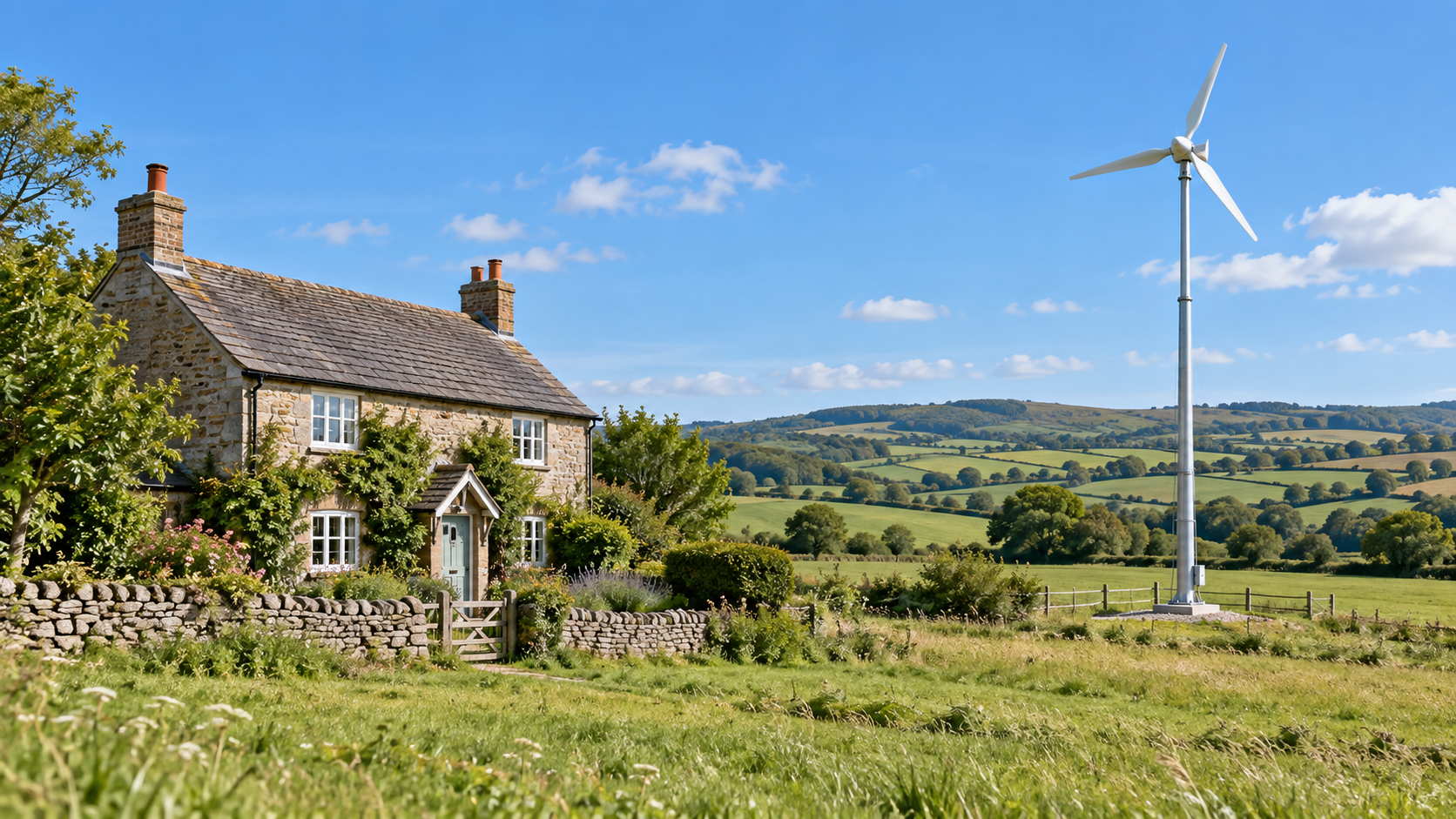
Which mounting option is usually better?
A properly sited freestanding pole or tower generally offers the better opportunity to reach useful, less turbulent wind while keeping vibration away from the house. A roof mount saves ground space but introduces substantial performance and structural questions. For a sheltered small property, neither option may be worthwhile.
A compact turbine turning above a roof looks like an appealing way to generate electricity. It occupies little garden space and seems to make use of wind that would otherwise pass by. But spinning blades are not proof of useful energy production.
Choosing between roof-mounted and pole-mounted wind starts with the air reaching the rotor, then moves to the building, available land, permissions and lifetime costs. Here is a practical way to compare the options before paying for equipment.
Start with the property, not the turbine catalogue
“Small property” can mean a small house in an exposed rural plot or a larger house squeezed between neighbouring buildings. Their wind opportunities are very different.
The Energy Saving Trust identifies open, exposed locations as the setting where freestanding turbines work best. A breezy patio is not enough evidence: you need to understand wind conditions at the proposed rotor height.
Walk around the plot and note nearby roofs, mature trees, slopes and the directions from which wind commonly arrives. Also consider how vegetation or neighbouring development could change the site. A short list of constraints now can prevent an expensive specification exercise for an unsuitable position.
Our home-energy planning guide can help you establish what you want generation to achieve: lower annual imports, support an off-grid load, or complement an existing system.
Why roof mounting often disappoints
Buildings disturb airflow. Around roof edges and neighbouring structures, wind can change speed and direction rapidly. A turbine sitting in that disturbed air may encounter poorer conditions than a regional wind map suggests.
The US Department of Energy’s small-wind guidance highlights rooftop turbulence, reduced production and vibration transmitted into buildings. It also explains why the extra work needed to address these issues can make rooftop systems less cost-effective than ground-supported towers.
Roof mounting therefore needs more than a bracket that fits. Ask for a structural assessment covering the proposed turbine and mounting arrangement, including repeated loads and extreme weather. Roof penetrations, waterproofing, access and the building’s existing condition all belong in the design discussion.
A seller’s claim that a turbine is “quiet” does not establish how it will sound inside a bedroom attached to the supporting structure. Nor does a lightweight rotor prove the roof is suitable.
What a pole or tower changes
A freestanding installation lets you choose a location independently of the house. With an appropriate tower and enough open space, that can improve access to the wind and avoid directly feeding turbine vibration into the building.
The trade-off is a larger installation project. The tower, foundation or anchors, cable route, access and maintenance arrangements all need planning. A guyed tower needs space for its support cables; a freestanding tower still needs a properly designed foundation.
Some systems can be lowered for servicing, but that requires clear space and a manufacturer-approved procedure. Ask the installer to show how maintenance will happen on your actual plot, rather than assuming someone can simply climb up whenever necessary.
A pole placed beside a tall hedge may achieve little. The benefit comes from suitable siting and height, not the word “pole” in the product description. The Centre for Alternative Technology’s wind advice stresses the importance of location and the poor performance found in building-mounted field trials.
Roof versus pole: the practical comparison
| Issue | Roof-mounted | Pole or tower-mounted |
|---|---|---|
| Wind exposure | Often affected by the building and nearby obstacles. | More freedom to seek an open position and suitable height. |
| Ground space | Less garden space occupied by the support. | Needs foundation, access and sometimes guy-wire space. |
| Structure | Existing building and attachment points need assessment. | Tower and foundations need an engineered design. |
| Vibration | Can be transmitted into living spaces. | Support is separate from the house; sound still needs assessment. |
| Servicing | Roof access may add difficulty and cost. | Access depends on tower design and available clearance. |
| Best next step | Demand site-specific evidence before committing. | Assess exposure, space and permissions before sizing. |
Measure wind where the rotor would operate
Online maps are useful for screening an area, but they cannot resolve every tree, roof and sheltered corner. DOE’s wind-data guidance cautions against treating broad maps as detailed site assessments.
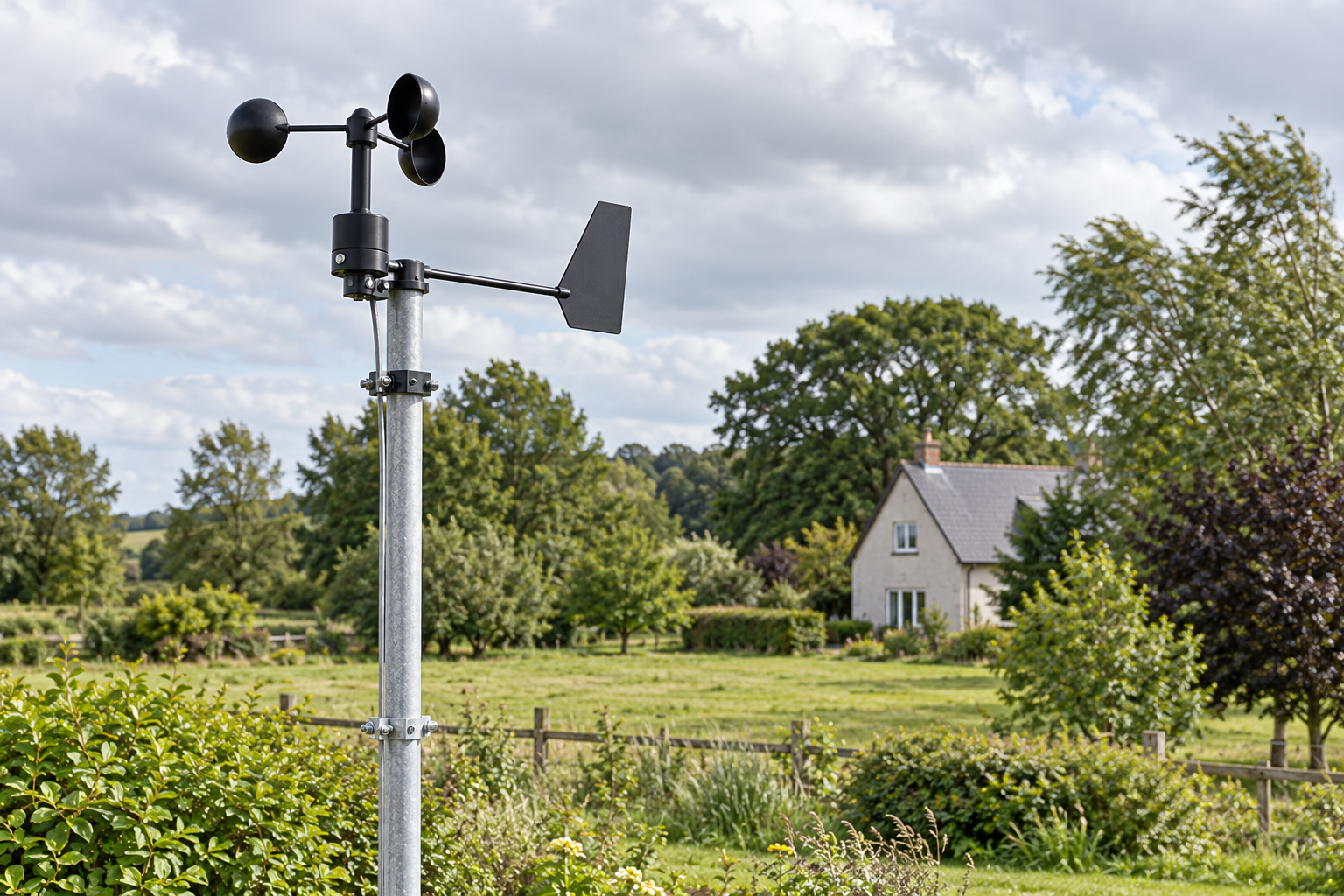
A competent assessor should explain the data used, its measurement height, local obstacles and the uncertainty in the estimate. If monitoring is appropriate, the sensor location must represent the proposed turbine position. A cheap meter at fence height cannot simply be read as the wind resource above the roof.
The Small Wind Guidebook recommends that on-site measurement systems are best run for at least a year. That captures seasonal differences a windy weekend cannot. For a very small project, a staged feasibility assessment can establish whether spending on monitoring is justified.
Compare annual energy, not just rated power
A “1kW turbine” does not produce 1kW continuously. Its output depends on wind speed and the machine’s performance curve. The wind speed at which its rating is quoted matters, as does the amount of time your site experiences those conditions.
Request a predicted annual energy yield in kWh for the exact model, site and mounting height. Ask which losses, downtime and local effects are included. Compare a cautious estimate with an optimistic one.
For illustration only, a 1kW turbine operating at an assumed 10% capacity factor would generate 1 × 8,760 × 0.10 = 876kWh a year. At an assumed 20%, it would generate 1,752kWh. Neither percentage is a forecast for a roof or pole installation; the calculation shows how much the assumptions matter.
Independent certification can make product comparisons more meaningful. The ICC Small Wind Certification Council publishes performance and sound ratings. Check the current certificate, reference conditions and exact model. A certification figure is a benchmark, not guaranteed production on your property.
Exploring broader energy ideas? View the separate Energy Revolution offer and seller’s details. This promotional link does not establish that any wind turbine will work at your site.
Check permissions before selecting a final position
For England, some domestic wind installations can fall within permitted development, but only if all relevant conditions are met. The rules distinguish building-mounted turbines from standalone turbines.
Height, blade clearance, boundary distances, rotor area, designated land and other equipment at the property can affect the position. A small garden can make the required clearances particularly restrictive. Ask the local planning authority to assess the proposed installation rather than relying on a seller’s general “no permission needed” statement.
These links concern England. Scotland, Wales, Northern Ireland and other countries have their own requirements. Confirm applicable building, structural and electrical requirements as well as planning. Planning permission alone is not a complete engineering approval.
Also be careful with reform headlines: the UK government’s March 2026 wind consultation proposed a new route for certain non-domestic installations, while proposing not to change existing domestic rights. A consultation is not itself permission to install.
Include the electrical system and servicing
Ask for a complete system design covering the turbine, control equipment, protective functions, electrical connection and any storage. Grid-connected generation and an off-grid battery installation are different projects.
Confirm how the selected system behaves during strong winds, a power cut and a full battery. Do not assume a generic solar controller or inverter is suitable for a wind turbine. Follow the turbine manufacturer’s specified equipment and operating procedures.
For background on matching output to appliances, see our shed inverter guide. It explains power and energy limits, but is not a wind-system wiring guide.
Get written servicing intervals, inspection requirements, warranty conditions and likely access costs. Ask whether spare parts and local technical support are available. Manufacturer service and spares information illustrates why ongoing support should be part of the buying decision.
Compare the full cost with alternatives
Request an itemised installed quotation covering the survey, tower or roof work, foundations, cabling, controls, commissioning and any permissions work. Add maintenance and likely replacement costs when assessing the investment.
Separate electricity you use at home from electricity exported. Their financial values may differ. Use your own applicable import and export rates, with a conservative estimate of when generation matches demand.
Compare this with insulation, reducing avoidable consumption and a properly assessed solar installation. Our solar-power introduction provides a starting point. Wind can be useful at a suitable exposed property, but it should earn its place through evidence.
Questions to put to an installer
- What wind data supports this exact location and hub height?
- What annual output do you predict, and what uncertainty remains?
- How are turbulence, sound and structural loads assessed?
- Which permissions and electrical connection steps are included?
- How will the turbine be inspected, stopped and serviced safely?
- What is excluded from the quotation and warranty?
Frequently asked questions
Is a pole-mounted turbine always worthwhile?
No. A sheltered location, insufficient clearance or high installation costs can rule it out. A separate tower improves positioning options; it does not create a wind resource.
Does a vertical-axis turbine solve rooftop turbulence?
Do not assume so. Ask for independently supported performance, structural and sound evidence for the exact design and site. A different rotor shape does not remove the need for assessment.
Can a turbine keep my house running during a power cut?
Only if the complete system is designed for that purpose. Owning a turbine does not establish backup capability. Ask the designer which loads remain powered, under what conditions and for how long.
Choose the site before the mounting system
For an exposed plot with adequate space, investigate a freestanding turbine first. For a sheltered house with a compact garden, compare other energy improvements before committing to either mounting option. The best decision is the one supported by credible wind data, a complete quotation and a workable maintenance plan.
Explore the wider energy offer
If you want to investigate additional energy ideas, read the seller’s product information, price and purchase terms. This is a separate affiliate offer, not a verified turbine package or a promise of savings.
View the Energy Offer and Purchase DetailsBefore installation: read our guide to planning permission for home solar and wind in England, including the updated 2026 solar rules and separate safety checks.
Neighbours nearby? Use our small wind turbine noise questions before committing to a mounting position.