A small wind turbine can look affordable when you see only the generator and blades in an online listing. The difficult question comes later: what will it cost to turn that equipment into a safe, useful source of electricity on your property?
The turbine price is only one part of the project. A complete budget may also need a suitable tower, foundations, site assessment, planning work, electrical controls, installation, testing and ongoing maintenance. Batteries are another possible cost, but they are not compulsory for every system.
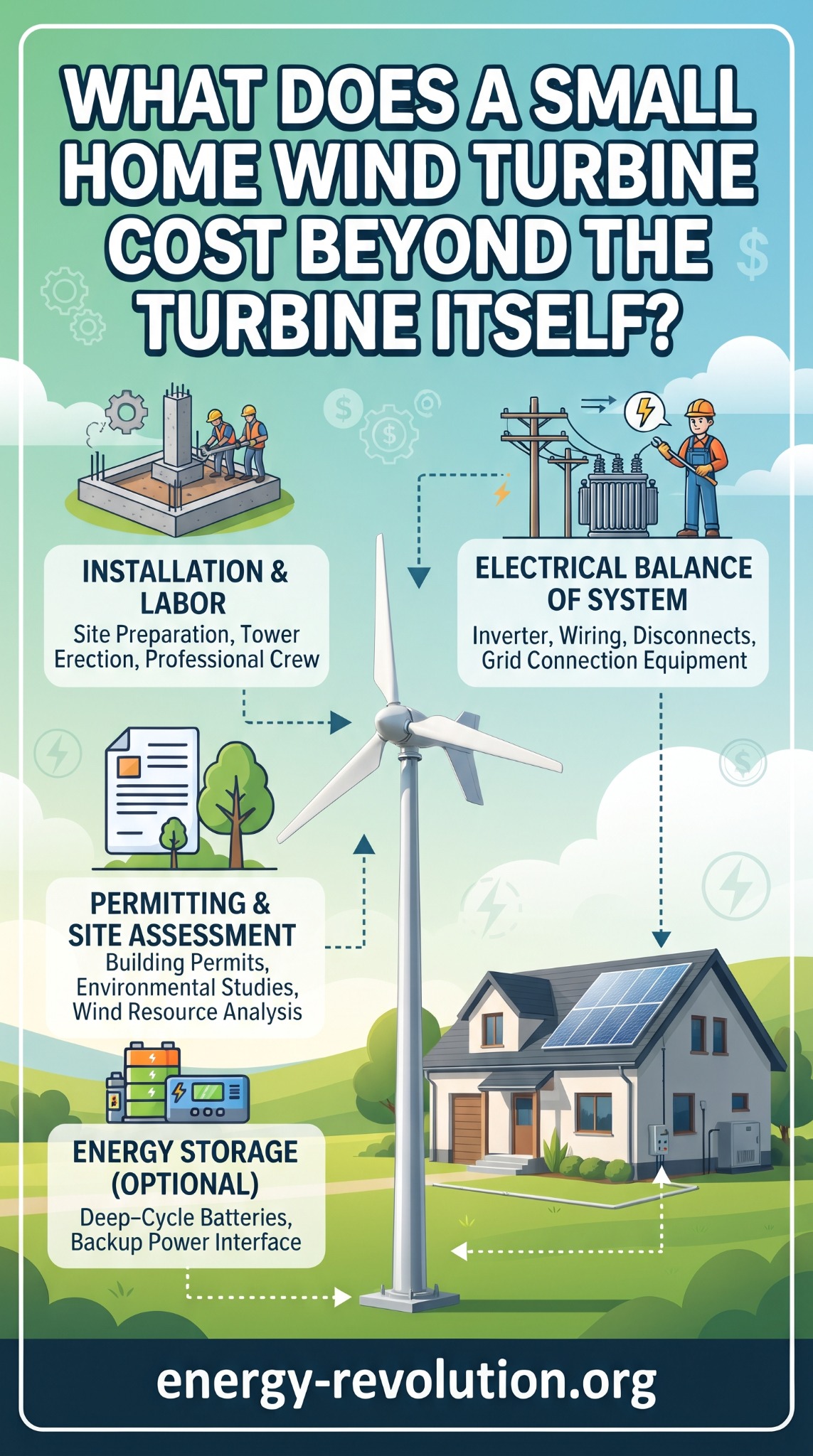
Our Pinterest pin groups these extras into installation, electrical equipment, permissions and optional storage. Those are useful headings. However, the transformer shown is illustrative: a separate transformer is not an automatic requirement for every small home installation. The actual equipment depends on the design.
Start by defining what “small” means
A little battery-charging turbine for occasional use and a professionally installed pole-mounted household system are different projects. Their supports, controls, permissions and expected output cannot be compared just by looking at advertised watts.
For context, the Energy Saving Trust’s UK guidance, checked in November 2026, gives around £35,000 for equipment and installation for a 6kW pole-mounted system. That is a broad reference, not a quote for your property, not the price of a bare turbine and not a figure to scale down mechanically for a smaller machine.
Ask what a price actually covers. “Turbine kit”, “supply only” and “installed system” can describe very different packages. Request a written list of inclusions and exclusions before comparing totals.
1. Site assessment: pay to check the resource first
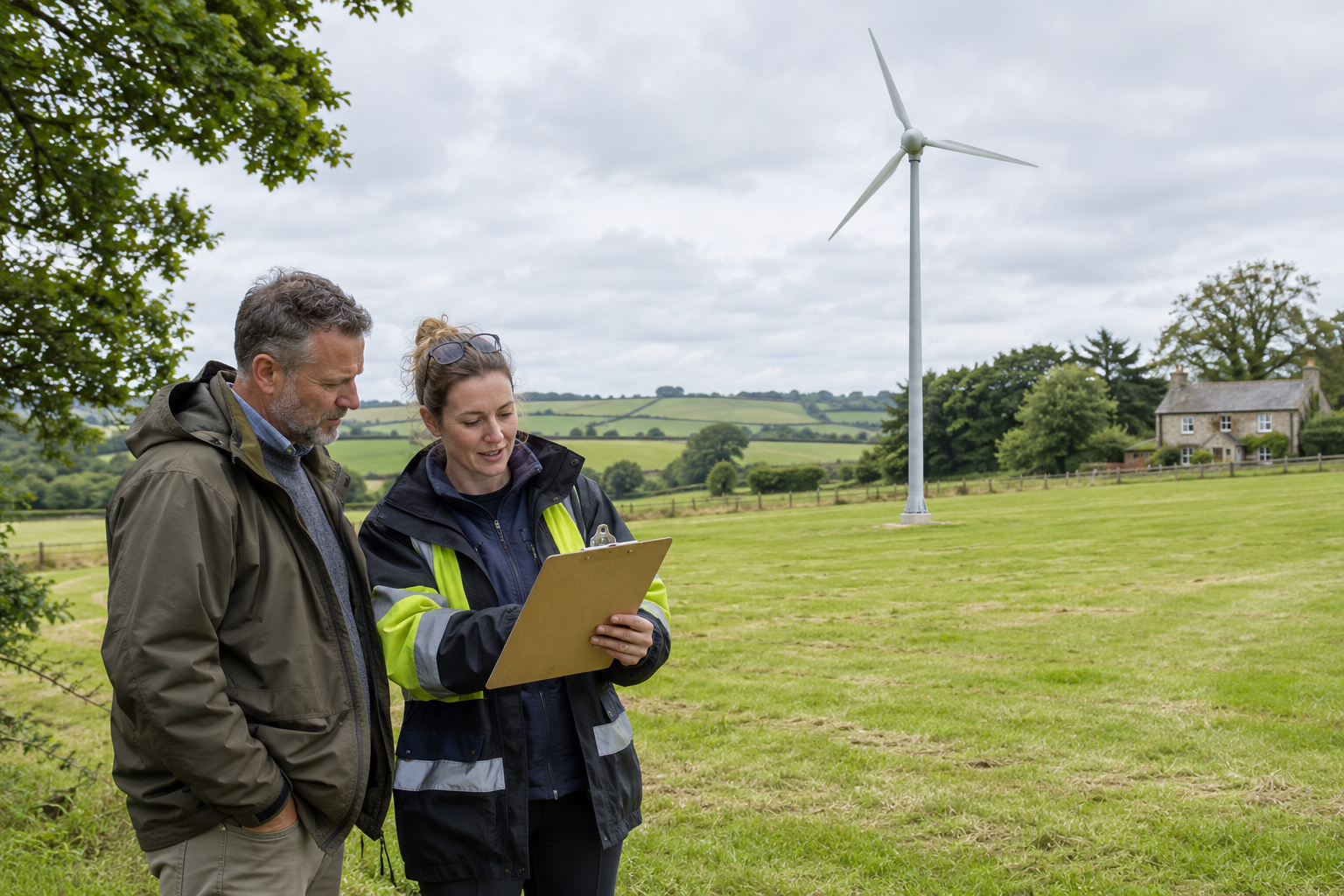
Wind needs to be assessed where the rotor will operate. A breezy garden at head height does not establish useful wind at the proposed hub height. Trees, buildings, slopes and prevailing wind directions all affect the decision.
A quote may include a survey, wind-resource analysis or a monitoring proposal; another may leave these out. Ask what evidence supports the estimated annual output, how site obstructions are considered and whether extra measurement is recommended. Monitoring equipment, installation and interpretation may carry separate costs.
Money spent rejecting an unsuitable site can be more useful than money spent buying a turbine that rarely produces much. Our wind-site log guide helps you gather observations before approaching an installer.
2. The tower, supports and foundations
The support is part of the generating system, not just a stand. Its height and position affect access to wind; its design must suit the turbine and the site’s structural conditions. A lower or improvised mounting is not an equivalent cheaper version of a properly specified tower.
Ask whether the price includes the tower, base, anchors, any guy wires, delivery and structural design. Groundwork may involve excavation, concrete, reinforcement, spoil removal and reinstating the surface. Difficult ground or restricted access can change the scope substantially.
Compare how the turbine will be serviced later. A suitable lowering arrangement may change the initial price and future access costs. A tower needing specialist lifting equipment should have that requirement considered before installation, not discovered at the first repair.
3. Delivery, access and installation labour
A long mast and heavy components need more thought than a parcel delivery. Can the vehicle reach the proposed location? Is there space for lifting equipment, if required? Will access cross a neighbour’s land or damage a lawn that needs restoring?
Ask who arranges delivery, unloading, erection, electrical installation and commissioning. Confirm whether quoted labour includes travel and return visits, and what happens if weather delays a lift. Groundworks, tower installation and electrical work may be supplied by different contractors.
A written division of responsibilities avoids two firms each assuming the other is providing a necessary part. It also makes it easier to compare an all-inclusive quote with one that expects you to arrange local contractors.
4. Electrical equipment beyond the generator
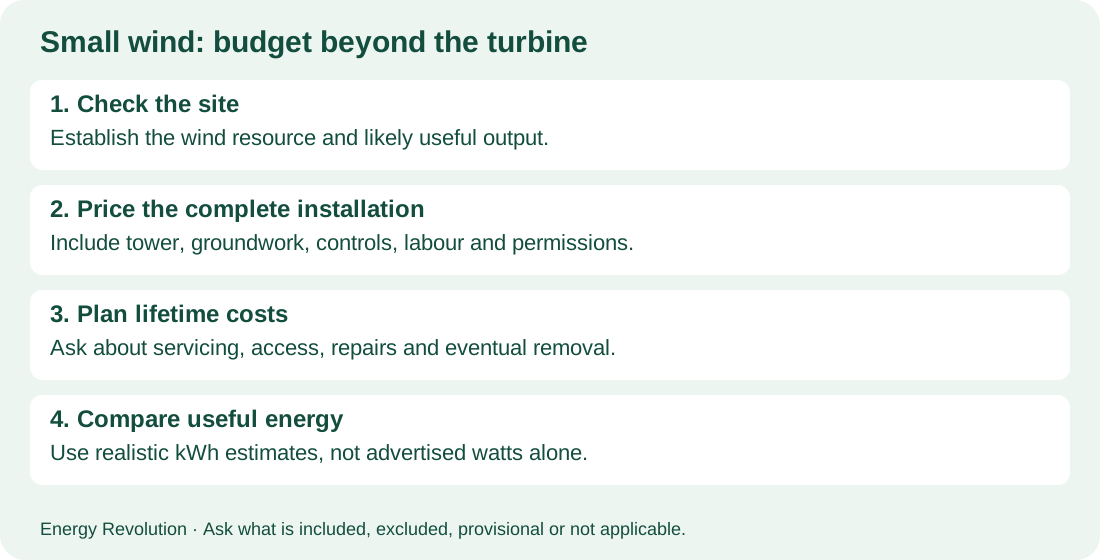
Installers sometimes call the supporting components the balance of system. In plain language, this means the other equipment and work needed to make the turbine useful. Ask for an itemised design, rather than treating a generic accessory list as a shopping list.
Depending on the installation, costs may include a rectifier, wind-compatible controller, inverter, cabling, protective devices, isolation, earthing arrangements, monitoring and suitable enclosures. Include the cable route between the tower and the point of use, with any trenching and surface repairs.
Longer distances can affect both cable cost and electrical losses. Ask the designer how these are allowed for. Do not choose cable sizes or protections from an online illustration.
Wind equipment also needs the manufacturer’s specified method of handling high winds, shutdown and situations where the battery cannot accept more energy. Some designs use diversion loads or other controls. Do not assume a solar controller can safely manage a wind turbine simply because its voltage appears to match.
5. Planning, surveys and network connection
Check the planning position with your local planning authority before committing to equipment. Requirements vary by location and proposal. Ask whether the quote includes drawings, application work and any requested noise, landscape or other assessment. Not every project requires every study shown in a generic checklist.
Our questions about turbine noise near neighbours are useful when discussing siting. Addressing concerns before purchase is preferable to paying for changes after equipment has been ordered.
For a grid-connected design, ask the installer and your distribution network operator which connection procedure applies, who handles the paperwork and whether approvals, network work or testing create additional costs. Existing solar or storage must be considered as part of the proposed installation.
National Grid Electricity Distribution’s G99 guidance notes that witness testing can sometimes incur a fee. That does not mean every domestic turbine faces the same process or charge. Get the requirements for your actual connection in writing.
6. Batteries: optional for some systems, important for others
A grid-connected turbine does not necessarily need a battery. An off-grid household usually needs storage and a plan for calm weather, but the required capacity depends on demand and other supplies. A direct-use application may have a different design again.
If storage is needed, budget for more than battery cells: compatible charging controls, protection, enclosure, installation and any necessary inverter changes matter too. Adding a turbine to existing solar storage is not automatically a plug-in upgrade.
Ask what happens when the battery is full or its management system stops accepting charge. The wind system’s control strategy must remain appropriate. Avoid buying a cheap turbine first and hoping a controller can be found afterwards.
7. Maintenance, repairs and eventual removal
Wind equipment has moving parts and operates outdoors. Obtain the manufacturer’s service schedule and a realistic local maintenance quote. Ask who can work on the model, how far they travel and whether parts are available.
Pacific Northwest National Laboratory identifies labour, travel, consumables and possible equipment hire as contributors to small-turbine maintenance costs. Its guidance also highlights access and spare-parts availability. These principles are useful, but US cost figures should not be treated as UK service quotes.
Check warranty exclusions and whether labour, travel, access equipment and shipping are covered. Ask about insurance, monitoring charges and a sensible repair reserve. Include eventual removal or replacement in a lifetime plan, particularly if specialised lifting is required.
A quote-comparison checklist
| Budget line | What to ask |
|---|---|
| Resource and feasibility | What site evidence and yield assessment are included? |
| Turbine and support | Which exact model, tower and structural design? |
| Groundworks and access | Are excavation, delivery, lifting and reinstatement covered? |
| Electrical system | Which controls, cable routes, protections and monitoring? |
| Permissions and connection | Who handles applications, testing and possible extra fees? |
| Storage, if needed | Is it compatible, installed and included in the price? |
| Aftercare | What are the service, repair, access and warranty terms? |
| Commercial terms | Are VAT treatment, exclusions, deposits and quote validity clear? |
Mark every line “included”, “excluded”, “allowance” or “not applicable”. An allowance is not a fixed price. Ask what evidence is still needed to turn it into one. Check the applicable VAT treatment rather than adding or removing a blanket percentage without confirmation.
A simple way to keep the arithmetic honest
Suppose a hypothetical turbine costs £3,000 and separately priced project work totals £7,000. The project subtotal is £10,000. If you choose to reserve another £1,000 for unresolved costs, the planning budget becomes £11,000.
These are invented arithmetic figures, not current market prices, a typical installation or a recommended contingency rate. The point is that the turbine’s ticket price can be a poor guide to the money you need. Add optional storage separately and avoid counting something twice if it is already inside a package.
Compare cost with useful energy, not nameplate watts
Ask for estimated annual energy in kWh, with the wind assumptions and losses stated. A turbine rated in kW does not produce that power continuously. Our guide to reading a wind turbine power curve explains the difference.
For another purely illustrative calculation, £12,000 of installation cost plus £3,000 of maintenance and repairs over an assumed period totals £15,000. If useful energy over that same period is 30,000kWh, the simple cost is 50p per useful kWh. At 15,000kWh it becomes £1 per useful kWh.
This is not a payback forecast: it excludes finance, discounting and any unlisted costs. It shows why output matters. Count only energy you can use or export as intended, and apply the appropriate value to each. Do not value exported electricity as though it all avoided retail imports.
Frequently asked questions
Can I save money by mounting it on the roof?
Do not assume so. Structural work, vibration and turbulent airflow need assessment, alongside likely output. Compare complete designs for your site rather than assuming the cheapest mounting gives the cheapest electricity.
Does every small turbine need a transformer?
No. The pin’s transformer is an illustration of electrical infrastructure. Ask the installer which components your specific design needs.
Can I reuse my solar battery?
Possibly, but compatibility must be established for the complete system, including wind control and battery charge restrictions. Matching nominal voltage is not enough.
What should I do before buying?
Gather site information, establish the planning and connection position, and request itemised proposals with realistic output estimates and service arrangements. A sensible feasibility check can prevent an expensive unsuitable purchase.
Planning resources
Explore our recommended products and resources once you know what your project needs. Our own DIY Alternative Energy Projects Bundle offers introductory learning and planning material. Its download price is separate from the cost of equipment and installation.
Explore the alternative-energy guide ↗
Sources and further reading
Checked 5 November 2026. US technical guidance provides background; UK permissions, prices and connection requirements must be established locally.
- Energy Saving Trust: domestic wind, installed cost context and installer advice
- US Department of Energy: small wind systems, towers and supporting equipment
- Pacific Northwest National Laboratory: maintenance and access costs
- National Grid Electricity Distribution: G99 procedures and testing