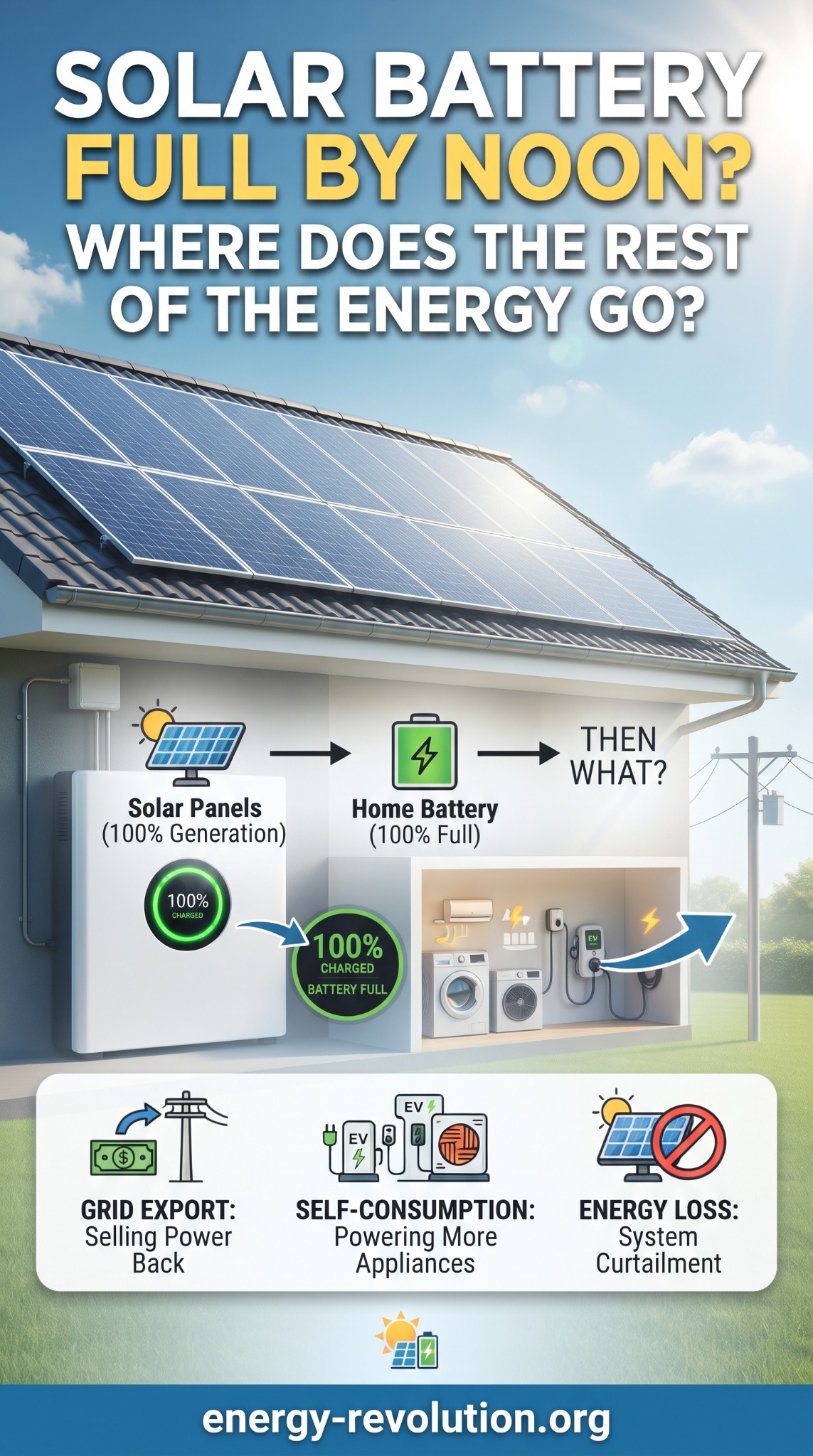

Your battery reaches 100% before lunch, the roof is still in sunshine and the solar graph suddenly drops. Has the electricity disappeared? Usually, nothing mysterious has happened. The system has changed what it needs to harvest.
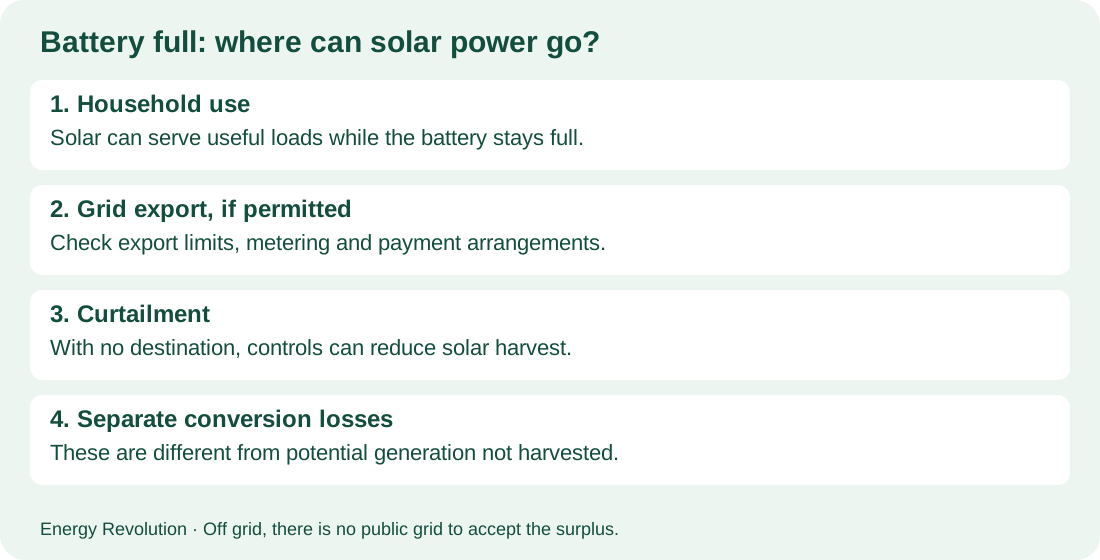
When a solar battery is full, available solar power can serve household loads, flow to the grid where export is allowed, or be curtailed by the controls. The exact balance depends on your equipment, settings and connection. A full battery does not automatically mean a fault, and it does not automatically mean that you need more storage.
First, the battery is not a compulsory stop
The picture on our Pinterest pin is a useful starting point, but electricity does not always travel from panels into the battery and then into the house. Depending on the design, solar generation can serve appliances directly through the inverter or shared electrical system while the battery charges, rests or discharges.
A battery percentage tells you about stored energy. It does not tell you the roof’s available output, the home’s demand or how much is leaving through the meter. Also, “100% generation” on an illustration is not a real operating condition: sunshine, shading, panel temperature and equipment limits change output throughout the day.
Start with four readings taken at approximately the same moment: solar output, household demand, battery charge or discharge power, and grid import or export. Check the app’s arrows and units carefully. Some displays update at different intervals, so a single screenshot can look unbalanced.
Route one: the house uses the electricity
Even with the battery full, fridges, broadband equipment and other loads still need power. If solar production covers those loads, the battery can remain full while solar does useful work. Switch on another suitable appliance and solar output may rise if the system had been holding generation back.
That does not mean you should run appliances without a purpose. The useful opportunity is to move a job you already need to do into a sunny period: laundry, charging an electric vehicle, or heating water through suitable controls. Avoid starting several large loads together without understanding the inverter’s continuous power limit.
For systems with little overnight demand, reducing background consumption may still be more valuable than buying another battery. Our guide to more battery capacity versus lower energy use helps you compare those choices.
Route two: permitted surplus goes to the grid
A grid-connected system may export the surplus once household demand and any charging have been met. The Energy Saving Trust describes this as one possible outcome when storage is full. Export permission, export limits and payment arrangements are separate questions: seeing electricity leave your house does not prove that you are being paid for it.
In Great Britain, eligible small-scale generators can receive payment for metered export through a Smart Export Guarantee tariff. Check the supplier’s requirements, your meter and the installation paperwork. Northern Ireland has different arrangements. Do not assume any advertised tariff applies to your installation or that your permitted export equals the panels’ rated capacity.
If the app says export is zero, ask whether the system is configured for zero export, has reached its permitted export limit, or has a metering or control issue. Your installer can explain the intended settings. Do not bypass an export limiter to improve the generation graph.
Route three: solar generation is curtailed
When the house needs little power, the battery cannot accept more and export is unavailable or restricted, the controls can reduce how much electrical power is harvested from the panels. This is curtailment. Potential generation is left unharvested.
The panels are not continuously making their maximum electrical output and forcing it into a full battery. A solar controller can move the array away from its maximum-power operating point. In a compatible AC-coupled system, other controls can reduce inverter output. The method depends on the system design.
Victron’s solar-charger troubleshooting guidance specifically explains that charging current can stop or fall substantially when the battery is full. That can be normal behaviour. It does not mean every drop in solar output has that cause: clouds, shading, temperature limits and faults also need to be considered.
Our pin calls curtailment “energy loss”. A more precise description is an opportunity to generate electricity that was not taken. This differs from electrical conversion losses, where energy already entering equipment becomes heat during conversion or storage.
A simple noon example
Imagine the battery is full and the home needs 0.8kW. Assume the sunshine could support 4kW at the household AC side after conversion. These are hypothetical steady readings, not a forecast. We exclude small auxiliary demands and changing conditions to keep the comparison clear.
| Situation | Solar actually harvested | Used at home | Exported | Potential unharvested |
|---|---|---|---|---|
| Export can accept the surplus | 4kW | 0.8kW | 3.2kW | 0kW |
| Export capped at 1kW | 1.8kW | 0.8kW | 1kW | 2.2kW |
| Off-grid or zero export | 0.8kW | 0.8kW | 0kW | 3.2kW |
kW is a rate; kWh is an amount. If the last row lasted exactly one hour, 0.8kWh would be harvested for the house and 3.2kWh of potential generation would remain unharvested. Real conditions change, so you cannot multiply a noon snapshot by the whole afternoon and call it a measured daily loss.
Nor does a low generation reading reveal the missing potential by itself. Estimating curtailment needs an additional basis, such as equipment data or a suitable model. Comparing two days without accounting for sunshine can be misleading.
What changes off grid?
An off-grid home has no public grid to accept the surplus. With a full battery and low demand, reducing PV harvest is an ordinary part of keeping the system balanced. A summer afternoon with curtailed solar may coexist with a difficult winter energy shortage.
Judge the system against the days that matter to you. If the battery gets you through the night and there is no useful extra job to run, some summer curtailment may be perfectly acceptable. Adding storage merely to capture every sunny-day surplus can leave expensive capacity underused.
Solar-only behaviour should not be assumed for wind or micro hydro. Those generators can require specific braking, diversion or load-control arrangements. Follow the design and manufacturer’s instructions for every generation source in a mixed system.
Clipping and charging limits are different clues
Inverter clipping occurs when available panel power exceeds what the inverter can convert at that moment. It can happen while the battery is not full. Export limiting restricts power crossing the grid connection. Battery charge-power limits restrict how quickly energy can enter storage, even when capacity remains.
Battery management may also restrict charging because of temperature or another protective condition. On some systems, a schedule or chosen charge target changes the charging pattern. These causes can overlap, so a flat-topped graph alone is not a diagnosis.
Small differences between daily solar generation, consumption, export and battery energy can also reflect conversion losses, standby demand and measurements taken at different points. Read our guide to inverter standby consumption before attributing every difference to lost sunshine.
Use surplus for a worthwhile job
Start with timing rather than shopping. Can an existing task run during the period when surplus normally appears? A timer is less precise than compatible surplus-aware control, but both need sensible limits. Keep normal appliance supervision and operating instructions in mind.
A properly specified hot-water diverter may be an option where there is a suitable cylinder and immersion heater. It is not a universal solution for every boiler or hot-water setup. Compare it with your existing way of heating water and read our solar water heating versus solar PV questions. Electrical installation and thermal safety controls need professional attention.
Similarly, an EV charger may require a minimum charging power and a compatible surplus mode. A passing cloud can cause grid imports unless the controls prevent them. Ask how the proposed equipment behaves when demand rises, sunshine drops or the battery starts discharging.
Would a larger battery actually help?
It might, if you regularly have unharvested surplus and later need energy that extra storage could realistically supply. Compare several representative days, including the less sunny season. Check usable capacity, compatible expansion options, charging power, discharge power and warranty terms.
For a simple illustrative comparison, suppose importing electricity costs 25p/kWh and export earns 10p/kWh. Using 1kWh of surplus directly for a necessary job instead of exporting it could improve the energy bill by 15p, assuming it genuinely replaces a 25p purchase. These are made-up rates, not current tariff quotes.
If 1kWh sent into storage later delivers 0.9kWh to that same load, the avoided import is 22.5p. Subtract the 10p export opportunity and the margin is 12.5p before battery purchase, wear and other costs. Use efficiency figures measured on a consistent basis. For otherwise curtailed off-grid energy, the forgone export value is zero, but the storage still has costs.
A safe checklist before calling the installer
- Record the time, weather, battery percentage and charging target.
- Save solar, household, battery and grid readings with their units and timestamps.
- Check whether overnight grid charging or a schedule explains the early full battery.
- Look for export-limit, temperature, charge-limit or fault messages in the normal app.
- Compare afternoon behaviour and overnight energy supplied over several days.
- Ask the installer to explain unexpected changes, repeated alarms or implausible readings.
Use the app and accessible displays only. Do not open enclosures, disconnect live PV connectors or change battery protection settings. If the battery claims to be full unusually quickly yet gives very little useful energy later, ask about state-of-charge accuracy, usable capacity and configuration rather than immediately buying more panels.
Frequently asked questions
Will full batteries damage the solar panels?
A correctly designed system controls charging and solar output within its limits. A full battery is an expected operating state. Follow the equipment instructions if alarms or abnormal behaviour appear.
Can I sell surplus without a battery?
Yes, storage is not inherently required for solar export. Payment still depends on your installation, metering and export arrangement.
Should I deliberately empty the battery each morning?
Not simply to make room. Consider reserve needs, tariffs, efficiency and the manufacturer’s guidance. A compatible control strategy should serve the household’s needs rather than chase a full generation graph.
Does a full solar battery keep the house on during a power cut?
Only if the system has suitable backup capability and the required installation. A full battery alone does not prove that any circuit will remain powered during an outage.
Planning resources
Our recommended products page collects further resources. If you want our own downloadable planning material, explore the Energy Revolution digital bundle. A guide is separate from the cost of batteries, controls and professional installation.
Explore the alternative-energy guide ↗
Sources and further reading
Checked 5 November 2026. Manufacturer examples describe their own equipment; your system’s manual takes priority.
- Energy Saving Trust: battery storage and what happens when it is full
- Ofgem: Smart Export Guarantee eligibility
- Victron SmartSolar: battery-full behaviour and troubleshooting
- Victron ESS: grid feed-in and export-control configuration
- Sandia PV Performance Modeling Collaborative: inverter clipping