
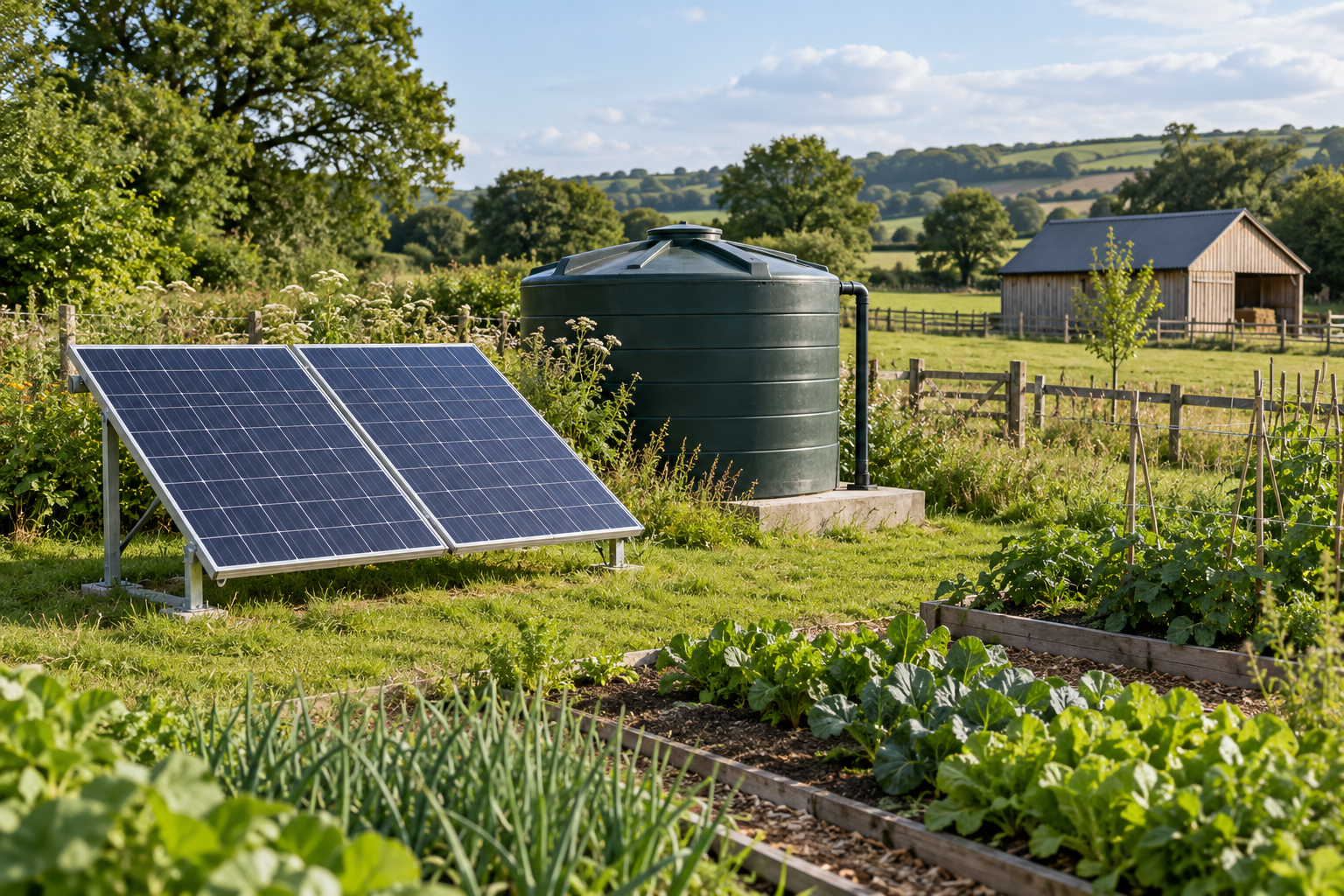
A solar pump can move water to a vegetable plot, storage tank or livestock trough without a mains cable running across the holding. But choosing one by panel wattage, or by the biggest flow number on the box, can leave you with plenty of sunshine and too little water.
Start with the litres you need on a demanding day and the total head the pump must overcome. Then check whether the complete pump-and-panel system can deliver that volume in the season when you need it. Storage, source yield and backup are part of that decision.
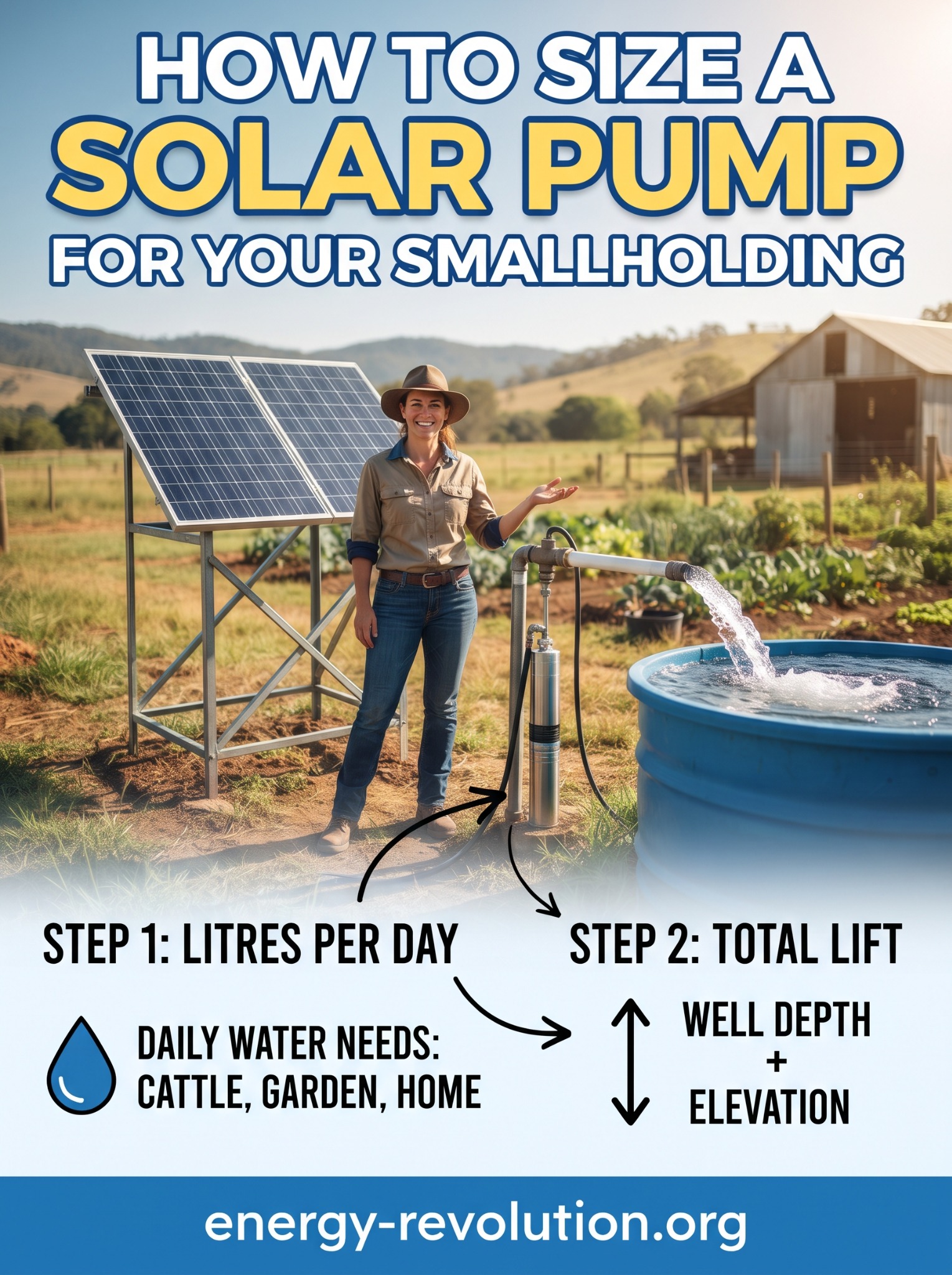
Our Pinterest pin captures the two starting questions: “litres per day” and “total lift”. Below, we turn them into a practical brief you can take to a supplier, with an illustrative calculation rather than a one-size-fits-all shopping list.
1. Count the water before choosing the pump
Make a list of everything the proposed system will supply. Separate livestock, crop irrigation, cleaning and household uses. Measure existing consumption where possible: a water meter or a known-volume container and timed flow test can be more useful than a guess.
For irrigation, the useful conversion is simple: 1mm of water over 1m² equals 1 litre. If a particular bed needs 4mm of additional water on a chosen day and covers 100m², that represents 400 litres reaching the bed. It is an arithmetic example, not a daily watering prescription; rainfall, soil, crop and irrigation losses change the actual requirement.
Animal demand also varies with species, size, weather, diet and production stage. Use suitable husbandry guidance for your stock and record hot-weather consumption where possible. Do not use an invented “litres per animal” figure to size an essential supply.
| Use | Assumed daily volume |
|---|---|
| Vegetable beds and polytunnel | 800 litres |
| Livestock drinking supply | 500 litres |
| Equipment washing | 200 litres |
| Subtotal | 1,500 litres |
| Illustrative 20% planning allowance | 300 litres |
| Example design demand | 1,800 litres/day = 1.8m³/day |
The allowance is an explicit assumption, not an industry rule. Explain what yours covers and avoid counting the same losses twice. Fix leaks before paying for a bigger system to supply them.
2. Measure lift from the pumping water level
In a borehole, three different measurements can be confused: the depth of the hole, the depth at which the pump is installed, and the depth of the water surface while pumping. For lifting water, that last measurement is crucial.
Suppose a borehole is 45m deep, the pump sits at 35m, and the water surface settles at 18m below ground during the intended pumping test. An open tank inlet is 7m above the same ground reference. The vertical lift is 18 + 7 = 25m, not 45 + 7m. The full pipe route still matters when calculating friction.
A resting water level can fall once pumping begins; this is drawdown. Seasonal conditions can also change it. Ask the driller or installer for pumping-test results, the expected low water level and a sustainable abstraction rate. Do not climb into a well to measure it.
3. Add pipe losses and delivery pressure
The pump must do more than raise water vertically. Pipework, bends, valves and filters resist flow. A sprinkler or other pressurised outlet also needs pressure remaining at the point of use. These requirements are expressed as metres of head.
Total dynamic head ≈ vertical lift + pipe and fitting losses + required outlet pressure head. This is a useful planning form for a typical open-source installation; the designer should account for the actual arrangement.
One bar of water pressure is approximately 10.2m of head. An outlet needing 2 bar therefore adds about 20.4m, before its pipe losses are included. Filling an open tank is a different duty from feeding that outlet directly.
Horizontal distance is not added metre-for-metre to vertical lift. A 100m pipe run does not automatically mean 100m of head, but it can cause significant friction. Ask the supplier to calculate losses using the actual internal diameter, length, material, fittings and design flow. A larger suitable pipe can sometimes be more worthwhile than a larger pump.
4. Turn daily demand into a working duty point
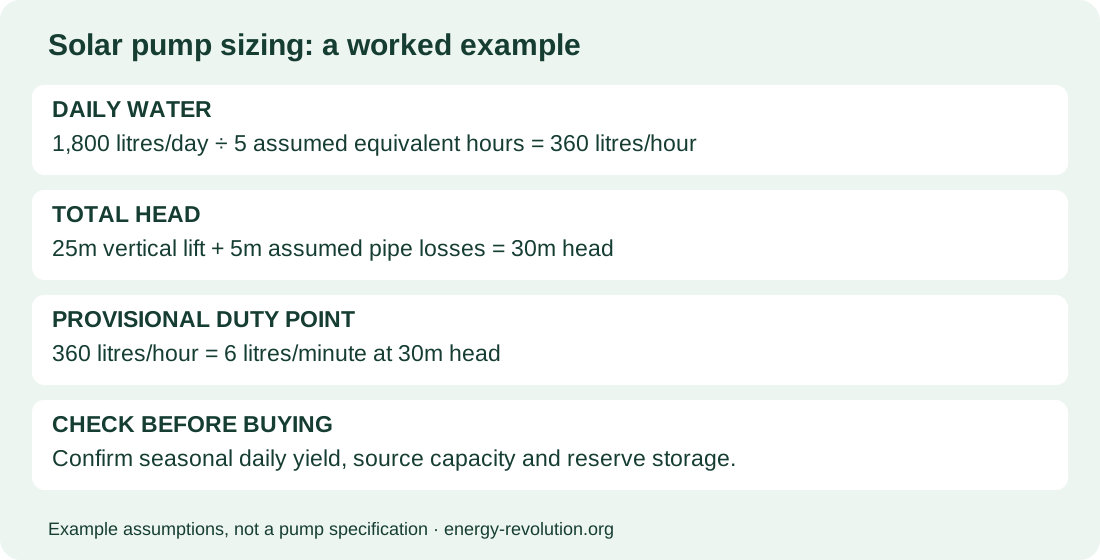
Continue the example with a free discharge into an open storage tank:
- Daily demand: 1,800 litres.
- Vertical lift: 25m.
- Assumed pipe and fitting losses at the proposed flow: 5m.
- Extra pressure requirement at the open outlet: 0m.
- Example total dynamic head: 30m.
If a preliminary calculation assumes five equivalent hours at a representative pumping rate, the rate would be 1,800 ÷ 5 = 360 litres/hour, or 6 litres/minute. The provisional duty point is therefore 6 litres/minute at 30m head.
Five hours is only a demonstration assumption. Daylight hours are not full-output pumping hours, and “peak sun hours” describe solar energy rather than promising a steady pump flow. A solar pump may start late, slow down under cloud and stop while there is still daylight.
Ask for a modelled daily volume for your location, chosen month, array and head. If the available equivalent pumping period were only three hours, the arithmetic rate needed for the same volume would be 10 litres/minute. Pipe losses must then be recalculated at that higher flow; the 5m assumption cannot simply be carried over.
5. Read the curve, not two separate maximum figures
A listing might advertise “maximum flow 20 litres/minute” and “maximum head 50m”. Those normally describe different ends of the performance range. They do not promise 20 litres/minute at a 50m lift.
For a centrifugal pump, shut-off head is the head at zero flow. You need the manufacturer's curve or sizing result showing useful flow at your operating head, with the available electrical input. KSB’s pump guidance explains this relationship between head and flow.
For our example, ask: “What flow does this system deliver at 30m head, and what daily volume is predicted in my design month?” Also ask whether the source can sustain the proposed pumping rate. A more powerful pump cannot make a low-yield well replenish faster.
6. Match the panels to the season and controller
Grundfos highlights the importance of choosing the critical sizing month. A summer-only irrigation system has a different requirement from a year-round livestock supply. A good July result does not establish dependable December production.
Give the supplier your location, shading, panel orientation and months of operation. Ask for monthly water-production estimates and the assumptions behind them. Average daily production also needs a plan for several poor days in succession.
The controller's allowed PV voltage and current, the motor and the array must be compatible. Do not assume a spare panel or an existing portable power station can run a pump simply because their wattage labels look suitable. Have the supplier specify the complete electrical arrangement, including cable losses and protection.
7. Consider storing water before adding batteries
Where the layout allows it, pumping into a tank during sunshine lets you use the water later. That can avoid running the transfer pump at night. It does not automatically provide the pressure needed by every downstream appliance.
As an example, two days at 1,800 litres/day require 3,600 litres of usable reserve. That is not necessarily a 3,600-litre nominal tank: outlet height, minimum operating level and other unusable volume affect the amount available. Nor are two days automatically enough for your climate or livestock.
Consider how the system will replenish a depleted reserve while still meeting that day's demand. A pump sized to exactly match consumption on an average day may have little recovery capacity.
For the delivery side, read our gravity-fed water versus a pressure pump guide. If pumping after dark is necessary, our solar pump battery-backup article covers the separate storage question. Our dry-spell tank-sizing guide helps distinguish daily use from reserve capacity.
What to put in the supplier's brief
Send one clear page with your daily demand by season, source type and tested yield, pumping water level, delivery elevation, required pressure, pipe route and sizes, and proposed storage. Add the site location, shading photographs and whether the supply is essential.
Request the selected duty point, predicted monthly litres per day, panel and controller specification, dry-run protection, tank-full shut-off and an achievable backup plan. LORENTZ, for example, provides dry-run and tank-full accessories for its S systems; check what is actually included in any quote.
Allow access for cleaning filters, servicing and winter drainage. Keep a way to monitor delivered volume and tank level, so a gradual loss of output is noticed before a trough runs empty.
Check water use and permissions separately
The pin mentions the home as well as garden and cattle. Pumping water does not make it safe to drink. Household use needs an appropriate private-supply assessment, treatment where required and suitable materials; consult your local authority and the Drinking Water Inspectorate guidance for England and Wales.
Check abstraction requirements before committing to equipment. In England, taking more than 20,000 litres a day is likely to require an Environment Agency licence. Smaller abstractions and new groundwater works still need the relevant checks; that threshold is not blanket permission for every project. Other UK nations have their own arrangements.
Frequently asked questions
Can I choose a pump from the solar panel wattage alone?
No. Daily demand, head, seasonal sunshine and the matched pump/controller performance determine whether it will do the job.
Is borehole depth the same as lift?
No. Use the pumping water level and delivery elevation for vertical lift, then account for losses and outlet pressure.
Do I always need a battery?
No. Daytime pumping into adequate storage may suit the job. Night pumping or pressurised delivery may require a different arrangement.
What is the most useful question to ask a seller?
“How many litres per day will this complete system deliver at my head, at my location, in my critical month?” Ask for the supporting sizing result.
Further reading and project resources
Sources checked on 30 October 2026:
- Grundfos: solar pumping system sizing.
- LORENTZ PS2 manual: head, losses and system planning.
- Virginia Cooperative Extension: solar-powered water pumping.
- KSB: pump characteristic curves.
- LORENTZ: solar pump guide and water storage.
- LORENTZ S1-200: controls and accessories.
- Environment Agency: abstraction licence checks in England.
- Drinking Water Inspectorate: private water supplies.
For wider project planning, explore our Recommended Products and DIY Alternative Energy Projects bundle. These are planning resources, not a matched pump specification.
View the DIY Alternative Energy Projects bundle
Explore the Energy Revolution offer
Affiliate offer: review the seller’s claims and terms independently. We do not guarantee results.