
Quick answer
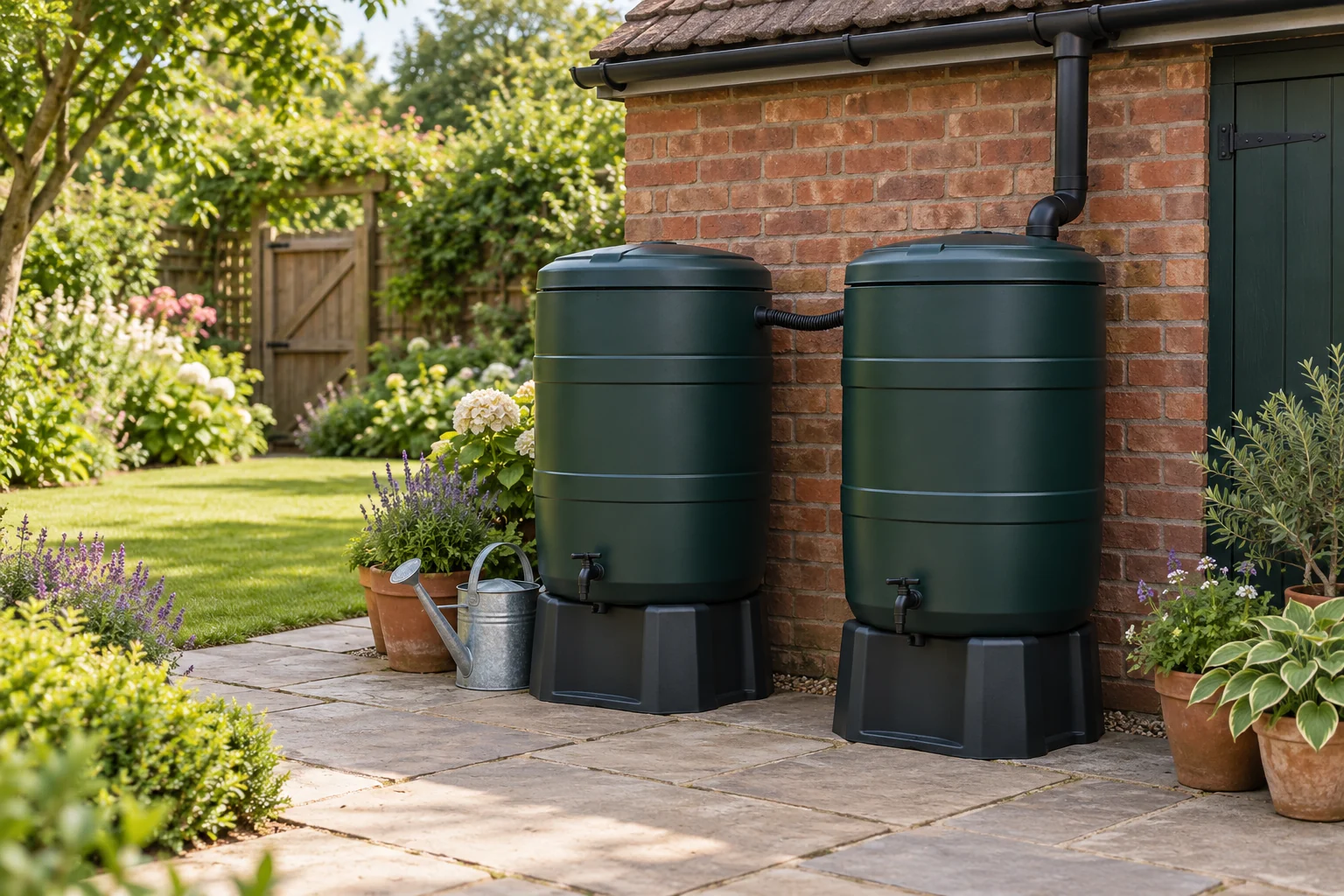
Two linked water butts suit a small garden when you already own a sound butt, have room for a second and can connect them correctly. One larger tank suits a garden with a suitable uninterrupted space where a single container makes access and maintenance simpler. Compare the installed footprint, usable water and overflow arrangements—not just the litres on the label.
A full water butt is reassuring until a few dry days empty it. Adding another container seems straightforward, but a bigger tank may be easier to live with. Equally, replacing a perfectly useful butt can cost more than expanding what you already have.
The best choice depends on the space beside your downpipe, how much rain the roof collects and how you take water out. Here is how to compare the options for a compact garden.
Affiliate disclosure: This page includes affiliate links. If you buy through them, we may earn a commission at no extra cost to you. The energy offer linked below is separate from this rainwater-storage comparison.
Start with the problem your current storage has
Watch what happens during wet and dry weather. If your existing butt fills quickly and repeatedly overflows, extra storage could catch water you currently lose. If it rarely fills, another tank will not create more rainfall or increase the collecting roof area.
If there is water left but filling a watering can is awkward, the real problem may be tap clearance or access. If an irrigation system stops while the tank still contains water, check its intake position and pressure requirements before buying more capacity.
Our guide to rainwater storage for summer dry spells looks at the demand side. Decide which plants you want to support and roughly how much water they use before choosing a tank.
Two linked butts or one tank: a practical comparison
| Question | Two linked water butts | One larger tank |
|---|---|---|
| Can I reuse existing storage? | Often, if its condition and fittings are suitable. | May replace the existing butt or move it elsewhere. |
| How much space is needed? | Two bases, a connection and access to both containers. | One footprint; shape and depth matter greatly. |
| Can one tap drain everything? | Depends on link height and the system design. | Usually one draw-off point, with some water remaining below it. |
| What needs checking? | Levels, compatible fittings, hose route and overflow. | Delivery access, support, inlet height and overflow. |
| What about maintenance? | Two lids and more joints; separation may help if isolation is provided. | Fewer interconnecting parts, but one larger vessel to clean. |
Compare usable litres, not just advertised capacity
Two 200-litre butts and one 400-litre tank offer the same nominal total. They do not necessarily deliver the same amount through your chosen outlet.
Water below a tap may remain inaccessible without another suitable draw-off arrangement. A pump may need a minimum operating depth. The inlet, overflow and linking positions can also limit the level the system reaches.
For an illustrative calculation, suppose either arrangement gives you 320 usable litres and the garden needs 20 litres daily. That is 16 days without replenishment. These are planning assumptions, not a promised performance figure: actual demand changes with weather, plants and watering habits.
Ask where the manufacturer's capacity is measured and how much remains below the outlet. A simple sketch of the water levels is often more useful than comparing product photographs.
Measure the complete installation footprint
Measure the available width, depth and height, then allow space for the stand or base, pipework, tap and a full watering can. Check that you can open the lid and reach the connections without climbing over planting.
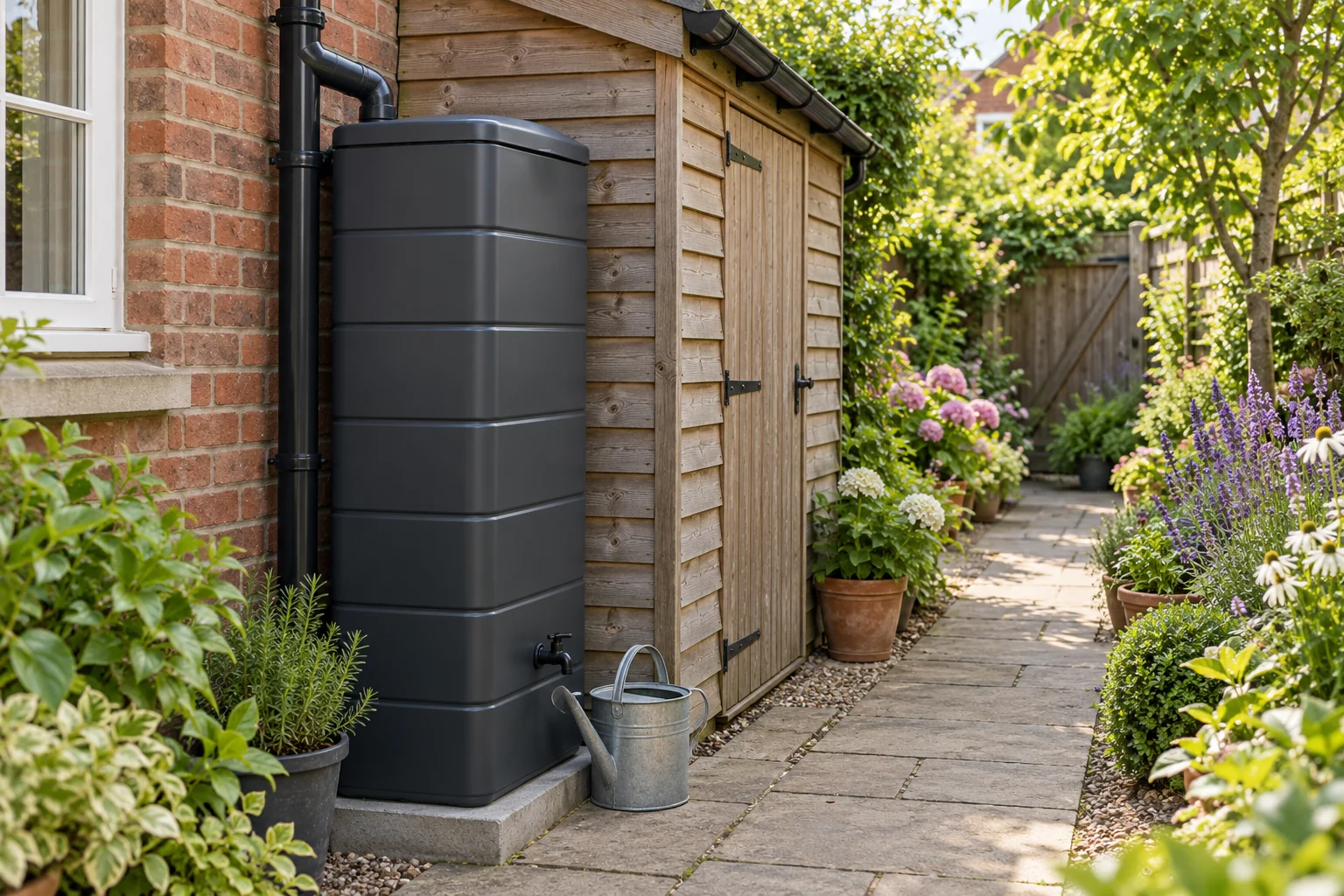
Two round butts may occupy more useful path space than a rectangular tank against a wall. However, a deep single tank may obstruct a narrow route more than two smaller containers arranged along a wider boundary.
Do not assume “slimline” means suitable. Check the actual dimensions, whether the tank needs manufacturer-specified restraint and whether it can pass through your gate. Keep doors, air vents and garden access clear.
Understand what the linking connection does
Linking kits are not all interchangeable. GARANTIA's connection-kit guidance, for example, demonstrates a hose and fittings intended to connect compatible containers. Use instructions for your actual tanks and kit, including the permitted connection positions.
A high-level link transfers water above the connection
With a straightforward high-level hose connection, the first butt must reach the link before water can pass into the second. Once the levels fall below that connection, water stored lower down in the second container cannot return through that hose.
You may therefore need to use each butt's tap. Do not assume a single tap on the first butt can empty both. Siphon-based products work differently and need their own installation and operating instructions.
A low-level link can share the stored water
Where a suitable low connection remains submerged and clear, with both tanks properly vented, connected water tends towards the same surface height when flow settles. It equalises height, not the percentage full in each vessel.
This matters if the tanks differ in height or stand on different ground levels. A lower overflow can release water before a taller tank fills. The manufacturer's RAINPOD guidance on ground levels illustrates why relative levels need attention; its product-specific arrangements should not be assumed to apply to every kit.
A low link also means a leaking connection can lose water from both containers down to the leak level. Ask whether the approved arrangement allows isolation for servicing. Avoid improvised drilling positions or unsupported hoses.
Plan filling and overflow together
Both options still depend on the same collecting roof unless you add another catchment. A rough calculation is roof plan area in square metres multiplied by rainfall in millimetres: the result is litres before losses.
For example, 20 square metres receiving 10 millimetres of rain gives 200 litres gross. If you assume 80% collection for this example, that becomes 160 litres. An empty 400-litre system will not fill from that shower.
A diverter may return excess water to the downpipe when installed at the specified height. Check the manufacturer's explanation of rainwater-tank operation and the instructions supplied with your diverter.
With linked butts, check that water can transfer fast enough and that the whole arrangement has a suitable overflow route. A narrow link can restrict transfer during heavy rainfall. Excess water should not pool around foundations, erode the base or discharge onto a neighbour's property.
Also exploring home energy ideas? Our separate affiliate energy offer has its own product details and terms. It is not a water-butt or rainwater-tank recommendation.
Check support, pressure and everyday use
Water is heavy: 400 litres weighs about 400 kilograms, before adding the container and supports. Two butts divide that load between two positions; they do not remove it. Use firm, level support that meets the manufacturer's requirements. Do not assume decking can carry a full tank without checking its capacity.
The RHS guide to collecting and storing water recommends firm, level stands with enough clearance for a watering can. It also advises close-fitting lids, keeping gutters clear and cleaning containers annually.
More litres do not automatically mean more pressure. Gravity pressure depends on the height of the water surface above the outlet. A wider tank holding more water at the same height does not improve that pressure simply because it is larger.
If you use drip irrigation, check the equipment's required pressure and filtration. Our solar drip irrigation and water-butt guide covers that pairing. Do not raise a heavy tank on makeshift supports to chase extra pressure.
Compare the full cost and cleaning effort
Price the containers, approved bases, diverter, linking kit, delivery and any groundwork. Reusing an existing butt may save money, but extra fittings and another base can narrow the difference. One large tank may require more effort to deliver through a tight passage.
Check that you can inspect and clean either option safely. Two butts can be convenient if the design lets you disconnect or isolate one; without that provision, maintenance may affect both. Never enter a tank. Keep lids secure, inspect joints and follow the manufacturer's winter-care instructions.
Which arrangement would suit your garden?
- Choose two linked butts if your current one is sound, a second fits comfortably, and an approved connection gives you practical access to both stores.
- Choose one larger tank if its dimensions fit the available space better and you value a single container with fewer connecting parts.
- Reconsider extra storage for now if the existing butt rarely fills, the base is unsuitable or the installation would block essential access.
Mark the proposed footprint on the ground and carry a watering can through the remaining gap. That small trial can reveal an awkward layout before you order anything.
Frequently asked questions
Do linked water butts need to be the same size?
Not always, but different heights and connection positions complicate usable storage and overflow. Matching containers can simplify planning. Confirm compatibility with the kit supplier.
Will both butts empty from one tap?
Only if the connection and draw-off arrangement allow it. A basic high-level link leaves lower water in the second butt needing its own outlet.
Is one large tank always better for a small garden?
No. A well-shaped tank may save space, but delivery access, tap clearance and support can make two smaller butts more practical.
Will extra storage solve a long dry spell?
It helps only if rain fills it beforehand and your demand fits the usable reserve. Prioritising plants and reducing watering losses can extend either arrangement.
Choose storage you can actually use
For a small garden, convenient access to stored water matters as much as headline capacity. Measure the complete setup, check the connection levels and overflow, and calculate how long the usable water will last. Choose the arrangement that fits those checks and your daily routine.
Explore a separate home energy offer
If you are also researching home energy products, read the seller's full description, price and terms before deciding. This affiliate offer is unrelated to the rainwater-storage options above.
View the Energy Product and Full Details