
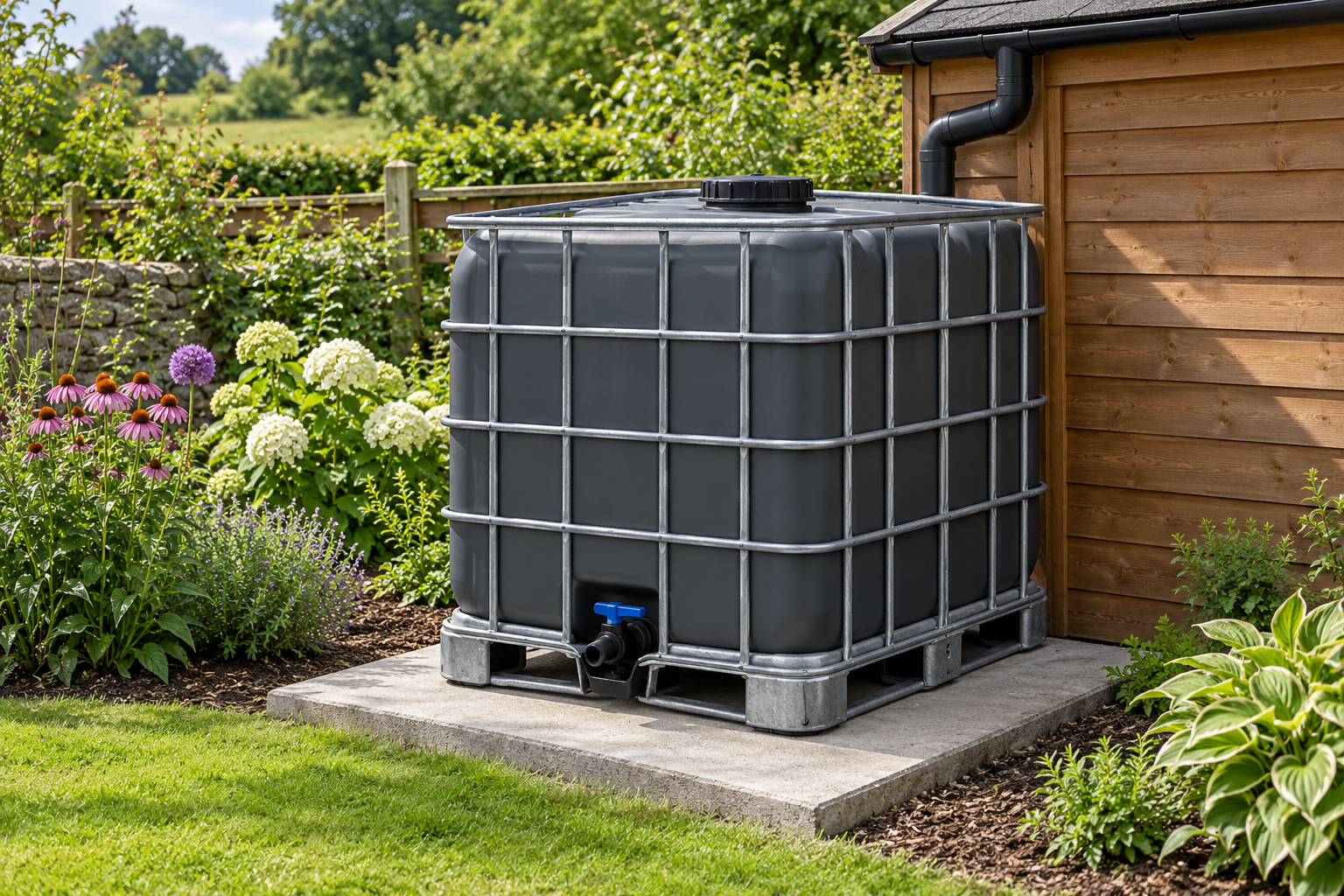
A used IBC can look like a bargain: a large tank, a protective metal cage and enough storage to outlast several small water butts. But a container that is suitable for one industrial liquid is not automatically suitable for your garden.
Yes, a used IBC can be a sensible rainwater store when its history is documented, its previous contents were suitable, its condition is sound and its installation is properly planned. If you cannot establish what it has held, pass it by. A quick rinse, a clean appearance or the words “food grade” do not resolve an unknown history.
This article considers above-ground storage for garden watering. It does not cover making rainwater drinkable, connecting it to household plumbing or burying an industrial container.
What is an IBC, and why consider one?
IBC stands for intermediate bulk container. A familiar type has a plastic inner bottle, a metal cage, a pallet base, a top filling opening and a low outlet valve. Many hold 1,000 litres, but sizes and construction vary.
As one manufacturer example, the SCHÜTZ ECOBULK LX 1000 has a 1,200 × 1,000mm footprint, a height of 1,160mm and a listed empty weight of 60kg with its wooden pallet. Those figures describe that model, not every tank advertised locally.
The attraction is storage capacity in a relatively compact footprint. The trade-offs are weight, access, appearance, fittings and the need to verify previous use. Check gate widths and delivery access before paying: an empty IBC is still a bulky object.
Previous contents: the most important buying question
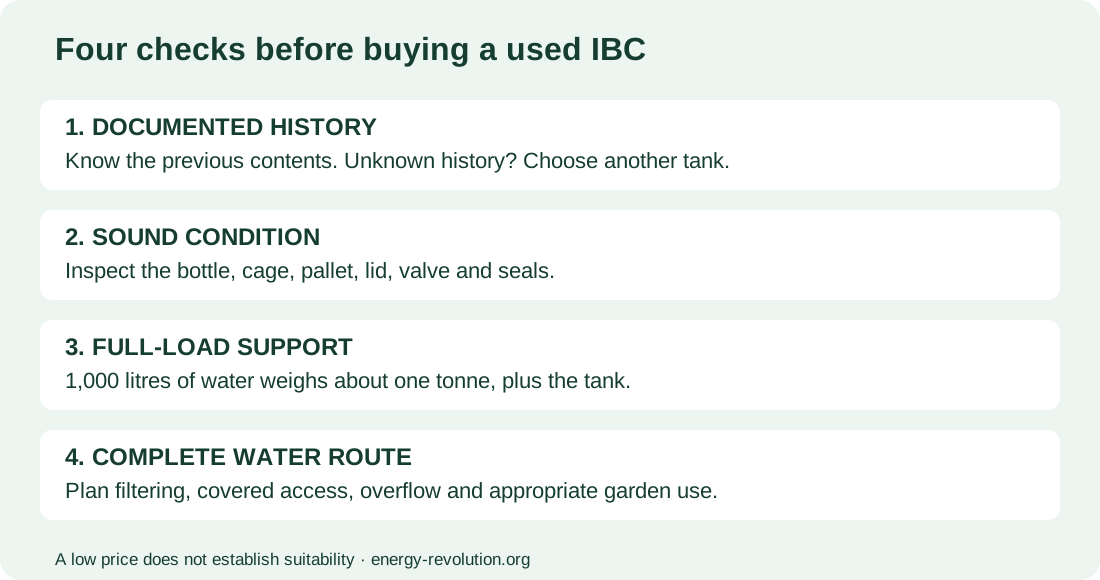
Ask for the actual product name and documented history, not simply “it came from a food factory”. A site that handles food may also use cleaning agents and other chemicals. Ask whether the tank has been refilled with anything else since its original use.
University of Nebraska–Lincoln guidance advises against rainwater containers that previously held oil or pesticides. Rutgers likewise advises against barrels that held toxic industrial chemicals. For a household garden project, an unknown or hazardous previous filling is a reason to choose another container, rather than attempt DIY decontamination.
A documented, suitable food-only history is a better starting point, but food residue still needs appropriate cleaning. Syrups, oils and other residues can leave deposits; an intact-looking valve can retain material that is hard to inspect.
- Ask what every known previous filling was.
- Request traceability, cleaning information and the supplier’s written statement of intended reuse.
- Check that labels and the seller’s explanation agree.
- Reject unexplained residues, chemical odours or an evasive history.
Do not deliberately sniff inside a tank, taste residue or use clear rinse water as proof of safety. Your senses cannot establish that an unknown container is suitable.
Used, reconditioned and rebottled are different
| Description | What to establish |
|---|---|
| Used, sold as seen | Previous contents, cleaning needs, leaks and structural condition remain your questions to resolve. |
| Reconditioned | Ask whether the original bottle remains, what cleaning and testing were done, and which uses the supplier supports. |
| Rebottled | Usually a new inner bottle in a reused cage; confirm the valve, seals, bottle specification and cage condition. |
| New purpose-made rainwater tank | Compare the complete installed cost, suitable fittings and maintenance access. |
UK supplier PurePac distinguishes reconditioning, which retains the cleaned original bottle, from rebottling, which installs a new one. Its guidance does not approve its reconditioned tanks for food or drinking water. Always check the seller’s actual specification rather than relying on a loosely used marketplace label.
“Food grade” relates to intended material contact and supporting documentation; it is not proof of everything a used tank has contained. Nor does a new food-contact bottle turn roof runoff into drinking water.
Check the bottle, cage, pallet and outlet
Inspect for cracks, damaged seams, serious staining, distortion and deterioration around the top opening and valve. Examine the cage for bent members or corrosion and the pallet for rot, broken supports or instability.
Ask the supplier to demonstrate that the outlet closes properly and explain how replaceable seals or valves are serviced. Confirm the outlet thread and adapter you need; do not assume every large IBC fitting accepts an ordinary garden-hose connector.
Check suitability for outdoor exposure, including the bottle’s UV protection. An opaque cover can reduce light reaching the water, but it does not repair sun-damaged plastic. It must also leave necessary access and ventilation arrangements functional.
A transport marking is not a garden installation plan. Ask for the manufacturer’s handling and support instructions for the actual container, particularly if parts have been replaced.
A full tank needs a properly designed base
One thousand litres of water weighs approximately 1,000kg. Add the container itself: the example above would weigh about 1,060kg when holding that amount. That is a substantial load beside a shed or on an allotment plot.
Provide a firm, level base that supports the pallet as its manufacturer requires. Assess the ground underneath, not just the appearance of the paving. Soft soil, unsupported slab edges and a sloping surface need attention before filling.
Do not copy a stack of spare wooden pallets as a raised stand. The container’s original pallet and an improvised tower are different things. If you need elevation, have a suitable support designed or selected for the full load, stability and outdoor conditions.
Keep access to the valve and inspection points clear. Consider where a major leak would run, and avoid placing the tank where escaping water could undermine its base or damage a building. Move it empty using suitable handling arrangements; do not attempt to drag a full tank into position.
What our Pinterest image gets you thinking about
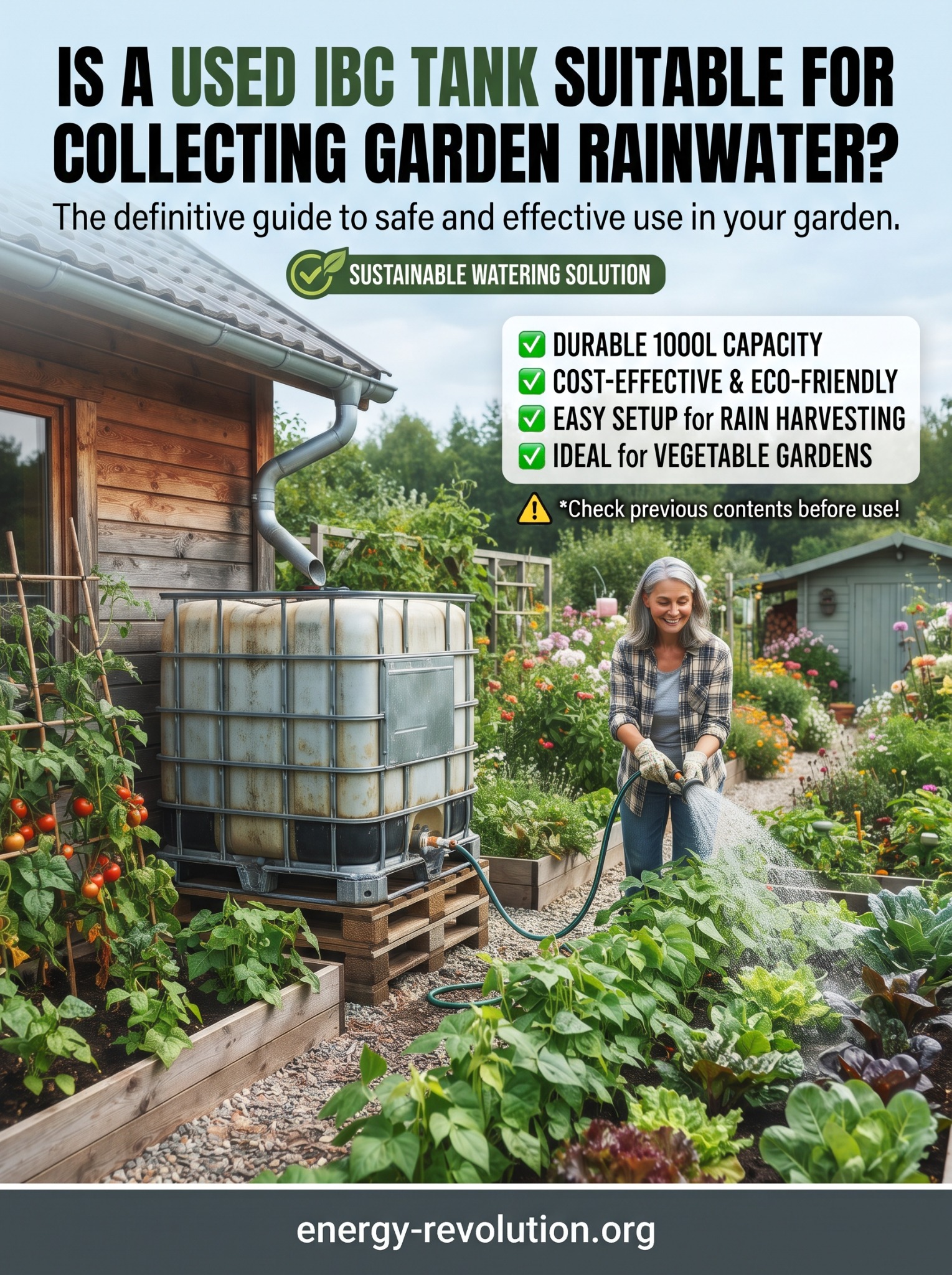
The pin highlights capacity, reuse, cost and checking previous contents. Those are useful starting questions, rather than guarantees. Its raised-pallet arrangement and strong hose spray are illustrative: they are not a support design or proof of gravity-fed pressure. Its claim about vegetable gardens also needs the water-quality distinctions below.
Plan collection, overflow and cleaning access
You need a suitable roof catchment, guttering, a collection connection and a way for excess water to leave safely. A debris filter can intercept leaves and moss; it cannot certify chemical or microbiological safety.
Keep the filling opening securely covered and protect appropriate openings against insects and animals. Use a purpose-designed inlet and overflow arrangement that preserves any required venting. Do not make the tank a sealed pressure vessel or attach it directly to mains pressure.
Plan the overflow before the first heavy shower. Surplus water must reach an appropriate drainage route without continually wetting the foundation or flooding a path. If collection stops unexpectedly, our diverter and overflow troubleshooting guide helps separate inlet problems from water escaping early.
Choose a tank you can maintain from outside. Never climb inside, put your head through the opening or cut a larger access hole to enter. HSE guidance identifies serious hazards in confined spaces; professional cleaning or a different container is preferable to entering a tank.
Will your roof fill 1,000 litres?
A larger tank stores water; it does not create more rainfall. For a simple estimate, 1mm of rain over 1m² of roof footprint equals 1 litre before losses.
Suppose 20m² of roof drains to your collection point and a shower delivers 10mm. That is 200 litres before losses. With an illustrative overall collection factor of 80%, you would collect about 160 litres.
Starting empty, that example needs roughly 62.5mm of rainfall to collect 1,000 litres, assuming the same factor and no water use between showers. The 80% is a planning assumption, not a guaranteed filter efficiency.
Check the area actually served by the chosen gutter. Our shed-roof rainwater guide explains the catchment question. A small roof and heavy watering demand may make dependable refilling more important than maximum storage volume.
Will a hose work without a pump?
Gravity pressure depends on the vertical distance between the water surface and the outlet you are supplying. Approximately one metre of water height gives only 0.1 bar before friction losses. Pressure falls as the tank empties.
A watering can or irrigation system designed for very low pressure may work well. A spray gun or pressure-dependent dripper may disappoint. A large tank can contain plenty of water while delivering little pressure.
Do not raise a tonne of water on an improvised stand to imitate a mains-fed hose. Consider an appropriate rainwater pump if your chosen watering equipment requires it, with suitable electrical installation and protection.
Can I use the water on vegetables?
Separate two questions: is the container suitable, and is the collected water suitable for its intended use? A known tank history does not remove contamination from roof debris, bird droppings or roofing materials.
Guidance differs. The RHS encourages rainwater collection in its vegetable-watering advice, while University of Minnesota Extension takes a more conservative position and generally advises against rain-barrel water for edible crops. It specifically warns against contact with edible plant parts.
For a cautious household approach, reserve uncertain-quality stored water for established ornamental plants. Use a clean, reliable water source for seedlings, produce washing and watering that contacts edible parts, especially crops eaten raw. Where suitable rainwater is used around established crops, target the soil rather than spraying the harvest; this does not make chemically contaminated water acceptable.
Keep the tank closed, maintain gutters and filters, and follow an appropriate cleaning schedule. Never treat this water as drinking water for people or pets. A filter screen and a dark cover do not disinfect it.
Is the apparent saving worthwhile?
Add delivery, base preparation, fittings, a filter, overflow components, light protection and any pump to the tank price. Compare that complete figure with a purpose-made rainwater tank or a smaller arrangement. Our linked water butts versus one larger tank guide helps with that choice.
Reuse can be worthwhile when the container is suitable and useful for years. It is not automatically the cheapest or best option if you must replace damaged parts or cannot safely site it.
Frequently asked questions
Can I clean an unknown chemical IBC for my garden?
Do not attempt to make an unknown or hazardous previous filling safe with household washing. Choose a traceable suitable container and ask the supplier about professional handling of the unsuitable one.
Does a black cover solve algae problems?
Reducing light can discourage algae, but debris, storage conditions and maintenance still matter. A cover does not remove existing contamination.
Can I bury a used IBC?
Not unless that exact tank is explicitly designed and approved for burial. An industrial cage does not establish resistance to surrounding soil or groundwater loads.
Can I leave it full all winter?
Follow the container and fittings manufacturers’ frost instructions. Ice can damage tanks, valves and hoses. Plan draining and bypass where required, rather than assuming the cage makes it frost-proof.
Sources and further planning
Checked on 28 October 2026. Product-specific instructions take priority over general examples.
- University of Nebraska–Lincoln: choosing rain-barrel containers.
- Rutgers: previous contents and rain-barrel reuse.
- PurePac: reconditioned and rebottled IBCs.
- SCHÜTZ: example 1,000-litre IBC specifications.
- RHS: rainwater storage and maintenance; vegetable watering.
- University of Minnesota: rainwater quality and edible crops.
- HSE: confined-space hazards.
For broader projects, browse our Recommended Products and DIY Alternative Energy Projects bundle. Neither certifies a second-hand IBC: establish its suitability before buying accessories.
Explore the Energy Revolution offer
Affiliate offer: assess the seller’s claims and terms independently. We do not guarantee results.