Quick answer
A hydro system delivering a genuine, continuous 100 watts generates 2.4kWh in 24 hours before downstream losses. That could support carefully chosen lighting, phone charging, laptop use, Wi-Fi and an efficient small fridge. Whether they fit together depends on measured daily consumption, battery storage and peak power. It is not a whole-house electric heating supply.
A hundred watts sounds modest. A kettle can demand many times that amount. Yet a small stream has an appealing advantage when conditions allow: it can keep generating while you sleep. Small amounts arriving steadily can become a useful daily energy budget.
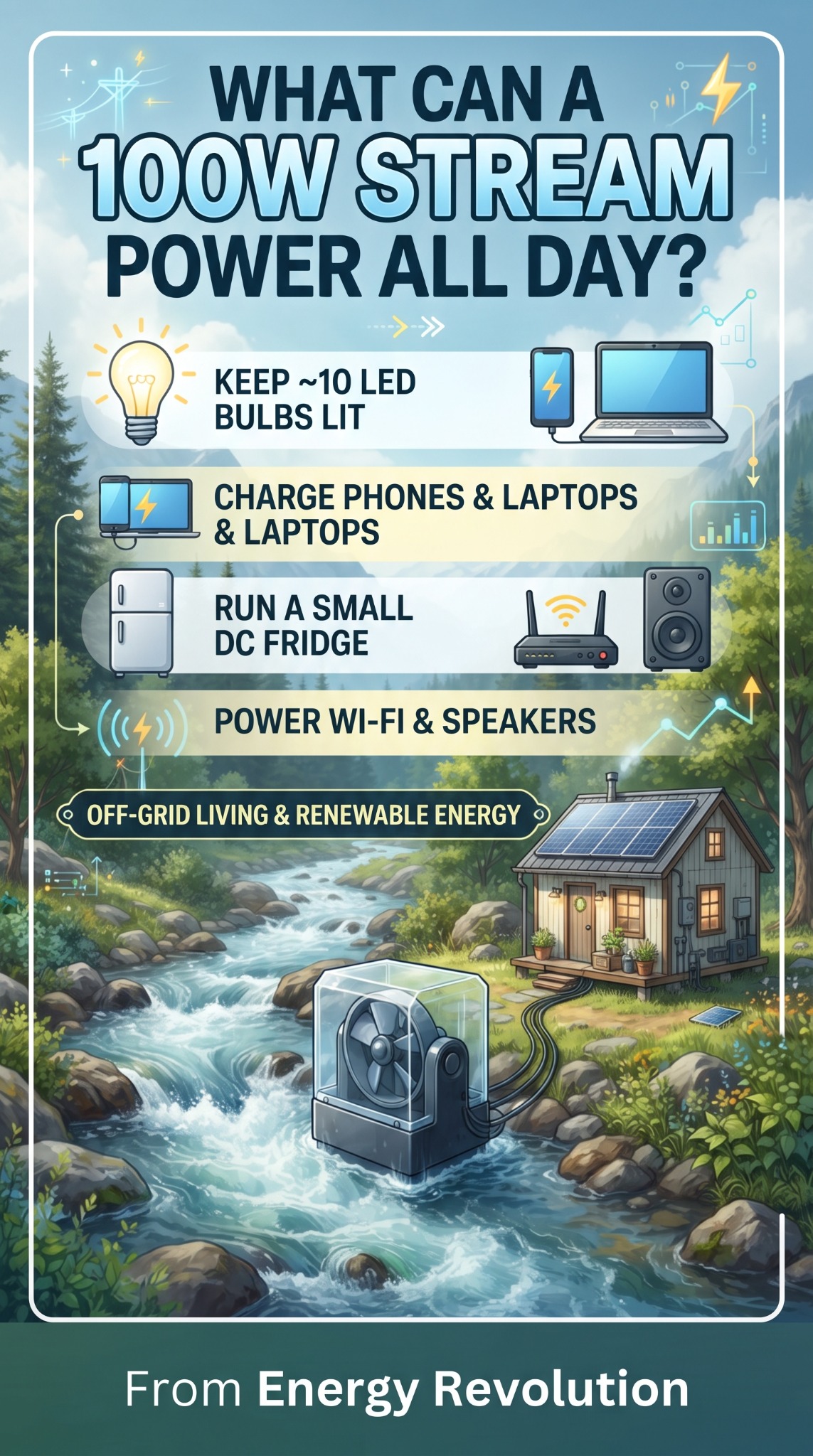
Our Pinterest pin highlights the possibilities: LED bulbs, phones, laptops, a small DC fridge, Wi-Fi and speakers. Treat those as ideas to investigate, rather than a promise that every item can run continuously together. Here is how to turn that inspiration into a realistic plan.
Affiliate disclosure: We may earn a commission from purchases through affiliate links, at no extra cost to you. Our own digital bundle is also linked. Product links are not evidence of hydro compatibility.
First, what does a “100W stream” mean?
A stream does not come with a fixed electrical rating. Here, 100W means measured electrical output from a correctly matched turbine and generator under the conditions being discussed—not the energy in the water or a seller’s maximum rating.
The US Department of Energy explains that conventional hydro potential depends on water flow and vertical drop, known as head. A lively-looking stream alone does not prove either. Usable flow also depends on environmental requirements.
Record where the output is measured. If 100W is measured at the generator, cable and controller losses still come later. If it is measured at the battery charging input, some losses are already accounted for. Avoid subtracting the same loss twice.
Watts tell you the rate; watt-hours tell you the total
Think of watts as the speed at which electricity arrives. Watt-hours describe how much arrives over time. The calculation is simple:
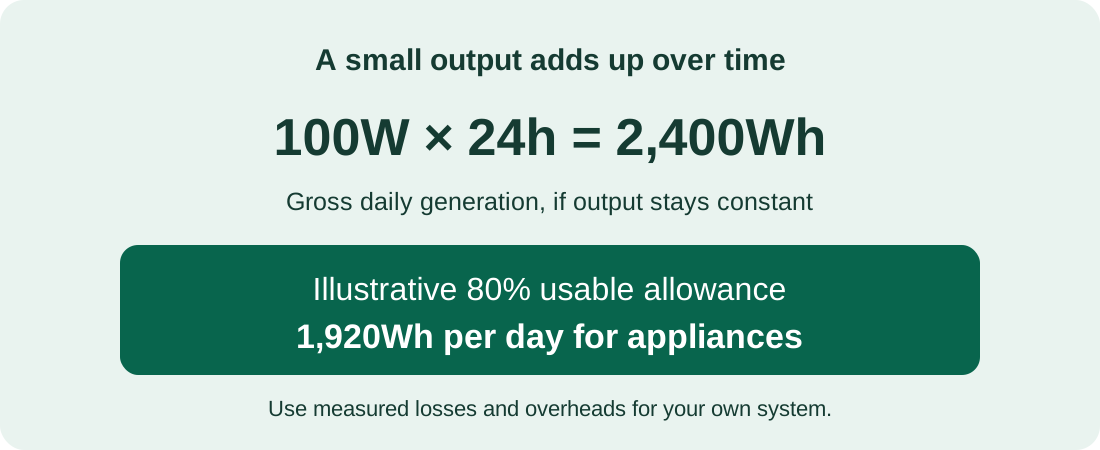
100W × 24 hours = 2,400Wh = 2.4kWh per day.
Over 30 uninterrupted days that is 72kWh. Over 365 uninterrupted days it is 876kWh. These are arithmetic ceilings under the stated assumption, not forecasts for an unmeasured stream. Dry weather, maintenance and shutdowns reduce the total.
For an illustrative planning budget, suppose 80% of the generated energy remains available for appliance use after all relevant downstream losses and system overheads. That gives 2.4 × 0.80 = 1.92kWh a day. The 80% figure is an assumption, not a universal efficiency rating. Replace it with equipment data and measurements.
Can it really keep ten LED bulbs lit?
Yes, potentially—but bulb wattage matters. Ten 5W LEDs draw 50W together. Left on for 24 hours, they use 1,200Wh. Ten 10W bulbs draw 100W and consume the entire 2,400Wh gross daily output before any losses.
For a cabin, a more sensible example is four 5W bulbs for five hours: 4 × 5 × 5 = 100Wh. Lighting only the occupied rooms makes the same generation go much further. The pin’s “around ten bulbs” idea therefore needs a wattage and a runtime alongside it.
A realistic daily budget for the pin’s appliances
The following example combines the pin’s ideas into one modest cabin day. All figures are illustrative appliance-side energy, not tested product claims. Measure your own equipment, including its adapters.
| Appliance | Example use | Daily energy |
|---|---|---|
| Four LED bulbs | 20W total × 5 hours | 100Wh |
| Laptop and charger | 50W average × 5 hours | 250Wh |
| Two phones | Charging allowance combined | 40Wh |
| Router | 10W × 24 hours | 240Wh |
| Small speakers | 10W average × 3 hours | 30Wh |
| Efficient small fridge | Assumed measured daily consumption | 600Wh |
| Total | Appliance energy only | 1,260Wh |
Against the illustrative 1,920Wh usable budget, that leaves 660Wh unallocated. Keep some headroom for warmer weather, longer laptop sessions and imperfect measurements. If your losses and overheads exceed the assumed allowance, the margin shrinks.
Always-on equipment deserves attention. A separate 10W device running all day adds 240Wh. Include a fibre terminal, modem or mobile broadband unit if your internet setup needs one alongside the router. Our laptop, monitor and router load planner helps organise those figures.
The fridge needs a proper measurement
A fridge switches its compressor on and off, so multiplying its running wattage by 24 can mislead. Measure energy over several representative days, including warm conditions and normal door opening. For AC models, use a suitable plug-in energy meter; a DC installation needs appropriate DC monitoring.
The example above assumes 600Wh daily. A different fridge might use substantially more. “Small” and “DC” do not guarantee low consumption: insulation, temperature, ventilation and compressor design all matter. Thermoelectric coolers can behave very differently from compressor fridges.
Also check starting demand. A compressor may briefly need more power than it uses while running. The battery, wiring and inverter, where used, must support that demand. See our fridge runtime guide for the measurement approach.
Why you may still need a battery
A steady trickle of generation does not automatically match changing demand. Imagine the combined load reaches 180W for an hour while hydro supplies 100W. The missing 80Wh must come from stored energy, with additional allowance for losses.
A suitably designed battery system absorbs surplus when demand is low and supplies the difference when demand rises. Hydro manufacturer Energy Systems & Design describes this steady-generation, battery-storage arrangement, with an inverter where AC power is needed.
Size storage around the largest expected energy shortfall, the required reserve and the permitted discharge limits. A battery advertised as 1kWh does not necessarily deliver 1kWh to appliances. Temperature, conversion losses and operating limits affect usable capacity.
For perspective, covering one no-generation day of the example loads requires 1.26kWh at the appliances, plus system losses and an appropriate reserve. That is a different requirement from merely smoothing brief demand peaks. Our essential-load reserve guide explains the distinction.
What about a kettle, heater or microwave?
High-power appliances reveal the difference between energy and power. A 2,000W kettle used for three minutes consumes approximately 100Wh. That amount fits within many daily budgets, but its 2,000W demand cannot be supplied directly by a 100W generator.
A battery-backed system might support it only if the battery discharge capability, inverter continuous rating and electrical installation are suitable. Do not choose equipment from daily watt-hours alone.
Heating is much harder to accommodate. A 1,000W heater running for two hours consumes 2kWh—already more than our illustrative usable daily budget, before lighting or refrigeration. Electric showers, routine space heating and extensive electric cooking are poor assumptions for this small supply.
What happens when the stream slows down?
Repeat the calculation for lean conditions. At 50W continuous output, gross generation falls to 1.2kWh daily. With the same illustrative 80% allowance, only 960Wh remains. Our 1,260Wh appliance plan now exceeds supply by 300Wh every day.
A larger battery delays that shortfall; it does not erase it. You must reduce demand or add another source. At zero usable flow, hydro contributes nothing. A stream can still contain water when the amount you are permitted to divert is zero.
Assess seasonal records, intake blockages and maintenance access before relying on “all day”. Read Can a Seasonal Stream Power an Off-Grid Cabin? and compare the renewable resources on your plot before deciding whether solar could complement the water supply.
Choose the complete system, not just the turbine
Ask a hydro specialist about the intake, pipework, generator, cable losses, charging control, battery protection and safe surplus-energy management. The design must remain safe when loads switch off or a battery stops accepting charge. An ordinary solar controller is not automatically suitable.
Inverter standby draw can also be significant relative to 100W. Check our guide to keeping a cabin inverter on overnight. Have appropriate electrical protection, isolation and installation work specified by a competent professional.
Our Recommended Products page includes portable storage and solar options to explore for separate backup needs. Do not connect a hydro generator to a power station’s solar input without explicit manufacturer approval and a compatible regulated interface. Matching a plug is not enough.
Check the water permissions early
In England, the Environment Agency’s hydropower guidance covers abstraction, impoundment, fish passage and works near watercourses. Confirm which permissions apply to your proposal, alongside planning and access rights. A low wattage is not automatic permission to alter a stream.
Other UK nations and other countries have their own arrangements. Establish feasibility with the relevant regulator before buying equipment or changing the channel.
Frequently asked questions
Can 100W hydro power a whole cabin?
It can potentially cover a modest electricity budget, with suitable storage and equipment. It does not imply electric heating, hot water and cooking are covered.
Can everything in the Pinterest pin run together?
Possibly for selected periods with a correctly sized battery system. Check both simultaneous wattage and total daily watt-hours; the pin is not a guaranteed package specification.
Is 100W hydro equivalent to a 100W solar panel?
They share a power figure, but daily energy differs. Hydro only achieves 2.4kWh if it genuinely sustains 100W for 24 hours; solar output varies with daylight and site conditions.
Can I pump water back uphill to keep it running?
Not as a self-powering loop. Pumping and generation introduce losses. Our pond pump and turbine energy balance explains why.
Start with the loads you actually need
List essential appliances, measure daily energy and check peak demand. Compare that with realistic low-flow generation, then plan storage and backup. A dependable 100W can be valuable when your expectations match the budget.
Explore more practical energy projects
Our DIY Alternative Energy Projects bundle brings together our ebook and additional project pack. Read the listing to decide whether it suits your interests; it does not replace a hydro site survey or electrical design.
Explore the DIY Alternative Energy Bundle on PayhipFor broader ideas, you can also view the separate affiliate energy offer. Review the seller’s details and terms; this is not a tested hydro-system recommendation.
Next, explore whether micro hydro needs batteries to cover peak loads and interruptions.