
A portable power station advertised with “3,000 battery cycles” sounds reassuring. But does that mean 3,000 plug-ins, 3,000 camping trips or a battery that suddenly stops working after eight years?
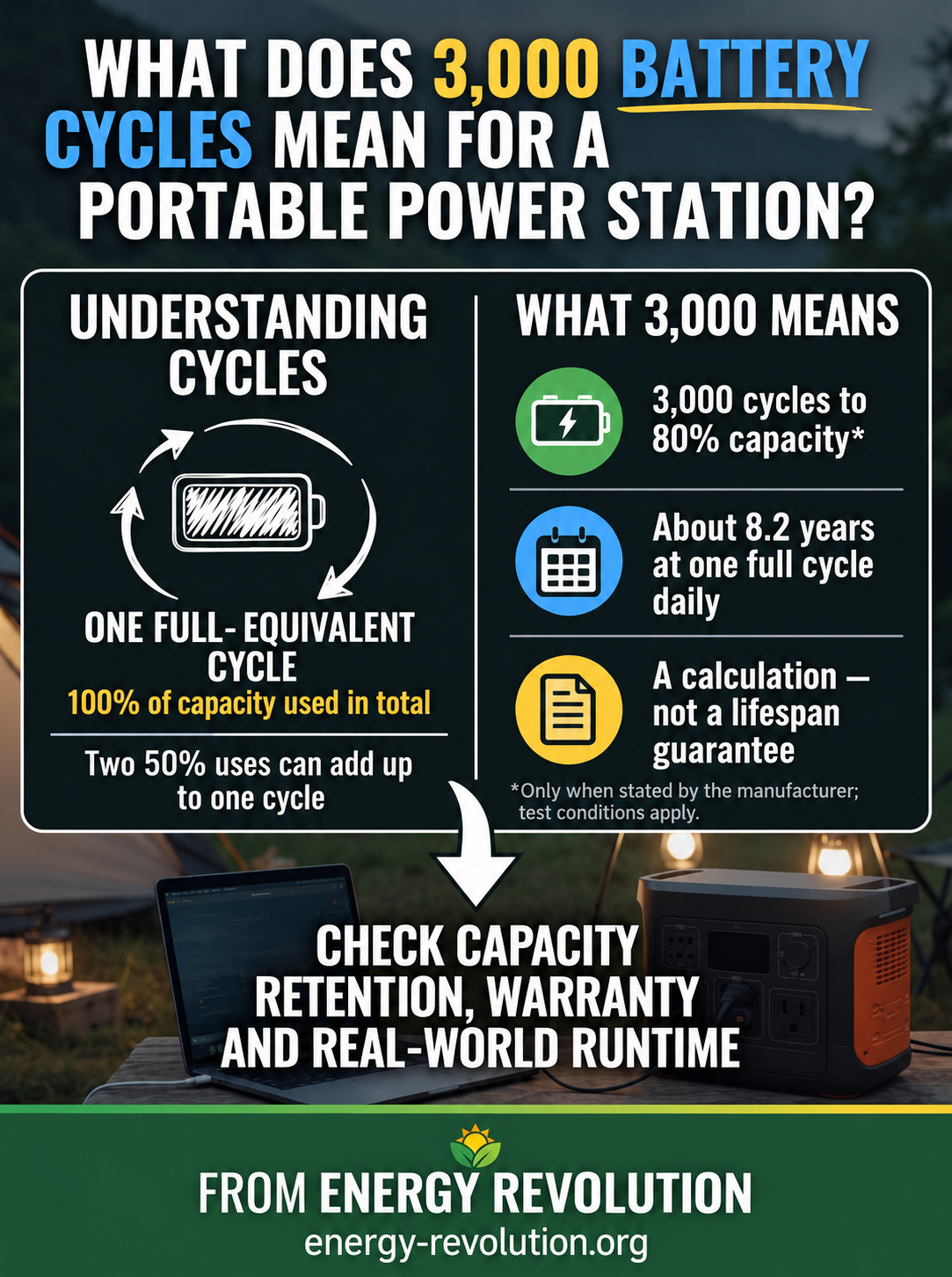
Usually, the useful claim is a number of charge–discharge cycles to a stated remaining capacity, under specified test conditions. For example, “3,000 cycles to 80% capacity” describes a capacity-retention benchmark. It is not a promise that every part of the power station will last that long.
Read the whole sentence, including its footnotes. A cycle count without a remaining-capacity percentage and test conditions tells you much less than the large number suggests.
What counts as one battery cycle?
A helpful way to understand everyday use is the full-equivalent cycle: using an amount of battery capacity equivalent to one complete battery’s worth. That use can be spread over several sessions rather than happening in one continuous discharge.
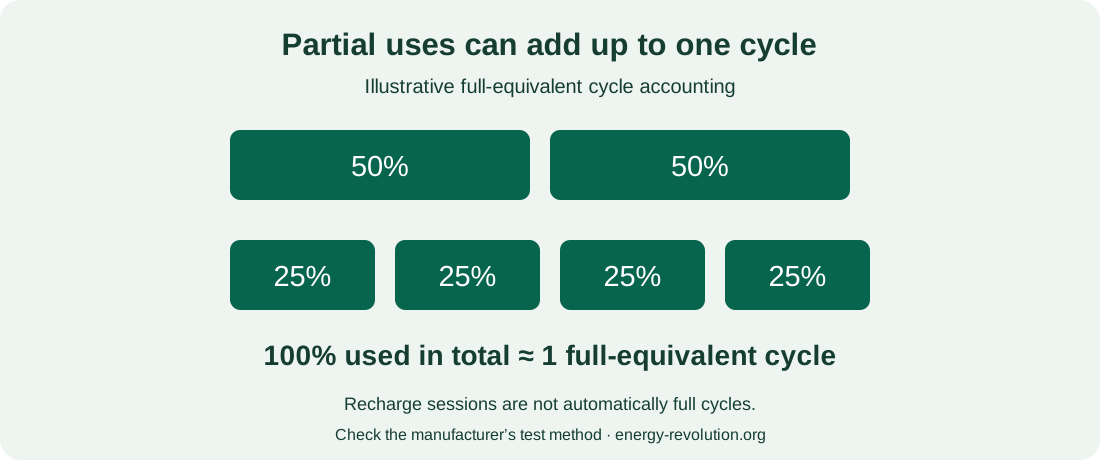
Imagine using 50% of the battery on Saturday, recharging, then using another 50% on Sunday. For simple usage accounting, those two half-battery uses add up to approximately one full-equivalent cycle. Four 25% uses would also total one.
Plugging the charger in four times therefore does not automatically mean four full cycles. Nor do you need to deliberately flatten the battery to make a cycle “count”. The percentage display is an estimate, so these are practical illustrations rather than precise measurements of cell-level energy.
There is an important qualification: a manufacturer’s laboratory cycle test may specify a particular depth of discharge, charge rate and counting method. Your app’s cycle counter may also use its own calculation. Use full-equivalent cycles to understand the principle, then check how the advertised rating was obtained.
What does “to 80% capacity” actually mean?
Suppose a new station has a nominal battery capacity of 1,000 watt-hours, written 1,000Wh. At 80% of its original capacity, the battery would store approximately 800Wh under a comparable capacity measurement.
It has lost some energy-storage ability. It has not necessarily become unusable, and reaching the stated threshold is not an automatic switch-off event. Whether its remaining runtime is useful depends on what you need to power.
Do not confuse state of charge with battery health. A display reading 100% usually means fully charged relative to the battery’s current usable capacity. An aged battery can show 100% while holding less energy than it did when new.
Likewise, an 80% capacity-retention figure does not mean the AC sockets now deliver only 80% of their rated watts. Storage capacity and output-power capability are separate specifications. Ageing, temperature or protection limits can affect performance, but you cannot calculate a new inverter rating simply by multiplying its wattage by 0.8.
Does 3,000 cycles mean eight or ten years?
At exactly one full-equivalent cycle every day, the arithmetic is:
3,000 ÷ 365 = approximately 8.2 years.
That is a conversion from cycles into time at an assumed usage rate. It is not a forecast of when a particular unit will reach 80% capacity, need repair or become unsuitable.
| Illustrative use | Full-equivalent cycles per year | Arithmetic time to 3,000 |
|---|---|---|
| One full battery’s worth daily | 365 | 8.2 years |
| Half a battery’s worth daily | 182.5 | 16.4 years |
| One full battery’s worth weekly | 52 | 57.7 years |
The last row shows why the calculation must not be treated as a lifespan promise. A power station used occasionally still gets older while sitting on a shelf. Its electronics, connectors, fans and battery can need attention long before an occasional user reaches 3,000 equivalent cycles.
Two kinds of ageing happen together
Cycle ageing relates to charging and discharging. The amount used, operating temperature and charge/discharge conditions all matter. Two people accumulating the same equivalent-cycle total need not see the same capacity loss.
Calendar ageing happens over time, including when the battery is not being actively cycled. Research on lithium-ion cells shows that temperature and storage state of charge influence this process. Results for one cell chemistry or laboratory test cannot predict the exact lifespan of every finished power station.
This matters for a weekend camper. A high cycle rating is useful information, but it does not cancel the effects of years spent in a hot vehicle or unsuitable storage. It also matters for a daily shed user: frequent cycling can make battery durability more relevant, while cooling and operating conditions still deserve attention.
How reduced capacity affects a real appliance
Consider a steady 60W load and a hypothetical 1,000Wh station. Assume 85% of the battery energy reaches the appliance after all relevant conversion and operating losses. This is an illustration, not a measured efficiency for any product.
- When new: 1,000Wh × 0.85 ÷ 60W = about 14.2 hours.
- At 80% capacity: 800Wh × 0.85 ÷ 60W = about 11.3 hours.
With the same load and assumed efficiency, runtime falls by roughly 20%. That might still cover a working day, but it may no longer meet a longer overnight requirement.
Actual results depend on the load, inverter overhead, temperature, battery reserves and output mode. For a fridge, use measured energy over time rather than treating its running wattage as a continuous load. Our fridge runtime guide explains that approach.
Low-power appliances can also make standby consumption surprisingly important. See where battery power goes when the inverter stays on before blaming every runtime change on battery wear.
What to ask about a 3,000-cycle claim
Look for the following details in the specification, manual or manufacturer’s written response:
- Remaining capacity: is the endpoint 80%, 70% or another figure?
- Depth of discharge: how much capacity was used in each test cycle?
- Temperature and charging rate: under what conditions was the battery tested?
- What was tested: individual cells, a battery pack or the complete power station?
- Warranty and service: what failures or capacity loss are covered, for how long, and can the battery be serviced?
Do not assume two products with the same headline count were tested identically. Likewise, a larger number may not justify a higher price if the unit lacks the output power, solar-input compatibility or service support you need.
As a real example of the wording, EcoFlow’s UK RIVER 3 series page states 3,000 charging cycles before capacity drops to 80%, with a testing caveat. That is a manufacturer claim for that range, not a universal rule for every lithium battery or every product on our website.
Is a cycle rating the same as a warranty?
No. A technical specification describes expected performance under stated conditions. A warranty sets out the manufacturer’s contractual support and exclusions. Read the terms for the exact model and market, including whether normal capacity loss is covered.
Keep the receipt and model details. Check registration requirements, the repair process and whether a replacement battery is available through authorised service. A long battery-cycle specification is less useful if the rest of the product cannot be repaired economically.
Habits that make practical sense
Follow the model’s charging, operating and storage instructions. Keep vents clear, protect the unit from water as specified, and avoid leaving it somewhere that becomes excessively hot. A car boot in sunshine is not equivalent to a cool indoor cupboard.
For long-term storage, use the charge level and checking interval in the manual. Advice differs between products; a universal “always store at 50%” rule can conflict with the manufacturer’s maintenance procedure. Do not leave it empty for months and assume it will recover normally.
Charging and discharging temperature limits can differ. Cold-weather charging needs particular care, even if the unit can supply power at a lower temperature. Our guide to keeping a solar battery in an unheated garage covers the questions to ask before winter storage.
If an app offers charging limits or a slower charging mode, check how the manufacturer recommends using them. Do not sacrifice essential backup readiness just to chase a perfect cycle count. Some manuals request occasional full charges or calibration procedures; follow those directions rather than repeatedly draining the unit yourself.
Choose for the job, not just the biggest number
A daily off-grid user should consider battery durability alongside dependable recharging and enough reserve for poor weather. An occasional camper may place more weight on size, weight, usable capacity and customer support.
Our Anker SOLIX C2000 Gen 2 and FOSSiBOT F2400 listings provide starting points for comparison. Check their current manuals and warranty terms; the 3,000-cycle example in this article is not being assigned to either product.
A useful buying question is: “Will this still cover my essential load if its usable capacity falls?” Leaving sensible runtime headroom can matter more than choosing between two impressive headline cycle figures.
Frequently asked questions
Does every recharge use a whole cycle?
No. Partial discharges can accumulate towards a full-equivalent cycle. Check the manufacturer’s method if you are interpreting an app counter or comparing published tests.
Does the battery die at cycle 3,001?
No. A capacity-retention rating is not an expiry counter. Continued usefulness depends on battery condition, the rest of the unit and the runtime you require.
Should I discharge to zero before recharging?
Not simply to complete a cycle. Follow the manual, including any specific calibration instructions. Routine deliberate deep discharging is not a general maintenance requirement.
Can I calculate lifetime energy as capacity multiplied by 3,000?
Only as a very rough starting quantity. Capacity changes over time, usable output differs from nominal storage, and operating losses vary. That multiplication is not a reliable guarantee of delivered lifetime kilowatt-hours or cost per unit.
Sources and further reading
Checked on 26 October 2026. Specifications and maintenance instructions are model-specific.
- EcoFlow UK: RIVER 3 cycle-life claim and testing caveat.
- Apple: cumulative battery-cycle definition — a general illustration, not a power-station specification.
- Journal of Power Sources: temperature exposure and calendar ageing research.
- Batteries & Supercaps: ageing tests and long-term prediction.
- EcoFlow UK: model-specific manuals.
For broader project planning, explore our DIY Alternative Energy Projects bundle. Start with your appliances and energy needs, then compare equipment that can support them.
Explore the Energy Revolution offer
Affiliate offer: assess the seller’s claims and terms independently. We do not guarantee results.