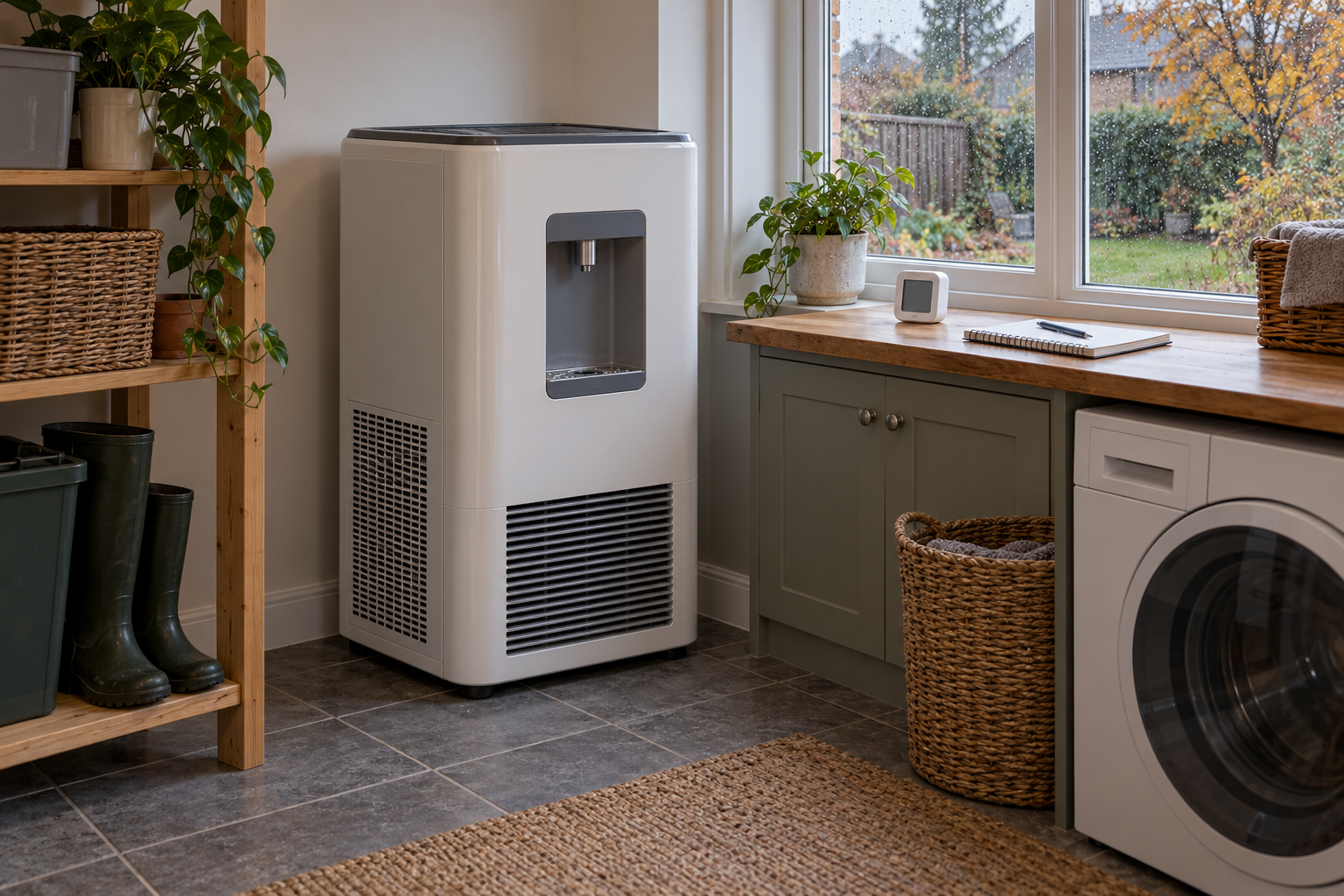
A wet November morning can make a water-from-air machine sound like an obvious fit for a UK home. There is moisture everywhere, so surely collecting a few litres should be straightforward?
The useful question is not whether the UK is damp. It is how much usable water the exact machine will produce, and how much electricity it will use, at the temperature and humidity where you intend to operate it.
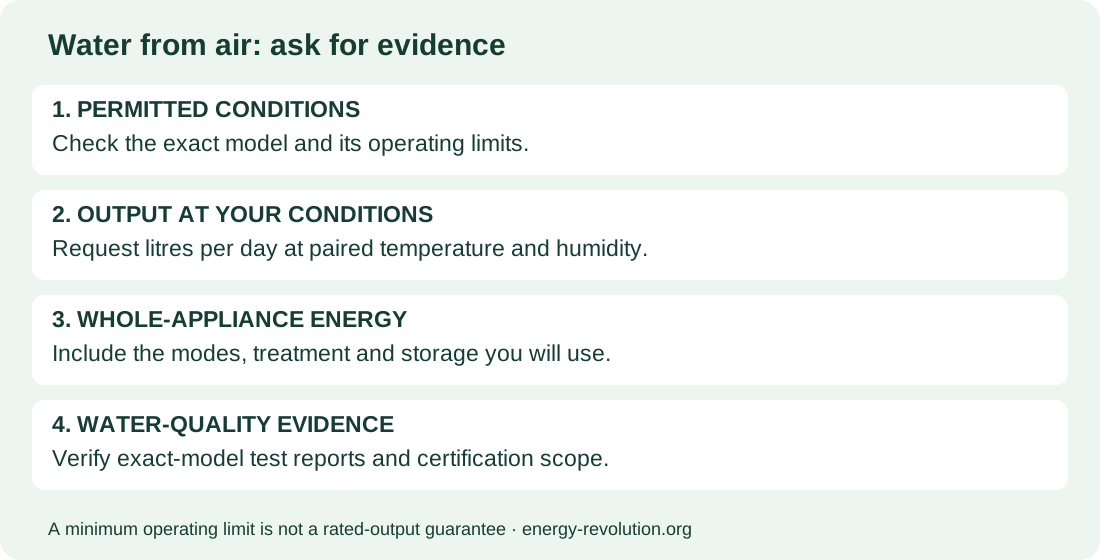
Before buying an atmospheric water generator, or AWG, ask for evidence covering cool conditions, realistic daily output, treatment, maintenance and after-sales support. A headline “up to” figure measured in warm air is not a household supply plan.
1. What technology does this machine actually use?
Many commercially available AWGs cool air across a surface so that water condenses. They then treat and store the collected water before dispensing it. The US Environmental Protection Agency describes this as a common approach and notes that production depends strongly on temperature and moisture conditions.
Other designs use different methods, including moisture-absorbing materials. Do not assume every machine has identical limitations or compare a laboratory demonstration with a finished domestic appliance.
Ask the seller for the model number, production method and current user manual. Establish whether the unit on offer is a shipping product, a prototype or a pre-order. Confirm the version intended for the UK rather than relying on a similarly named overseas model.
2. Why doesn't high relative humidity guarantee high output?
Relative humidity is a percentage of the saturation water-vapour level at a particular temperature. It is not a direct measure of how many litres a machine can collect.
As the Met Office explains, temperature and humidity are linked. Cold air at a high relative humidity can contain less water vapour than warmer air at a lower percentage. Consequently, a damp-feeling room and a warm, humid test chamber are not interchangeable operating conditions.
Heating air without adding moisture lowers its relative humidity; it does not create extra water vapour. Do not assume placing a heater beside an AWG will turn poor production into cheap water. Any deliberate heating introduced for the machine belongs in the energy assessment and must remain within the installation instructions.
Ask for paired temperature-and-humidity performance data. A temperature range on one page and an unrelated humidity range on another are not enough to predict the result at your chosen combination.
3. What will it produce at your actual room conditions?
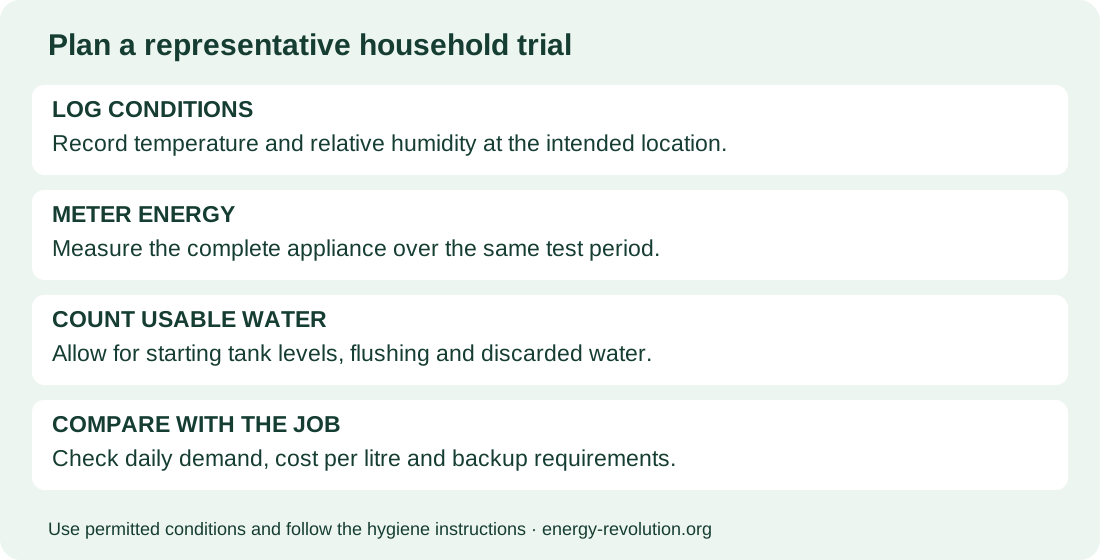
Measure the proposed location before ordering. Use a temperature and relative-humidity logger, or record readings at different times over a representative week. Include overnight periods when the heating is lower, not just a warm afternoon.
An unheated garage, a utility room and a heated kitchen may present very different conditions. Outdoor weather data can provide context but cannot replace measurements at an indoor appliance's air inlet.
Here is a useful request to send a supplier. These are example test points, not a claim that every machine operates at them:
| Example condition | What to request |
|---|---|
| The manufacturer's published rating conditions | Litres/day, kWh/day and the complete test method |
| 20°C and 60% relative humidity | Measured output and whole-appliance energy at this combination |
| 18°C and 60% relative humidity | Output, energy and whether any operating limit is approached |
| 15°C and 70% relative humidity | Whether operation is permitted at all; performance only if supported |
| Your measured overnight minimum | Shutdown, restart and water-storage behaviour |
If your conditions fall outside the permitted range, do not treat that as a request to override a sensor. Choose a suitable location or product, or reconsider the purchase.
4. Are the minimum conditions being confused with rated performance?
A published lower operating limit says where operation may begin or be allowed. It does not promise the advertised maximum output there.
For example, Watergen's GENNY Home page lists conditions starting at 18°C and 30% relative humidity, while its stated standard conditions are 26.7°C and 60% relative humidity. It lists energy use of 400Wh/litre under those standard conditions. Those figures should not be combined into a claim of that efficiency at the lower limits.
This is an example of how to read a specification, not our performance test or recommendation. The page was marked “Coming soon” when checked. Older GENNY documents also describe different limits and capacities, which is why the exact model and document revision matter.
If a seller cannot provide cool-condition results, record the output as unknown. Do not invent a percentage reduction from the headline figure and treat it as a reliable winter forecast.
5. What happens when output slows down?
Find out how the machine behaves near its lower limits. Does it stop producing? Keep a fan running? Enter a defrost or standby cycle? How much power do treatment and storage functions use while production is low?
These are questions for the particular design, not assumptions that every AWG behaves alike. Ask what the display reports: water made, water available, or water dispensed. A full storage tank can temporarily disguise low current production.
Also ask how restart works after a cold night or power cut. If stored water needs a cleaning, circulation or flushing procedure after a long shutdown, that affects convenience as well as usable yield.
6. What is the electricity cost per usable litre?
Request energy measurements over the same period as the water measurement. Include the functions you intend to use, such as chilled storage, treatment and hot-water dispensing. Nominal wattage alone does not tell you daily consumption.
Electricity cost per usable litre = measured kWh × electricity price per kWh ÷ usable litres.
Consider two purely illustrative trial results, both using an assumed tariff of 30p/kWh:
| Trial | Electricity in 24 hours | Usable water | Electricity cost/litre |
|---|---|---|---|
| A | 2kWh | 4 litres | 15p |
| B | 2kWh | 1 litre | 60p |
These are not predictions for a named machine or temperatures. They show why unchanged electricity use alongside lower output raises the cost per litre. If no usable water is produced, a meaningful finite cost-per-litre result cannot be calculated for that period; record the energy spent and zero yield.
Purchase cost, servicing, filters and discarded cleaning water still need including. Our household water-from-air cost guide provides the fuller calculation.
7. Will the proposed location suit continuous use?
Ask for clearance requirements, permitted room conditions and any restrictions on outdoor or unheated installation. Do not put an indoor appliance in a damp outbuilding simply because it feels humid.
Check the noise rating, the measurement conditions and the sound of different operating modes. A machine that is unobtrusive in a showroom may be inconvenient near a bedroom or home-working space.
Find out how heat rejection and moisture removal affect the room, and follow the specified airflow arrangement. Do not block vents or reduce required household ventilation to try to increase water production. Nor should a purchase plan depend on adding a humidifier to supply moisture: that introduces its own water and energy inputs.
Confirm electrical requirements and service access before delivery. If extra heating, cooling or ventilation would be introduced solely for the installation, ask for those costs to be included rather than counting only the appliance plug.
8. What evidence supports the drinking-water claims?
Water appearing clear is not a water-quality test. EPA research on atmospheric water generation emphasises that condensate is not sterile and requires adequate treatment before potable use. Results from one tested commercial unit do not validate every domestic model.
Ask for an independent laboratory report identifying the exact machine, sample point, test date, operating conditions and substances or organisms examined. Evidence for a freshly collected sample is not automatically evidence for water stored during repeated low-output periods.
If certification is claimed, check the certifier's listing and scope. NSF explains that certifications relate to specific performance and contaminant-reduction claims. A badge or certified component does not necessarily certify the complete appliance for every claimed use.
Request a written treatment and maintenance schedule, including what happens when a filter or disinfection component reaches its service limit. Ask whether dispensing stops after a treatment fault and how the owner is alerted.
Ordinary dehumidifier water is not a substitute. Meaco advises that its collected water is not drinkable. Do not assume a household filter jug turns untreated condensate into a verified drinking-water supply.
9. What will servicing and ownership involve?
Obtain itemised prices for replacement parts and consumables, their change intervals and availability in the UK. Some replacements may be time-based even if winter production is low.
Ask who performs servicing, what cleaning the owner must do and how the machine is prepared for holidays. Include delivery, installation if required, servicing travel charges and any water testing recommended for the proposed use.
Get the warranty, trial and returns terms in writing. In particular, ask how a performance complaint is assessed when the appliance is operating within its permitted range but produces much less than the headline output. Record any supplier commitment to your measured conditions in the quotation.
10. Does it meet the job you actually need done?
State the required drinking-water volume and the longest acceptable interruption. An AWG relying on electricity and suitable room conditions is not automatically an independent emergency supply.
For an off-grid home, put its measured daily energy into the winter budget. Solar production and AWG performance both need checking for the conditions that matter. Our battery capacity versus lower energy use guide explains why adding storage cannot solve a persistent energy deficit.
If the main goal is garden watering, investigate an appropriate non-potable collection option separately; our rainwater storage guide starts with demand and dry spells. That is a different job from making drinking water.
Frequently asked questions
Will an AWG work during a UK winter?
Possibly, depending on the exact model and its indoor or outdoor operating conditions. Ask for measured performance at the intended location's temperature and humidity, not a blanket climate claim.
Is 80% relative humidity enough information?
No. Temperature, airflow and the machine's performance data are also needed. The percentage alone cannot establish output.
Should I heat a room just to produce more water?
Do not assume that makes sense. It adds an energy input and does not create moisture. Assess the complete permitted arrangement and its costs.
What if the seller has no cool-weather figures?
Treat the output as unverified. Ask for a representative trial with clear terms, or wait for suitable evidence before relying on the machine.
Sources and project resources
Checked on 1 November 2026:
- Met Office: understanding humidity.
- US EPA: atmospheric water generation technology.
- US EPA: AWG microbial water-quality evaluation.
- Watergen: GENNY Home specifications.
- Watergen: earlier GENNY specification, illustrating model differences.
- NSF: contaminant-reduction claims and certification.
- Meaco: collected dehumidifier water is not drinkable.
Browse our Recommended Products for wider energy projects and our DIY Alternative Energy Projects bundle for planning ideas. Neither provides an AWG performance guarantee or drinking-water certification.
Explore the Energy Revolution offer
Affiliate offer: review the seller's claims and terms independently. We do not guarantee results.