The simple answer
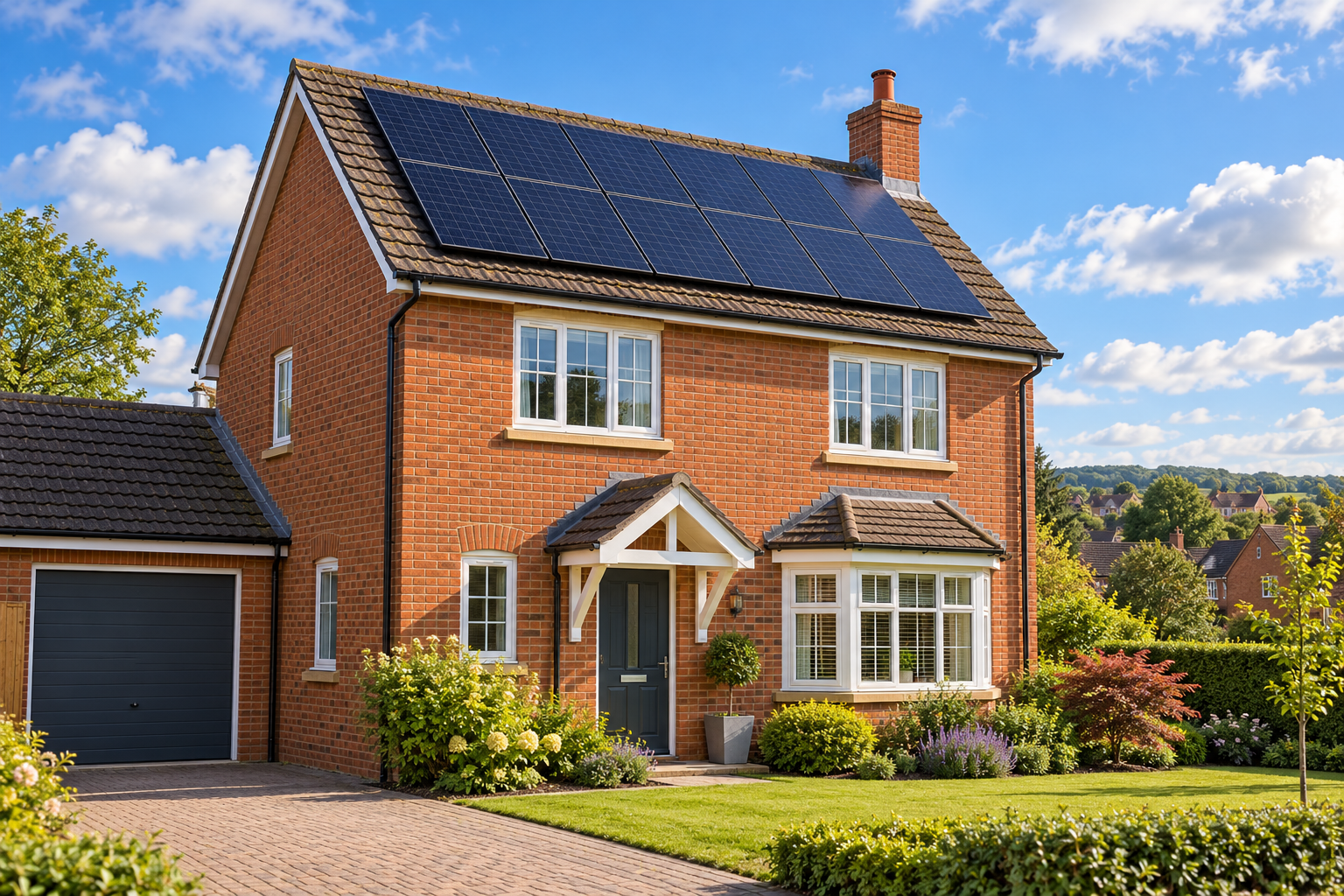
To solar power your home, you use panels to turn daylight into electricity, then use equipment that makes that electricity suitable for your appliances. A battery can save some for later. You can start with one small solar-powered device, try a portable panel and power station, or ask an installer to design a roof system. You do not have to power the whole house on day one.
Imagine sunshine arriving at your home like a free delivery of energy. Solar panels collect some of that energy. Your lights, laptop and other appliances can then use it. The sunshine costs nothing, but the equipment that collects and manages it does cost money.
This guide explains the basics without assuming you know anything about electricity. It will help you choose a sensible first step and understand what to ask before buying.
1. Understand what a solar panel does
A solar electricity panel contains small parts called solar cells. When light reaches those cells, they produce electricity. You may see the letters PV, which stand for photovoltaic. For now, just read that as “turning light into electricity”. The US Department of Energy explains this process in more detail.
Panels use light, not the warmth you feel on your skin. They can generate on cloudy days, although usually less than in bright sunshine. They do not generate useful solar electricity at night. Shade from a tree, chimney or nearby building can reduce output too.
Electricity-making panels are different from solar water-heating panels, which collect heat. This article is about solar electricity. Our guide to what solar panels are made of takes a closer look inside them.
2. Meet the main pieces of equipment
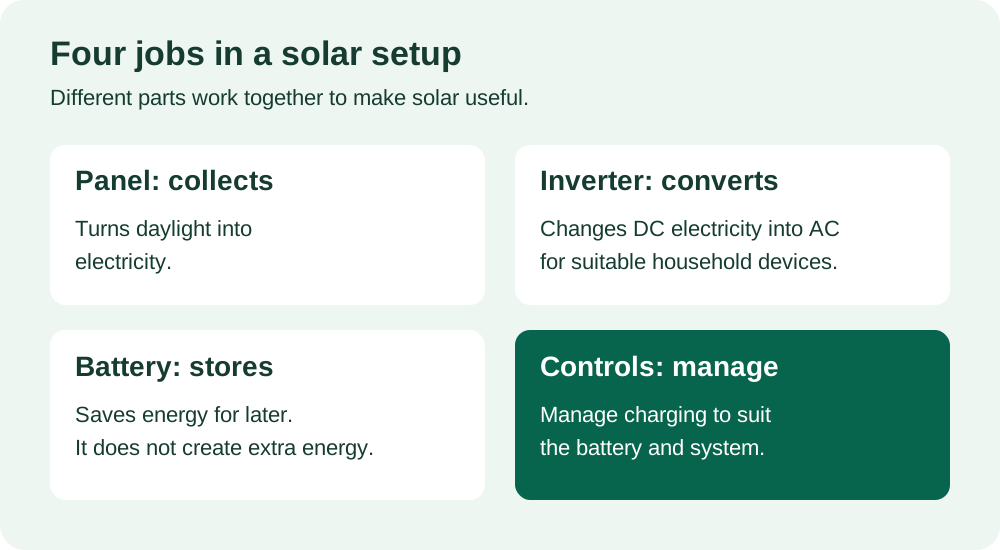
The panel collects energy. Think of it as the starting point. Its size and the light reaching it affect how much electricity it can make.
The inverter changes the electricity's form. Panels produce direct current, called DC. Most household sockets supply alternating current, called AC. An inverter converts DC into AC so suitable household appliances can use it. It is rather like a translator between two forms of electricity.
The battery stores energy. Think of a battery as a rechargeable energy tank. It lets you save electricity for later, but it does not create extra energy. Some energy is lost during charging and use.
A charge controller manages charging. It helps match the panel's output to the battery's needs. Depending on the system, this function may be built into a power station or inverter, rather than supplied as a separate box.
There are also mounts, cables, connectors and protective devices. These must suit the equipment and location. The DOE's system-design guide explains why panels are only one part of the complete setup.
3. Choose how you want to begin
One small job: a ready-made solar garden light is an easy introduction. Its panel, rechargeable battery and lamp are already matched. You can observe what happens after sunny and cloudy days without building an electrical system.
A few separate devices: a portable solar panel and compatible power station can supply suitable lamps, chargers or other appliances plugged directly into the station. This is useful for learning or occasional use. It does not automatically supply your home's existing wall sockets.
A home installation: professionally fitted panels can supply electricity through your home's electrical system. A typical grid-connected home still uses the public electricity network when solar is insufficient. Unused solar may charge a battery or be exported, depending on the installation and local arrangements.
Going fully off-grid means managing without that network connection. It needs a much more detailed plan for poor weather, winter demand and backup. Reducing electricity bought from the grid is a different goal from leaving it completely.
4. Work out what you want to power
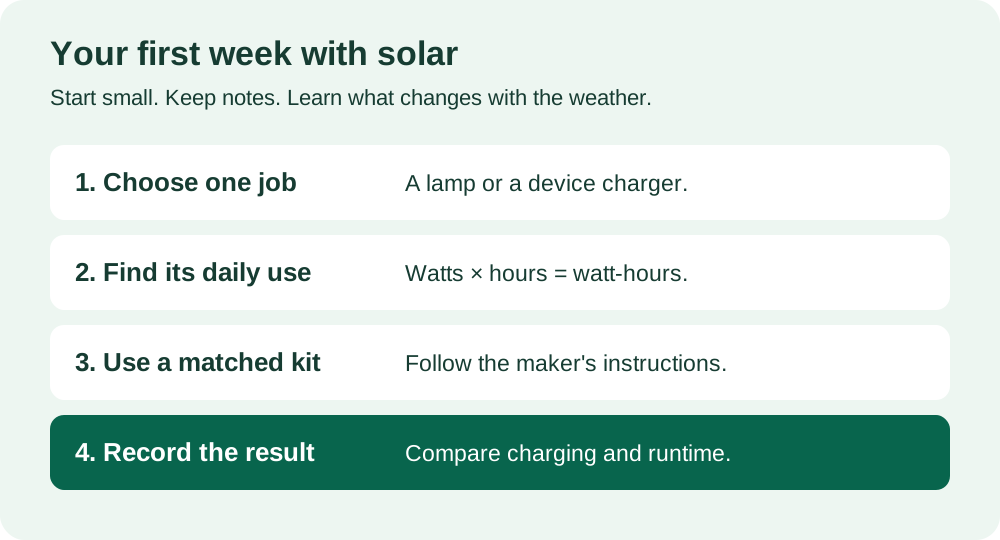
Start with a short list: perhaps a lamp, a laptop and a router. Write down how long each runs. Two simple terms help:
- Watts, or W: how quickly a device uses energy at a particular moment.
- Watt-hours, or Wh: how much energy it uses over time. Multiply watts by hours.
A 10W lamp used for five hours needs 50Wh. A kilowatt-hour, written kWh, is 1,000Wh. This is the unit you normally see on an electricity bill.
| Device | Example use | Energy |
|---|---|---|
| LED lamp | 10W × 5 hours | 50Wh |
| Laptop | 50W average × 4 hours | 200Wh |
| Router | 10W × 24 hours | 240Wh |
| Total | Before supply-system losses | 490Wh |
Actual devices vary. A label may show a maximum rather than normal use. An adult can use a suitable plug-in energy meter, following its instructions, to measure a plug-in appliance. For the whole home, gather a year's electricity bills and note when most electricity is used.
Heating appliances can demand much more power than lights. Fridges and pumps can briefly need extra power when starting. Our fridge runtime guide explains why measuring daily use is better than guessing.
5. A basic kit for starting small
For a first portable setup, choose a complete, manufacturer-supported combination. A shopping checklist could look like this:
- A portable solar panel: sized for your chosen task and the station's permitted solar input.
- A compatible power station: with enough stored energy and the right output sockets for your devices.
- The approved connecting cable: sometimes included, sometimes bought separately.
- A secure panel stand: often built into a folding panel.
- A suitable place: sunshine for the panel, with the station dry, ventilated and within its stated temperature limits.
- A small first load: such as an LED lamp or a charger that the station supports.
A panel around 100W and a station storing a few hundred Wh can be a starting point for comparing small-device kits. Those sizes are examples, not a promise that they will cover your particular daily use. Check the numbers first.
Ask the supplier to confirm panel voltage, current and connector compatibility. Matching plugs alone is not enough. With an all-in-one power station, charging controls and the inverter are usually built in; do not buy extra boxes unless its instructions require them.
Keep this setup separate from house wiring. Never feed a power station into a household socket. Fixed wiring and any home-backup connection need the correct professional design and installation.
6. Understand why a 100W panel does not make 100W all day
The number on a panel is a rating measured under standard test conditions. Real output changes with sunlight, angle, temperature and shade. Ten hours of daylight is not ten hours at full rated power.
Here is a learning example. Suppose a 100W panel receives a day's light equal to four hours at full reference sunshine. That gives 400Wh before losses. If our example system delivers 75% of that to the load, it provides 300Wh. The four hours and 75% are invented planning assumptions, not a forecast for your home.
That example would not cover the 490Wh device list above. You would need to change the demand, generation or charging plan. A bigger battery alone would only delay running short. Read Adding Panels or a Battery: Which Problem Are You Solving?
7. Products on our site that may help
Our DIY Alternative Energy Projects bundle costs £9.99 and combines an introductory ebook, seven small projects and printable planning materials. It is a useful learning companion for working out goals and trying simple activities. Hardware is not included, and it is not a qualification to install home electrics.
For readers needing larger portable storage, we feature the FOSSiBOT F2400 and Anker SOLIX C2000 Gen 2. Their manufacturers list 2,048Wh capacity and 2,400W rated AC output for the relevant models. Capacity describes stored energy; output describes how much power they can supply at once. Those are different numbers doing different jobs.
These are larger options, not necessary purchases for learning with one small lamp. Check the exact regional model, usable runtime, supported appliances and compatible panels. A station sold alone may not include a solar panel. Neither product is automatically a whole-house supply.
8. Taking the next step towards a solar-powered house
Before requesting quotes, gather your electricity bills, your goals and any plans for extra demand, such as an electric car. Note shade from ground level. Do not climb onto the roof to inspect it.
Ask an installer to assess roof condition, available space, shade and likely seasonal generation. Energy Saving Trust's solar guide is a useful UK starting point. Our installation guide explains what the process involves.
A home quote should cover panels, inverter equipment, mounting, cables, protection, access equipment, labour and testing. Add battery storage only where it serves your goals. Request the complete price, estimated yearly generation, assumptions about savings, warranties and aftercare.
Ask who handles permissions, inspections and electricity-network requirements in your area. Rules differ between the UK, US and Canada, and within those countries. Compare quotes on the same basis instead of choosing only by panel count.
Questions beginners often ask
Do I need a battery?
Not for every grid-connected system. You can use solar as it is generated and buy electricity when needed. A battery saves some energy for later, but adds cost. Energy Saving Trust's battery guide explains that trade-off.
Will solar keep the lights on during a power cut?
Not automatically. Ordinary grid-connected systems normally shut down during an outage. Backup needs suitable equipment and a design that safely separates it from the grid. The DOE's inverter guide explains why outage operation must be designed in.
Can I start if I rent?
You may be able to use a suitable portable setup where you have permission, safe space and useful sunlight. Read our solar guide for renters before buying. A shaded windowsill is not equivalent to an open sunny position.
Can children learn about solar safely?
Yes. An adult-supervised, age-appropriate low-voltage kit or intact solar garden light makes a good learning activity. Roof work, mains wiring and assembling large battery systems are not children's projects.
If you are comparing kits made from separate parts, our solar inverter and two-mini-panel kit introduction explains what to check. It is not the same as an all-in-one power station: confirm panel output, battery requirements, protection and installation needs before buying.
For a separate-component option, our ECO-WORTHY 400W kit overview introduces a panel, battery, controller and inverter package. It needs a suitable installation and a load plan; it is not an all-in-one portable power station or a whole-house solution.
If your first goal is lighting, our Photonic Universe 15W solar lighting kit overview offers a smaller, task-focused option to compare. It includes four LED lights and battery storage, rather than a household AC supply. Check the expected lighting hours against the sunlight available.
Start with one useful solar-powered job
Choose something small, measure what it needs and learn how sunshine changes the result. Our DIY Alternative Energy Projects bundle offers beginner activities and printable tools to help you plan.
Explore the DIY bundle — £9.99Before installation: read our guide to planning permission for home solar and wind in England, including the updated 2026 solar rules and separate safety checks.