
Quick answer
For most short camping trips with modest charging needs, a portable solar panel and a pre-charged battery are the simpler starting point. A portable wind turbine becomes worth considering when your pitch has sustained, usable wind, enough safe setup space and the campsite owner’s agreement. Exposure alone does not establish useful wind generation. Compare the energy you can collect during your actual stay, rather than the biggest wattage on the box.
An exposed campsite seems like the perfect place for wind power. The tent fabric moves, the washing dries quickly and there is little shelter between you and the hills. Meanwhile, a folding solar panel promises charging without a mast or spinning blades. Which deserves the space in your car?
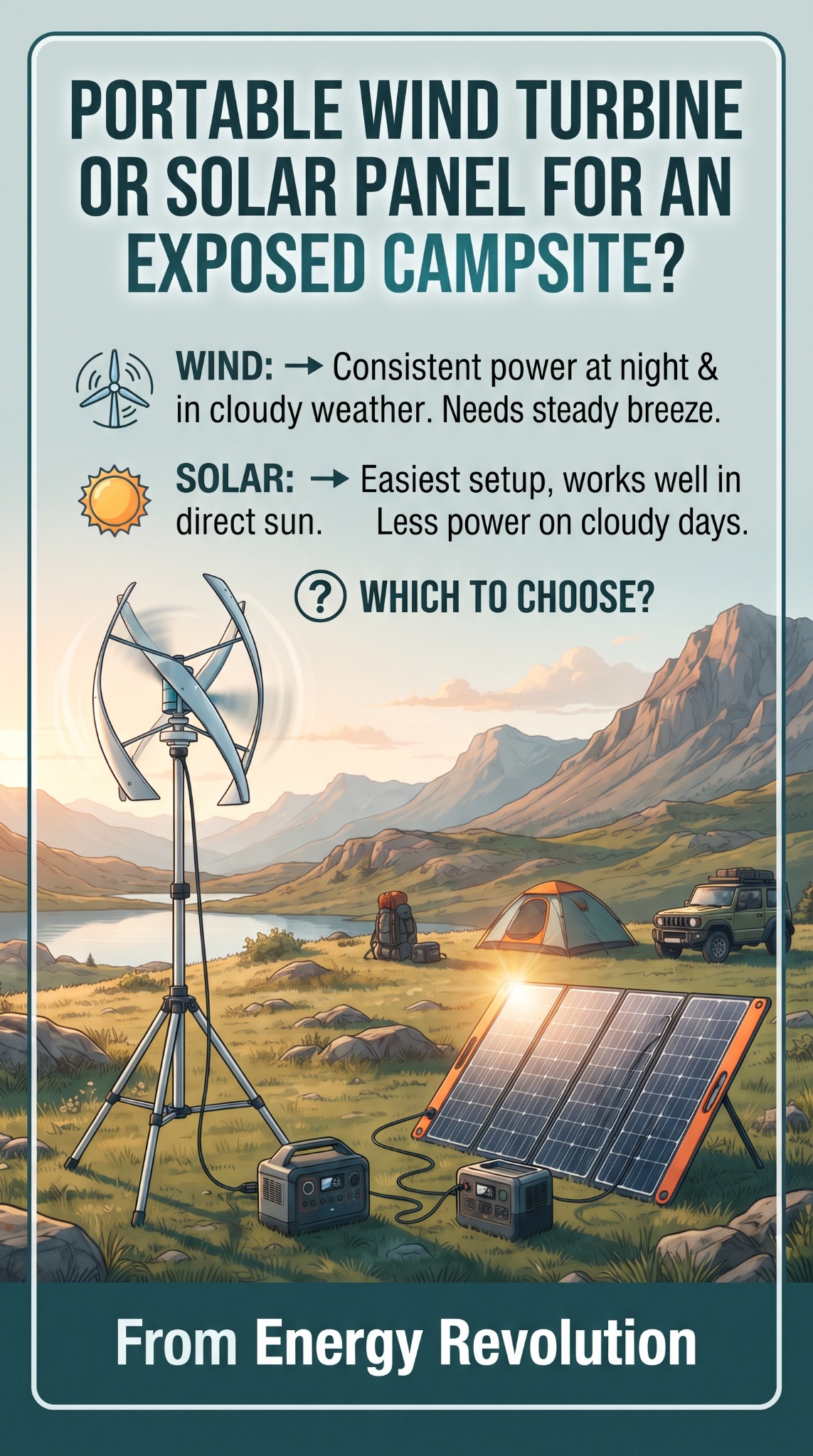
Our Pinterest pin captures the attraction of both: wind can work after dark, while solar offers straightforward daytime charging. One detail needs care: wind is not automatically “consistent” at night or under cloud. It can generate at those times only while conditions remain suitable.
Affiliate disclosure: We may earn a commission if you purchase through affiliate links, at no extra cost to you. We also link to our own digital bundle. The examples below are planning calculations, not results from a comparative equipment test.
Start with what you actually want to charge
Two phones and a lantern are a very different task from a fridge, laptop and electric cooking equipment. Make a daily list before comparing generators. Use watt-hours, or Wh: watts multiplied by hours of use.
| Example camping load | Daily allowance | How to check it |
|---|---|---|
| Two phones | 40Wh combined | Measure energy at the charging source |
| LED lantern | 5W × 4 hours = 20Wh | Check consumption at your chosen brightness |
| Camera or small devices | 20Wh | Allow for actual charging frequency |
| Total | 80Wh per day | Before battery-system overheads |
These are illustrative figures. Add a laptop drawing an average 45W for three hours and another 135Wh appears. A fridge needs a separate daily measurement because its compressor cycles; see our fridge runtime guide. Electric heating and kettles also require a separate power and energy budget.
For two days of the modest example, you need 160Wh at the loads. If you assume 80% of a battery’s nominal capacity reaches those loads, that suggests at least 200Wh nominal before adding reserve. Actual usable capacity depends on the equipment, temperature and output used.
Why solar is often the easier first choice
A folding panel generally needs a suitable sunny position, a stable support and a compatible charging connection. There is no rotor to keep clear and no turbine mast to assemble. That makes it a practical first option for short stops and ordinary pitches, provided sunlight and space are available.
Place the panel where tents, vehicles and hedges will not shade it as the sun moves. Aim it towards the sun as the manufacturer recommends. A sunny pitch at breakfast may be shaded by a campervan later, so think about the hours when the panel will actually be deployed.
EcoFlow’s portable-panel manual illustrates the importance of sunlight, avoiding shade and matching electrical parameters. It also describes secure fixing in windy conditions. Follow the manual for your own panel: mounting arrangements and weather limits vary.
Solar’s main limitation is timing. It generates nothing at night, and heavy cloud can leave very little useful charging. Long summer daylight does not mean rated output throughout the day. Our guide to realistic portable solar output explains why location and exposure matter.
Why a windy-feeling pitch can disappoint
The wind at a portable rotor’s height may be quite different from a regional forecast. Tents, vehicles, buildings and nearby trees disturb airflow. Strong gusts between long lulls can feel impressive while delivering relatively little energy.
The US Department of Energy’s Small Wind Guidebook explains why wind speed, turbine power curves, height and local site conditions matter. Its larger-system guidance should not be treated as a direct prediction for a camping turbine, but the need to assess the resource still applies.
Ask for the proposed turbine’s output across a range of wind speeds. The speed at which it begins turning is not necessarily the speed at which it delivers useful charging. Read our cut-in speed versus useful output guide before relying on a “starts in a light breeze” claim.
Do not buy from rated watts alone. A turbine may reach its advertised rating only in wind substantially stronger than the conditions at your pitch. Our power-curve explanation shows how to separate a maximum rating from energy over time.
Compare daily energy with a simple example
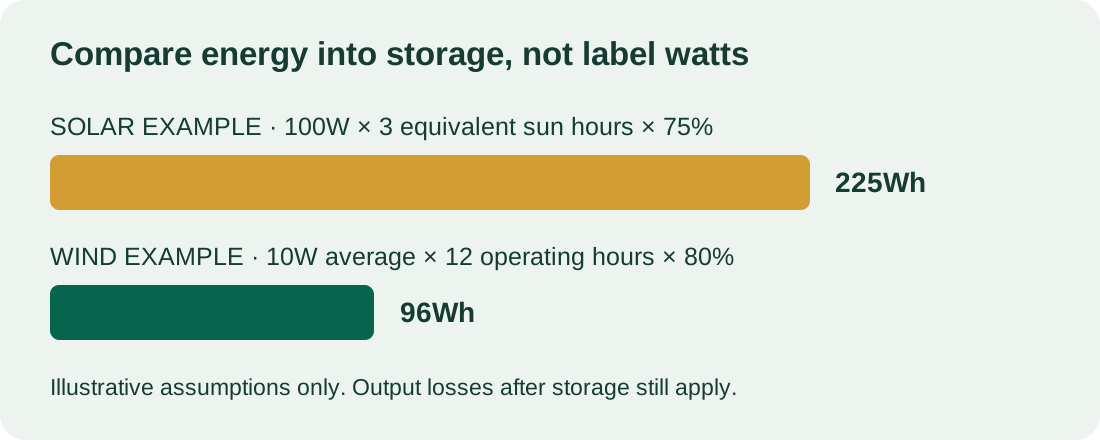
For solar, imagine a 100W panel receiving the equivalent of three hours at full reference sunlight over the day. With an assumed 75% allowance for real-world collection and charging performance, it would deliver 100 × 3 × 0.75 = 225Wh to storage. Three equivalent sun hours are not simply three hours between sunrise and sunset.
For wind, suppose measured output averages 10W for 12 operating hours. That is 120Wh at the measurement point. If only 80% reaches storage after the remaining losses, you collect 96Wh. At an average 20W for the same period, the result becomes 192Wh.
These deliberately hypothetical figures are not forecasts or matched product-test results. Their purpose is to show how operating time and average output change the answer. Energy entering storage is also not the same as energy later delivered to devices: allow for discharge and output losses.
What must fit on your pitch?
| Practical question | Portable solar | Portable wind |
|---|---|---|
| When can it generate? | During daylight, depending on sunlight | Day or night, while wind is suitable |
| What space is needed? | Unshaded panel area and safe cable route | Rotor clearance, support and any guy-line area |
| What needs securing? | Panel and stand against gusts | Mast, anchors and equipment as specified |
| What affects neighbours? | Placement, cables and any equipment fans | Those issues plus rotor sound and moving parts |
| What may stop generation? | Darkness, deep shade or packing away | Calm conditions, unsafe wind or required shutdown |
Ask the campsite before bringing a turbine. Describe its height, rotor size, anchoring requirements and intended operating hours. Permission to pitch a tent does not establish permission to erect a turbine. Confirm whether unattended or overnight operation is acceptable as well as permitted by the manufacturer.
Keep equipment and cables within your agreed area and clear of paths. Account for children, pets and people walking between pitches. A compact device still needs the clearances in its instructions. The Shine manufacturer’s manual page is an example of the model-specific setup and takedown information to obtain before buying.
Exposed does not mean safe in every weather
Both systems need a pack-away plan. A folding panel can catch the wind, and a turbine can have operating limits below the strongest gust forecast for your stay. Do not confuse an advertised survival rating with permission to keep generating in those conditions.
Check the manufacturer’s operating wind range, anchoring instructions and shutdown sequence. Pack equipment away before conditions make that difficult. Do not improvise turbine braking or disconnect a running turbine contrary to its instructions.
Keep the power station and connections within their stated weather limits, with ventilation maintained. A water-resistant panel does not make the connected battery weatherproof. Choose a safe pitch first; placing your tent in a hazardous exposed spot to improve charging is a poor trade.
Will it charge the battery you already own?
For solar, confirm the panel’s open-circuit voltage, operating voltage, current, polarity and connector arrangements against the power station’s input requirements. Account for temperature where the manufacturer requires it. A plug that fits is not proof of compatibility.
A wind turbine needs an appropriate charging and control arrangement. Never assume its output can go directly into a power station’s solar input. Some portable turbines provide regulated USB output; others use different battery interfaces. Check what the exact model supports and how it behaves when charging stops.
If you combine wind and solar, use a system explicitly designed to accept both sources safely. Our article on charging a 12V battery from small wind explains the wider compatibility questions.
Choose for the trip you actually take
A short summer weekend: start with your measured demand and a fully charged battery. A compatible portable panel can extend your reserve. If your battery already covers the whole stay comfortably, buying a generator may add little value.
A longer stay on an open, windy pitch: wind may be worth investigating if the owner agrees, the device has suitable performance data and the setup is manageable. Plan for lulls and weather shutdowns, not just the windiest hours.
A crowded or sheltered site: a turbine may be impractical regardless of the forecast. Consider solar where sunlight is available, a permitted charging service or electric hook-up using the correct campsite equipment.
For car or campervan trips, our FOSSiBOT F2400 and Anker SOLIX C2000 Gen 2 listings introduce larger storage options. Check current weight, usable capacity and charging requirements; this category may be excessive for two phones and unsuitable for backpacking. Neither listing establishes compatibility with a wind turbine.
Frequently asked questions
Does a portable turbine work at night?
It can, if the wind and operating arrangements are suitable. Darkness does not stop wind generation, but calm weather does.
Will solar still charge under cloud?
Often at a reduced rate, but thick cloud or deep shade can leave very little useful output. Carry enough reserve rather than assuming every day refills the battery.
Is a vertical-axis camping turbine automatically better?
No. Compare verified output, total carried weight, setup space, noise and operating limits for the actual model, rather than judging from rotor shape.
Can I leave a turbine running beside other tents?
Only if the site permits it and the manufacturer’s requirements can be met. Read our small wind noise guide and consider neighbours before setting up.
Should I take both?
Only when the extra weight, cost and setup solve a measured shortfall. Neither source guarantees charging, so retain an essential-load reserve.
A practical starting point
For ordinary camping, begin with efficient devices, a charged battery and a realistic daily budget. Add solar when the available daylight and pitch suit it. Investigate wind when sustained airflow and safe, permitted operation make it a credible addition. Our off-grid reserve planning guide helps you prepare for the days neither source delivers enough.
For broader research, you can view the separate affiliate energy offer. Check the seller’s description and terms; it is not evidence of camping-equipment performance.
Explore more practical energy ideas
Our DIY Alternative Energy Projects bundle brings together the ebook and additional project pack. Explore the listing for ideas to investigate around your own needs.
Explore the DIY Alternative Energy Bundle on Payhip