
Quick answer
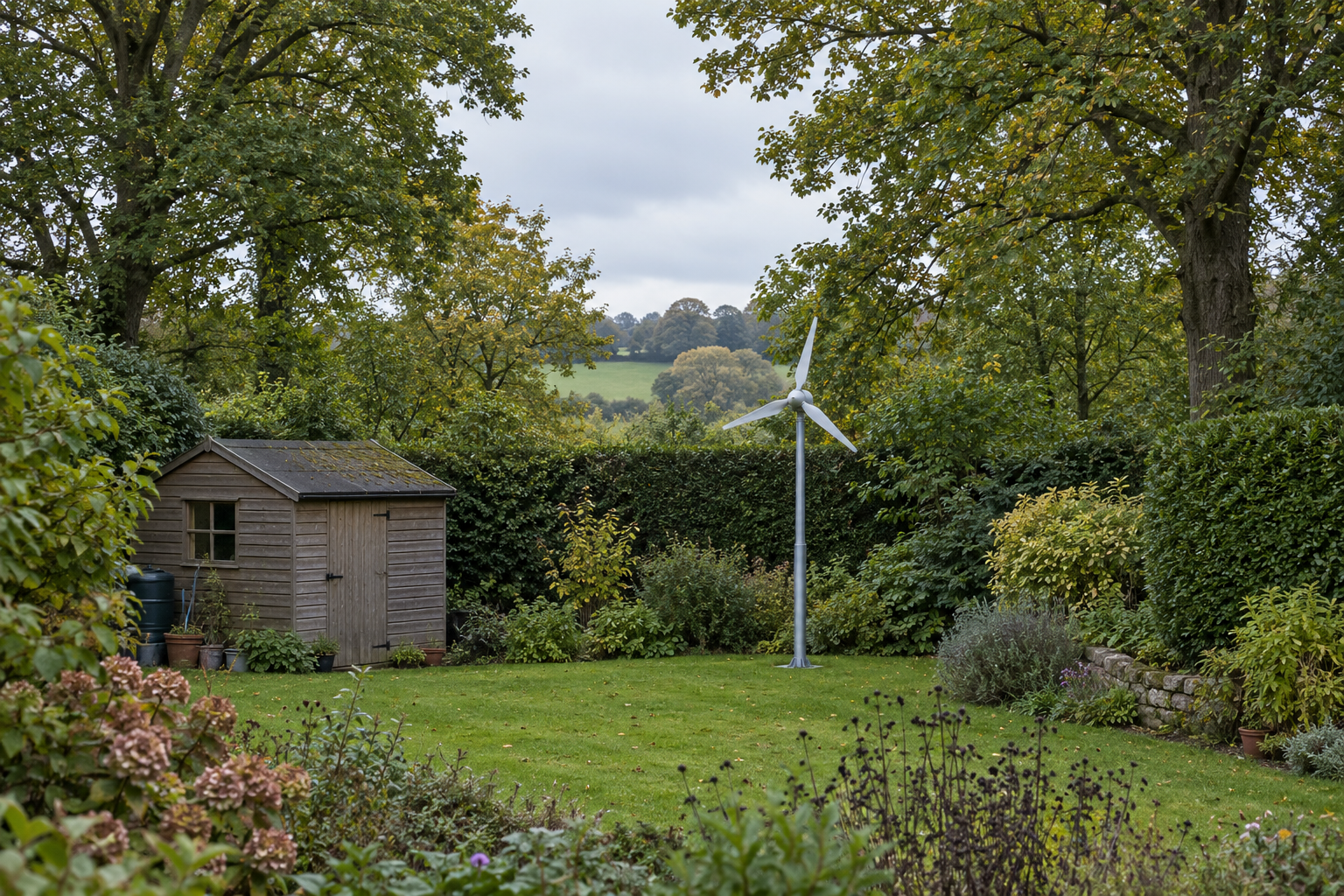
A small wind turbine is often a poor investment in a garden surrounded by trees, especially if its rotor would sit below or close to the canopy. Shelter reduces the wind reaching it, while turbulence makes the airflow less consistent. It may be worth investigating if a practical, permitted tower position can reach cleaner wind and a site-specific energy estimate supports the cost. Start with the site, not the turbine's advertised watts.
Tree branches moving above your garden can make a wind turbine seem an obvious choice. Yet the air at the proposed rotor height may behave quite differently from the air moving the treetops. A sheltered garden can feel gusty without providing a dependable supply of useful energy.
The question is not whether a turbine will turn. It is whether the complete installation will deliver enough usable electricity, over enough years, to justify its expense and maintenance. For a small shed supply, that distinction can prevent an attractive gadget becoming an expensive ornament.
What trees do to the wind
Trees slow and redirect airflow. Behind and around their crowns, wind can change speed and direction rapidly. The result depends on tree height, canopy density, gaps, distance and the direction from which the wind arrives.
A hedge on one boundary is different from mature trees on every side. A gap that admits wind from the east may offer little benefit when the most useful winds arrive from the west. Shelter also changes as deciduous trees gain or lose leaves, and as neighbouring trees grow.
Energy Saving Trust's wind guidance identifies exposed, windy locations as the better candidates and sheltered locations as less suitable. That makes tree cover a reason to investigate carefully, rather than a detail to ignore after choosing a turbine.
Do not assume a gust between two trees represents an improvement across the whole rotor. A small patch of fast-moving air is not the same as a broad, steady wind resource.
Why turbulence matters beyond average speed
A turbine works in the air that crosses its swept area. Rapid changes in that air affect how consistently it can extract energy. A horizontal-axis machine may repeatedly change its orientation, while changing loads act on blades, bearings, mountings and the support structure.
The US Department of Energy's small-wind FAQ warns that rooftop turbulence can reduce energy production and shorten equipment life. A roof that lifts a turbine a little higher is therefore not automatically a solution to surrounding trees.
Ask whether the proposed turbine and tower are suitable for the assessed conditions. A reassuring claim that a machine “works in gusty wind” is not a substitute for a yield estimate, a clear design basis and written maintenance requirements.
Can a taller pole fix the problem?
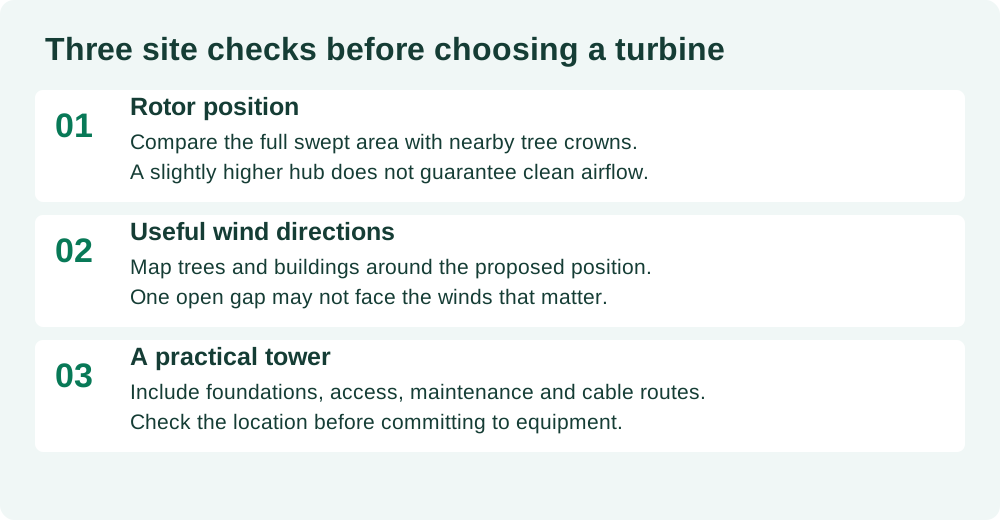
Sometimes height opens access to a better resource, but the improvement has to be demonstrated. Raising the hub just above one tree does not prove that the entire rotor has escaped disturbed air from every relevant direction.
The DOE Small Wind Guidebook gives a broad siting rule of placing a turbine about 9m above obstacles within roughly 150m. This US guidance illustrates the scale of separation being considered; it is not a UK planning permission rule or a universal guarantee of clean airflow.
For a small enclosed garden, a tower that genuinely improves exposure may be impractical. Include its base, any guy-wire footprint, access for lowering or servicing, cable route and relationship to nearby buildings and boundaries. A cheap turbine head does not make those requirements disappear.
Our roof-mounted versus pole-mounted turbine guide helps frame that comparison. Do not treat a chimney bracket or shed roof as an inexpensive substitute for a properly assessed support.
Why the rated wattage does not answer the question
A turbine's rated output applies at stated conditions. A model described as 1kW does not provide 1kW whenever there is a breeze. Below its rated wind speed, output may be much lower; below its generating threshold, useful electricity may be negligible or absent.
Wind's available power varies with the cube of wind speed when air density and swept area are held constant. As a simple physics illustration, air moving at 4m/s contains about 30% of the wind power available at 6m/s over the same area: 4³ ÷ 6³ is approximately 0.296.
This is not a prediction that a particular turbine will produce exactly 30% as much electricity. Its power curve, controls, losses and operating limits matter. Nor should you cube an annual average speed to calculate annual production: the distribution of speeds over time is important.
Read our 1kW wind turbine power-curve guide before comparing product labels. Ask for expected annual kilowatt-hours at your proposed location and height, with the assumptions clearly stated.
Collect useful evidence before requesting a quote
Begin with a sketch of the garden. Mark the candidate turbine position, buildings, boundaries, tree groups and approximate heights. Add photographs looking outwards in several directions, including the direction of the strongest regular winds.
Then record the intended job: perhaps charging lights and a laptop in a shed, rather than supplying a house. Include when those loads operate and how much energy they use. An annual generation total does not show whether energy arrives when you need it.
A regional wind map or nearby weather station can help screen an area, but cannot describe every sheltered garden. Measurements should be representative of the intended hub height and exposure. A handheld reading beside the patio on a windy afternoon cannot support a reliable annual forecast.
For a serious installation, discuss a measurement campaign with the assessor. A full year can capture seasonal differences, although equipment quality, mounting position, missing records and comparison with longer-term conditions also matter. Do not climb trees or improvise a tall mast to collect data.
Our wind-site log for installer quotes gives you a practical starting point. The aim is to make uncertainty visible before money is committed.
A simple financial stress test
Use the complete installed cost, not the turbine's checkout price. Include the tower, foundations, electrical equipment, installation, assessment, access and any storage needed for your intended use. Ask separately about servicing and likely replacement parts.
The table below uses invented annual yields and an assumed value of 25p for every usable kilowatt-hour. It illustrates sensitivity to output; it is not a tariff forecast or a prediction for a tree-surrounded site.
| Usable energy each year | Assumed value per kWh | Gross annual value |
|---|---|---|
| 100kWh | £0.25 | £25 |
| 300kWh | £0.25 | £75 |
| 600kWh | £0.25 | £150 |
If an entirely hypothetical system cost £3,000 and delivered 300 usable kWh annually at that assumed value, simple payback would be 40 years before maintenance, financing or replacements. This does not establish a typical turbine cost; it shows how modest output can overwhelm an attractive purchase price.
Value self-used and exported electricity separately using your own applicable rates. For an off-grid shed, compare the service provided and alternatives rather than assuming every generated unit saves a retail electricity purchase. Energy discarded when a battery is full has no useful-load value.
Will a vertical-axis turbine or battery rescue the idea?
A vertical-axis turbine can accept wind from different directions without a conventional yaw mechanism. That does not create energy in slow air or remove all the effects of turbulence. Compare independently supported performance information for the actual model, rather than assuming its shape solves a sheltered location.
A battery can shift available energy to another time. It cannot compensate indefinitely for low generation. Our panels or battery decision guide explains the same distinction for solar: insufficient energy production and insufficient storage are different problems.
Also check compatibility before buying a wind generator for an existing battery system. Wind equipment can require specific control and protection arrangements. A solar input on a portable power station is not automatically suitable for direct connection to a turbine.
When solar or a simpler supply deserves a look
If there is an unshaded roof or another suitable sunny location, compare a solar proposal with the wind proposal using the same loads and budget. Trees may shade panels too, so switching technologies without checking the site merely changes the problem.
Our shaded-shed solar guide helps you map that restriction. For occasional tool charging, reducing demand or charging batteries elsewhere may be more practical than installing a generating system in a poor location.
A small turbine can still have educational value. Treat a supervised demonstration as a learning purchase with a defined budget, rather than promising that it will pay the household bills. Measuring modest output honestly can be more useful than chasing an ambitious advertised rating.
Questions to settle before proceeding
Ask the installer what evidence supports the proposed height, how tree shelter enters the annual-energy estimate, what maintenance access is required and how performance will be monitored. Request a cautious scenario as well as the headline estimate.
Check local planning requirements before committing to a tower. Do not assume that a small turbine, a remote garden or a removable pole makes approval unnecessary. Consider neighbours, sound and service access early. Avoid basing the project on cutting back trees you do not control.
Frequently asked questions
If the trees sway, is there enough wind?
Not necessarily. Movement at canopy height does not establish the wind resource at the rotor, and gusts alone do not establish useful annual generation.
Will it work better when the leaves fall?
Exposure may change, but branches, trunks and other obstacles remain. Use seasonal evidence rather than assuming that winter removes the shelter problem.
Should I remove trees to make space?
Do not make tree removal the starting assumption. First establish whether a viable installation is possible, then consider the wider effects, ownership and any permissions with appropriate advice.
Can wind complement solar in winter?
It can at a suitable site, but only if the measured wind resource supports useful generation. A seasonal argument cannot rescue a rotor position that remains heavily sheltered.
Make the site earn its place in the budget
For most small gardens enclosed by mature trees, the sensible first decision is to pause the turbine purchase. Investigate only if a realistic location can offer better exposure and the expected usable energy justifies the complete system. Choosing another solution after checking the evidence is a successful outcome.
Compare the resources on your plot
Assess wind, sunlight and any usable water resource against your actual energy needs.
Compare Solar, Wind and Micro Hydro