
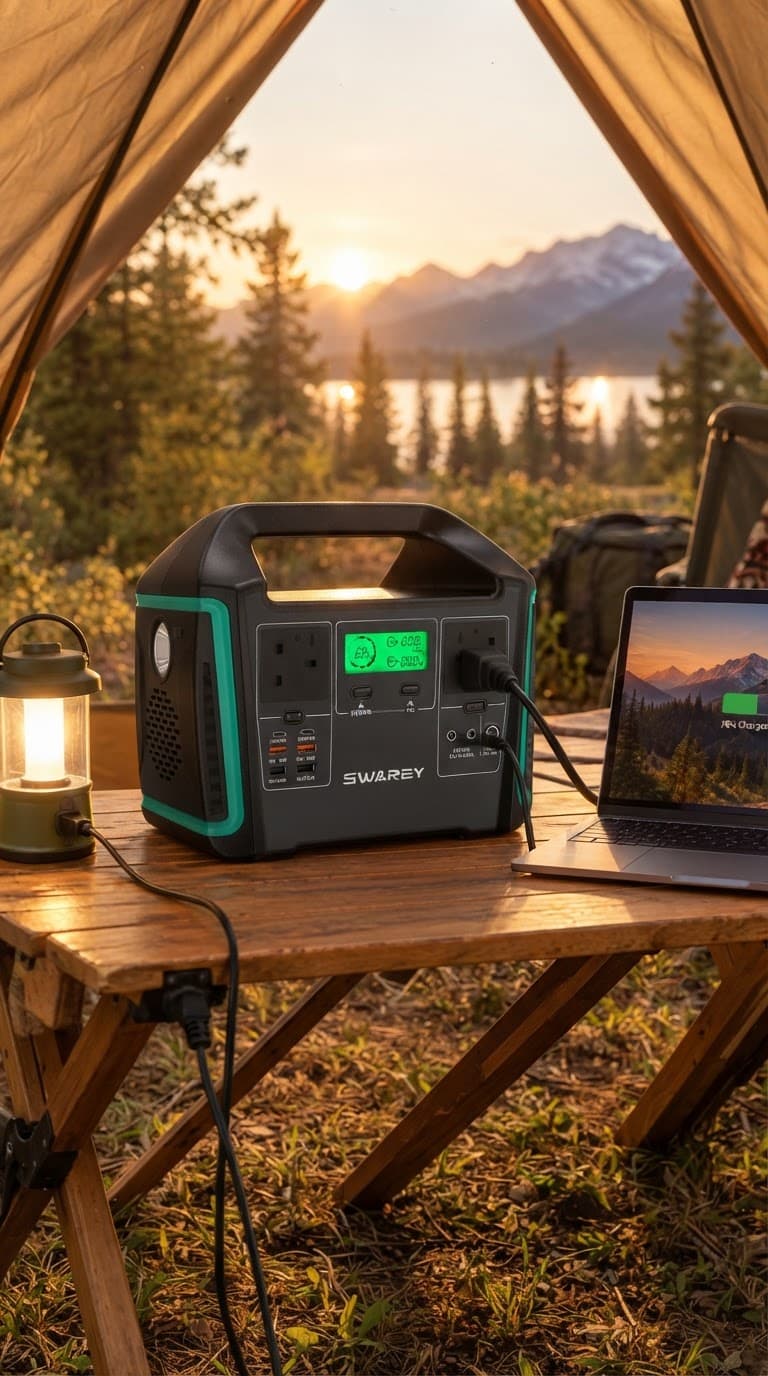
A portable power station can keep everyday essentials running without starting a petrol generator. For campers, laptop users and households preparing for short power cuts, it can fill the gap between a phone power bank and a much larger backup system.
The SWAREY unit supplied for this review is described as the S1000, with 1000W continuous output and a 725.76Wh battery. If those details match the exact Amazon option you choose, it belongs in the category of portable stations for electronics and modest appliances. The useful question is whether its capacity, charging options and power limit suit your actual needs.
What do 1000W and 725.76Wh mean?
These numbers describe different things. Watts (W) measure power: how much electricity equipment needs at a particular moment. A 1000W continuous rating would describe the combined load the station is designed to supply, subject to the manufacturer’s operating limits. Two sockets do not mean two separate 1000W allowances.
Watt-hours (Wh) measure stored energy: how much electricity the battery can hold. A 725.76Wh battery does not mean you can run a 1000W appliance for an hour. Some stored energy is used by the inverter and other electronics, so the amount reaching appliances will be lower than nominal capacity.
The draft also gives a 1500W surge figure. Confirm this for the exact model, including the permitted duration. A surge allowance is not permission to run a larger appliance continuously, and it does not guarantee that every motor or compressor will start.
What could it realistically power?
Subject to confirmed specifications and device compatibility, likely uses include phones, cameras, rechargeable lights, laptops, broadband equipment and small televisions. Certain camping fridges may also be suitable, but starting requirements and daily energy consumption need checking.
Many household kettles, hair dryers and electric heaters exceed a 1000W continuous limit. Even a heating appliance within that limit could drain a battery of this size quickly. Add together everything you intend to run at once, rather than checking each appliance in isolation.
A fridge switches on and off, so its measured consumption over a representative day is more useful than treating its running wattage as constant. Our guide to calculating fridge runtime explains how to make that estimate.
How long might the battery last?
A starting calculation is estimated runtime = usable energy reaching the appliance ÷ average appliance power. For illustration, assume that 80% of a 725.76Wh battery reaches an AC appliance. That gives approximately 581Wh. This is an assumed allowance, not a measured SWAREY efficiency result.
| Average combined demand | Illustrative runtime |
|---|---|
| 50W | About 11.6 hours |
| 100W | About 5.8 hours |
| 300W | About 1.9 hours |
| 600W | About 58 minutes |
Actual results depend on temperature, battery condition, inverter consumption and how the appliance operates. At very low loads, inverter overhead can make a fixed-percentage estimate particularly inaccurate. Read our explanation of inverter standby consumption before planning all-night operation around a small load.
Check the connections carefully
The supplied specification describes AC, USB-A, USB-C and 12V outputs, including USB-C charging up to 65W. Confirm the UK socket version, individual port ratings and any shared limits before buying. A USB-C socket alone does not establish charging speed: the station, cable and device must support the required profile.
Confirm the number of each port type against the exact listing and manual, as descriptions of similarly named models can differ. More sockets do not increase the total available power.
Likewise, confirm the voltage, polarity and connector for any DC appliance. Do not assume a plug that physically fits is electrically compatible. For a laptop, use a supported USB-C arrangement or its correct charger within the station’s limits.
How practical is solar charging?
The supplied draft states a maximum solar input of 126W. That figure needs confirmation alongside the permitted voltage, current, connector and polarity. Choose a compatible panel arrangement within every input limit; do not select a panel by wattage alone.
If 126W is the confirmed maximum, dividing 725.76Wh by 126W gives approximately 5.8 hours at that input before losses and other charging limitations. This is an idealised calculation, not a promise of a full charge in one UK day. Clouds, shade, season, panel temperature and positioning change what reaches the station.
Check whether panels and connection cables are actually included. A promotional image showing a panel does not establish the selected package contents. For a shaded camping pitch, a mains charge before departure may be more dependable than expecting the battery to refill each day.
Mains charging, car charging and portability
The original draft gives a mains recharge time of seven to eight hours and a weight of around 6kg. Treat these as supplied figures requiring confirmation, not independent measurements. Ask about the included charger’s rating and whether recharge time is quoted with the outputs off.
For car charging, check the supplied cable, permitted input and vehicle socket limit. Do not assume a short drive will replenish a depleted battery. For portability, consider the complete kit: station, charger, cables and any solar panels.
The supplied image illustrates a campsite use case. Its sockets, screen and accessories should not be used to identify the exact UK product or to infer waterproofing. Keep the unit dry, protect it from weather and follow its ventilation instructions.
Is it quiet and suitable indoors?
A battery station avoids engine noise and combustion exhaust while supplying power, but that does not establish silent operation. Cooling fans may run during charging or heavier use. Fan noise matters if the unit will sit close to a bed or desk.
“Completely safe indoors” is also too broad. Follow the manufacturer’s instructions for charging, temperature, positioning and ventilation. Keep the station away from bedding and other materials that could block airflow. Do not use a damaged unit or unsuitable charging equipment.
Supply compatible appliances directly. Never connect a portable station to household wiring through a wall socket or an improvised cable. A full battery does not automatically provide uninterrupted backup or power every circuit in a house.
Strengths and limitations to weigh up
Potential strengths: the supplied capacity could support useful electronics loads; the stated output covers more than phone charging; and several connection types may reduce the need for separate chargers. These advantages depend on the exact model matching the supplied details.
Limitations: stored energy is finite; heating and cooking loads may be impractical; solar charging is weather-dependent; and fan noise, charging speed, warranty and pass-through behaviour still need checking. There is no verified customer-feedback summary or numerical score in this review.
Who should consider it?
It may suit someone who can list a few modest loads, estimate their energy needs and recharge between uses. It is less suitable for someone expecting whole-house backup, prolonged electric heating or guaranteed operation of essential equipment.
Before buying, confirm the model number and UK version, usable capacity, continuous and surge limits, included accessories, current price, warranty and returns arrangements. Compare alternatives on useful capacity and charging performance rather than advertised watts alone. Our battery capacity versus lower energy use guide can help you decide whether extra storage is the right purchase.
Frequently asked questions
Can I charge it while using it?
Confirm pass-through operation and its limits in the exact model’s manual. Even where supported, that does not establish uninterrupted-power-supply capability or a transfer time suitable for your equipment.
Will it run a CPAP machine overnight?
We cannot establish that from the supplied specifications. Ask the medical equipment supplier about approved backup arrangements, then confirm compatibility and runtime for your exact setup. Do not rely on this review to select essential medical backup.
Are solar panels included?
Check the selected Amazon option and itemised package contents. The power station and panel bundles may be separate offers.
Is a pure sine wave inverter a compatibility guarantee?
No. If confirmed, it describes the AC waveform, but voltage, frequency, starting demand, total load and the appliance manufacturer’s requirements still matter.
Our verdict
The SWAREY described in the supplied specifications could be useful for camping electronics and selected essentials during short outages. Its suitability depends on confirmed specifications, your measured loads and a realistic charging plan. Those checks are more useful than an unsupported score or a promise that it will power everything.
Product information and review basis
Prepared 5 November 2026 using the owner-supplied product description and image. The exact Amazon listing could not be independently retrieved during preparation. No current price, buyer quotation, measured runtime or hands-on test result is claimed. The runtime table uses stated assumptions; confirm all model-specific details with the seller and the correct manual before purchase.