

Quick answer
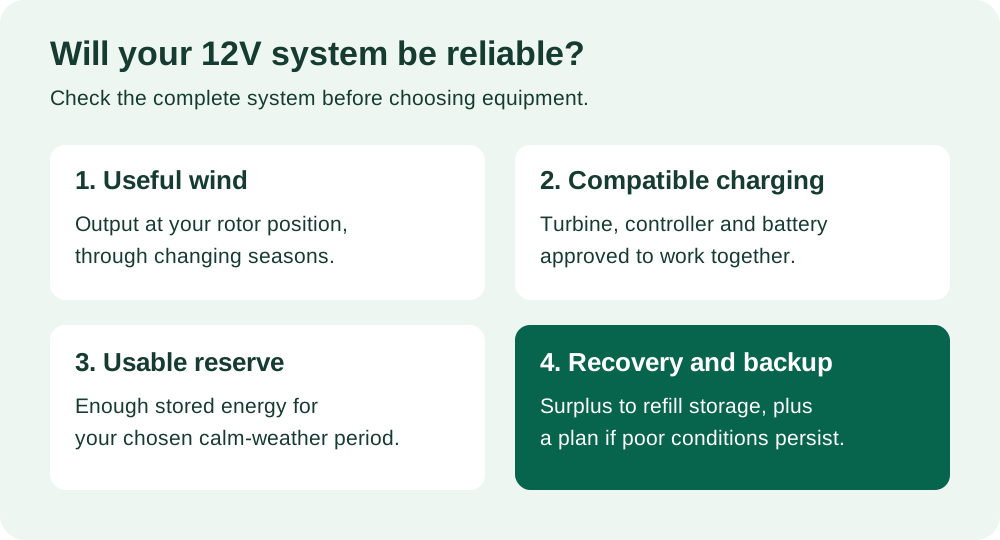
Yes—a suitable small wind turbine can charge a 12V battery, but reliable supply depends on the complete system. You need enough wind at the rotor, a compatible turbine and controller, an appropriate battery, and a load small enough for the energy available. For regular use, plan for calm periods and for recharging afterwards. A “12V” label and spinning blades do not establish reliability.
A battery makes wind power look reassuringly simple: generate whenever the breeze arrives, store the electricity, then use it later. That can work well. The difficulty is making sure the battery has enough energy when you actually need it.
Charging a battery occasionally is a much easier target than running cabin lights every evening or keeping equipment operating unattended. Start by defining the service you want, rather than selecting a turbine by its advertised wattage.
What does “reliably” mean for your project?
For a weekend shed, reliability might mean enough stored energy for two evenings of lighting, with time to recharge between visits. For a continuously operating sensor, it means meeting a small load throughout the week, including during prolonged calm weather.
Write down which loads can wait, which must keep working, and how long you want to manage without useful generation. Those decisions determine the reserve and backup you need. “It charged yesterday” does not answer any of them.
The US Department of Energy's small-wind FAQ identifies a strategy for wind variability—such as storage or a wind-and-solar system—as part of an off-grid proposal. Reliability is something to design and check, not a feature guaranteed by the turbine's nameplate.
A 12V battery does not charge at a fixed 12 volts
“12V” describes a nominal system class. The battery's actual voltage changes with its chemistry, state of charge and operating conditions. A suitable charger follows the manufacturer's specified charging profile rather than simply supplying a constant 12V.
As one model-specific example, Victron's Lithium Smart manual specifies 14.2V absorption for its 12.8V batteries. That is an illustration of nominal versus charging voltage, not a setting to copy into an unrelated system.
Check the exact turbine voltage version, controller, battery chemistry, permitted charging current and protection requirements together. A 24V turbine is not automatically suitable for a 12V battery, and a generic solar regulator is not automatically a wind controller.
The controller must manage the turbine as well as charging. Depending on the design, regulation may involve controlling rotor speed, diversion loads or other manufacturer-specified arrangements. Ask what happens when the battery is full, too cold to charge, or disconnected by its protection system.
Choose a supported combination
Manufacturer compatibility lists matter. For example, Marlec's HRSi regulator page identifies particular Rutland turbines and lead-acid battery types for that controller. It also describes reducing charge as the battery reaches its regulation level. This is evidence that compatibility is specific, rather than a recommendation to use that controller with any turbine.
Before buying separate components, ask the supplier to confirm the complete arrangement in writing. A lithium battery's battery-management system, or BMS, must work safely with the charging equipment; its ability to disconnect does not by itself prove the wind system is suitable.
Start with a small daily energy budget
Use watt-hours, not just appliance watts. Multiply power by hours of operation, then include standby consumption and conversion losses. The following invented example represents energy drawn at the battery side; the charging allowance already includes its small conversion losses.
| Use | Calculation | Daily energy |
|---|---|---|
| Two LED lights | 10W total × 4 hours | 40Wh |
| Small device charging | Measured battery-side allowance | 30Wh |
| Monitoring and standby loads | 2W × 24 hours | 48Wh |
| Total | Rounded up for this example | 120Wh/day |
The standby load is almost as large as the lighting demand. That is why leaving an inverter or accessory running can change a small system's prospects. Our guide to cabin night-time loads and inverter use explores that decision.
Use your own measurements for planning. If you measure an appliance at an AC socket, its reading excludes losses upstream in the inverter. If you measure total battery-side consumption, do not add those same losses a second time.
How much reserve does a 12V battery provide?
For an approximate first calculation, multiply nominal volts by amp-hours. A nominal 12V, 100Ah battery represents about 1,200Wh of nameplate energy. That does not mean all 1,200Wh is available for everyday use.
Suppose, purely for planning, you allocate 50% of that nominal energy: a 600Wh operating budget. At 120Wh per day, the arithmetic gives five days without generation. Three calm days consume 360Wh and leave 240Wh within that budget.
The 50% allowance is an assumption, not a universal rule for lead-acid or lithium batteries. Use the actual manufacturer's limits. Temperature, age, discharge rate, voltage cut-offs and conversion losses can reduce usable energy. A nominal 12.8V lithium battery also has a different nameplate calculation from a nominal 12V example.
Do not size a real system to reach its limit exactly on the final evening. Leave an appropriate margin and decide what to do if the calm spell continues. Our off-grid reserve planning guide applies the same reasoning to essential loads.
The overlooked test: can the battery recover?
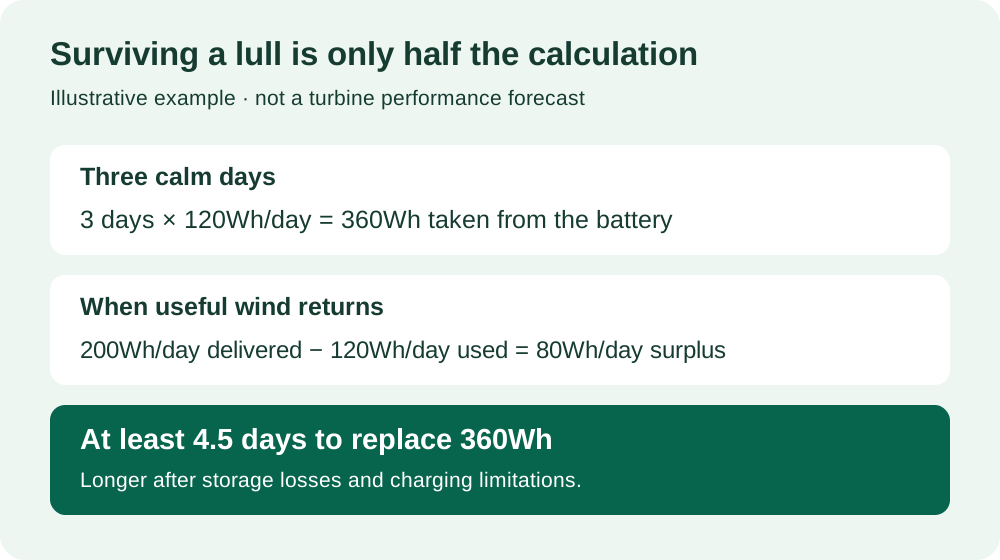
Surviving a lull is only half the problem. Imagine that, after those three calm days, the wind controller delivers 200Wh per day to the battery-and-load bus. Your loads still consume 120Wh daily, leaving at most 80Wh per day for replenishing the battery before storage losses.
Replacing the 360Wh deficit therefore needs at least 4.5 days at that surplus, and longer once losses and charging behaviour are included. Another lull before recovery could leave you with less reserve than expected.
This is why a system that merely matches average consumption can struggle. It needs enough surplus, at useful times, to refill storage as well as meet ongoing demand. A bigger battery extends the buffer but does not create the missing energy.
Check the wind before increasing the battery size
A turbine's advertised rating applies at specified conditions. To assess charging, you need its output at the speeds occurring at your proposed rotor position, plus an estimate of how often those speeds occur.
Our cut-in speed versus useful output guide explains why rotation can produce very little charge. The power-curve guide helps you look beyond the headline wattage.
A sheltered garden can have very different airflow from a nearby weather station. Read our guide to turbines surrounded by trees and prepare a wind-site log before asking for a yield estimate. Short observations are useful for questions; they cannot establish dependable year-round performance.
Cold weather and unattended operation
A windy winter day is not automatically a charging day if the battery is outside its operating limits. Victron's Lithium Smart manual, for example, permits charging from +5°C to +50°C. Other batteries have different requirements, including some with integrated heating. Check the exact battery, rather than applying a generic freezing-point rule.
Plan around the battery's measured temperature, any heater's energy use, and what happens when charging is inhibited. Our cold-weather charging checks explain why protective behaviour can resemble a fault.
For an unattended system, also consider how you will notice low energy, a controller fault or a maintenance problem. Set a practical inspection and response plan; a larger battery cannot repair a damaged turbine or failed connection.
Would solar or backup charging improve reliability?
Solar can add a second source when suitable sunlight is available, and wind may contribute outside daylight hours. The benefit depends on your actual site and seasons. Both resources can be weak together, so a hybrid label is not an assurance of uninterrupted power.
Compare the extra generation with reducing demand or having an approved alternative charging route. More generation or more battery capacity? is the useful question. Agree in advance when you will reduce optional loads or use backup, rather than waiting for a protective shutdown.
Relevant tools and recommended products
Our £9.99 DIY Alternative Energy Projects bundle is a useful starting point for organising loads and exploring the basics. It includes an introductory ebook, seven small projects and printable planning materials. The wind-to-light activity builds understanding; it does not measure a site's likely charging yield or replace an installation design.
If you mainly want occasional portable power, explore our Anker SOLIX C2000 Gen 2 and FOSSiBOT F2400 guides as alternative approaches. Check load compatibility and approved recharge methods. Neither link implies that a bare wind turbine can connect to the power station's solar input.
Frequently asked questions
Can I connect a turbine straight to a car battery?
Do not assume that is suitable. Use the turbine's specified charging and protection system. A starter battery is designed for a different duty from repeated off-grid cycling; choose a battery approved for your application.
How long will charging take?
Divide the energy you need to replace by the average net charging power as a rough starting point. Account for ongoing loads, losses, changing wind and the battery's charging profile. Nameplate turbine watts cannot give a dependable charging time.
Is 12V always the best choice?
It can suit modest loads. Higher-power systems need a wider design assessment because delivering the same power at lower voltage requires more current. Let the complete load and cable requirements guide the choice.
Does a larger turbine guarantee reliability?
No. Its site-specific output, storage reserve, recovery margin and maintenance still matter. Check expected energy and calm-period performance before spending more.
Have the support structure, cable sizing, protective devices and stopping arrangements designed for the actual equipment. Do not disconnect a spinning turbine or improvise live battery tests; even a 12V battery can supply dangerous fault currents.
Build your plan before buying the turbine
Start with your daily demand, calm-weather reserve and recovery target. Explore our DIY Alternative Energy Projects bundle for beginner projects and printable tools to support your next steps.
Explore the DIY bundle — £9.99