

Should the cabin inverter stay on overnight?
Keep it on when an essential AC appliance needs continuous availability and your battery budget supports it. Switching it off can make sense when every overnight need has a suitable independent supply or can wait. Search mode is a third option, but only after confirming that every connected load starts and operates reliably.
A cabin can look completely asleep while its battery continues supplying a fridge, internet router, heating controls and the inverter itself. Conversely, leaving a large inverter awake for a phone charger may consume more energy than expected.
The right decision starts with the services you need, rather than a blanket rule to leave everything on or shut everything down. This guide focuses on battery-powered cabin systems and gives a practical way to compare convenience, dependable operation and overnight energy use.
1. List what must work between bedtime and breakfast
Choose a clear period, such as 10pm to 8am. Walk through the cabin and list every device that might need electricity during those ten hours, including controls that work automatically.
Give each item one of three labels: must remain available, useful but optional, or can wait. A refrigerator may need to cycle while you sleep. A router may support essential communications or simply provide entertainment. Your circumstances determine the priority.
| Load | What to establish | Possible decision |
|---|---|---|
| Fridge or freezer | Required temperatures, cycling and restart behaviour | Maintain a dependable suitable supply |
| Heating or frost-protection controls | Consequences of interrupting controls, pumps or fans | Keep available where the system requires it |
| Router or monitoring equipment | Whether an outage loses a necessary service | Keep on, use an approved alternative or schedule off |
| Reading lights and phone charging | Whether charging can finish before bedtime | Often movable to an earlier period |
| Tools, television and kitchen appliances | Whether any automatic function is required | Usually candidates for switching off |
Do not include alarms or essential health-related equipment in a casual shutdown experiment. Establish their required supply and backup arrangements separately. An inverter being switched on does not guarantee continuity if its battery is depleted or a fault occurs.
2. Find the inverter’s own consumption
An inverter uses energy to remain ready to supply AC, even when no appliance is drawing power. Look for “zero-load”, “no-load” or “idle” consumption in the exact model’s documentation. Do not confuse this with its maximum output rating.
For example, the Victron Inverter Smart specifications list 8W zero-load power for the 12/1600 model, compared with 0.6W in ECO mode under the stated zero-load conditions. That example shows why mode matters; it is not a recommendation or a prediction for another inverter.
The same specifications list maximum efficiency separately. A maximum-efficiency figure is not a promise of that efficiency while supplying a tiny night light. For your cabin, the useful evidence is consumption at the loads you actually run.
What does idle power cost overnight?
Energy = power × time. An assumed 12W idle draw over ten hours consumes 120Wh, or 0.12kWh. At an assumed 30W, the same period consumes 300Wh.
These are illustrative values. They describe inverter consumption with no useful AC load, not the complete demand of an occupied cabin.
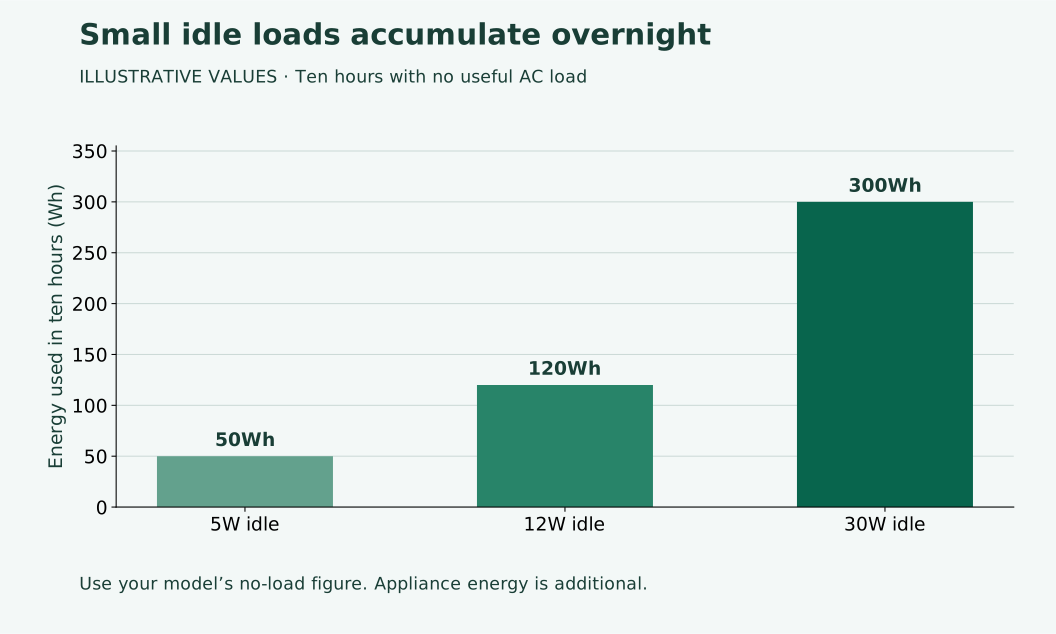
Against a small battery reserve, that overhead can matter. Against a cabin with necessary continuous AC services, it may be a reasonable energy cost. Compare it with the available reserve and the job being performed.
3. Measure energy, not just an instant wattage reading
A compressor that is off when you check it may restart ten minutes later. An appliance’s nameplate rating cannot tell you how long it operates overnight. Measure accumulated Wh or kWh across the full period, preferably over several representative nights.
A suitable plug-in energy meter can help with an individual plug-connected appliance. An installed battery monitor can show the combined battery demand, including inverter consumption and other DC loads. Use existing safe monitoring; have a qualified installer fit any equipment requiring changes to wiring.
The SmartShunt manual explains that a battery monitor tracks current flowing into and out of the battery, and that readings need correct synchronisation. Its displayed battery current is net current. Charging from another source can therefore obscure how much the loads themselves consumed.
Record the night’s conditions too: room temperature, fridge loading, router use and any charging source. Avoid comparing two very different nights and attributing the entire difference to an inverter setting.
Optional paid resource: You can view the linked energy offer while researching broader ideas. It is not a tested recommendation for cabin wiring or inverter settings.
4. Build a complete ten-hour budget
Suppose the following are hypothetical readings from AC appliance meters during one night. They are invented teaching figures, not typical consumption claims.
| Device | Ten-hour energy | How to interpret it |
|---|---|---|
| Cycling fridge | 240Wh | Total across its on and off periods |
| Router | 60Wh | Equivalent to a steady 6W |
| Bedside lamp | 10Wh | For example, 5W for two hours |
| AC total | 310Wh | Energy delivered to appliances |
Now suppose a correctly installed monitor records 430Wh leaving the battery during exactly the same period, with no charging and no other DC loads. The difference is 120Wh of combined inverter and associated system losses.
Do not add the inverter’s idle allowance to that 430Wh again. It is already included in the battery-side measurement. Equally, do not call all 120Wh “idle loss”: it also includes losses while supplying the appliances.
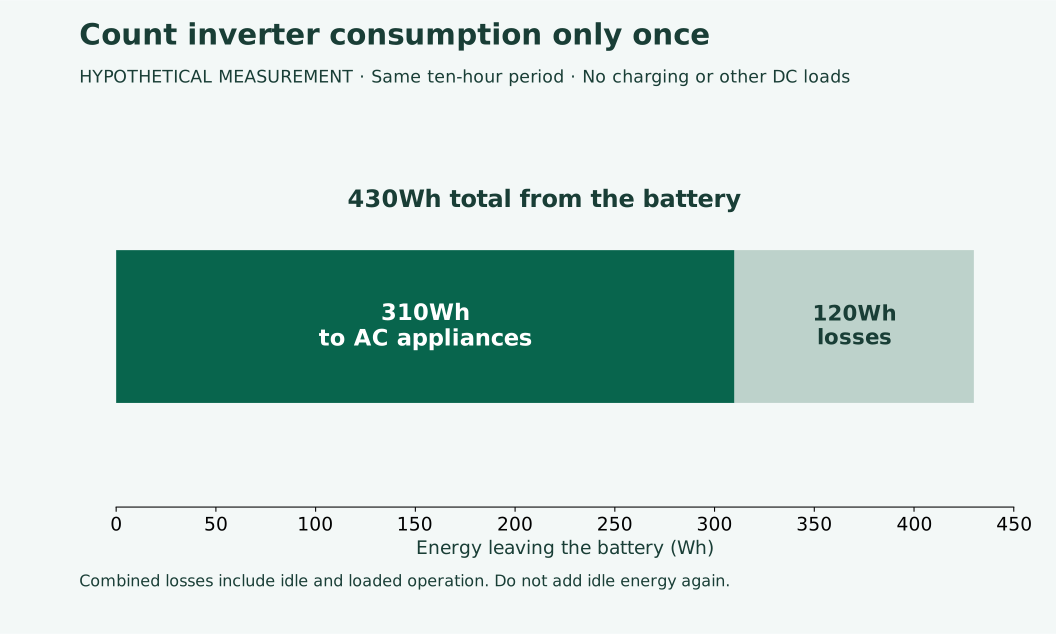
If you estimate instead of measure, use a clearly defined model. Dividing appliance energy by an assumed overall efficiency already includes the losses represented by that efficiency. Adding a separate idle term is appropriate only when the model explicitly excludes it. Measurement avoids much of this ambiguity.
5. When leaving the inverter on makes sense
Continuous operation is a sensible starting point when required AC loads must respond automatically, interruptions are unacceptable, and the installed system has enough usable energy and starting capability.
A fridge needs more attention than simply dividing its label watts by battery capacity. Check starting demand and measured energy; our fridge runtime guide explains the distinction. The Food Standards Agency recommends keeping a fridge at 5°C or below. Do not assume a closed door makes routine overnight shutdown safe.
Heating systems may also need electrical controls or circulation after the room appears warm. Follow the equipment instructions before interrupting power. Saving a modest amount of inverter energy is not useful if the result is an unreliable essential service.
Leaving the inverter on does not require leaving every appliance on. Finish discretionary charging earlier and switch off unnecessary loads while preserving the supply that required equipment needs.
6. When search or ECO mode can work
Search mode generally reduces consumption by withholding continuous AC output while periodically checking for a load. In Victron’s operating description, the inverter briefly checks at intervals and resumes normal operation when the detected load exceeds its set level.
That is different from simply running continuously at better efficiency. A small load may fail to trigger operation. Electronic controls can also behave differently from a simple resistive appliance.
The Morningstar SureSine Classic manual, for example, describes a standby detection threshold. Thresholds differ between models and versions, so never copy a setting from another cabin without checking the manual.
Test each intended load while present: does it start from standby, complete its cycle and restart later? Also test the smallest load operating alone. A combination that wakes the inverter may conceal the fact that one essential device cannot wake it independently.
Victron’s configuration instructions say settings depend on load type and specify that changes should be made by a qualified engineer. Use the appropriate installer or manufacturer support rather than treating threshold adjustment as a universal DIY fix.
7. When switching it off is practical
If no overnight service depends on AC, scheduled manual shutdown can remove unnecessary inverter operation. Have a charged torch or suitable independent light available, and confirm that anything expected to run automatically has another appropriate supply.
Approved DC equipment or a manufacturer-compatible DC converter may serve some low-power loads without AC conversion. Do not connect a router or other appliance directly to a battery merely because both mention “12V”: battery voltage varies, and regulation, polarity and protection still matter.
Use the inverter’s documented shutdown or remote-control method. “Off” does not necessarily mean electrically isolated, and combined inverter-chargers may treat charging and output modes differently. Check what the control actually disables before making it part of your routine.
8. Protect the morning reserve
Compare the overnight budget with energy available above your chosen operating reserve, not the battery’s entire nameplate capacity. Include other DC loads and leave room for breakfast, pumping or communications before reliable charging resumes.
For illustration, 430Wh overnight demand leaves 270Wh from a 700Wh allocation. Whether that is enough depends on the morning’s loads and replenishment. Do not assume a sunny forecast guarantees an early full recharge.
Our reserve-planning guide helps you define a fallback. If you also explore the seller’s energy presentation, independently check its claims against your measured requirements.
Frequently asked questions
Does a larger inverter always waste more energy?
No universal rule covers every design. Compare the actual models’ no-load consumption and performance at your intended loads, while retaining adequate starting capability.
Is ECO mode suitable for every fridge?
No. Check both manufacturers’ guidance and test complete operating cycles. Continuous AC may be necessary for reliable controls and restarting.
Can I just lower the battery cutoff?
Do not change protection settings to stretch runtime without manufacturer and installer guidance. Use settings appropriate to the battery and system.
What is the best first step?
List the overnight services, then measure a representative night. That tells you whether the main opportunity is reducing appliance demand, inverter overhead or both.
Keep the service you need, then reduce the overhead
Keeping an inverter on makes sense when dependable AC availability is worth its measured energy cost. Search mode needs demonstrated compatibility; shutdown needs a complete alternative for every essential service. Make the choice from your load list and overnight records.
For lighting alone, a dedicated low-voltage system may avoid running a separate mains inverter. Our Photonic Universe four-light kit overview explains one example. Its small battery and panel still need to be matched to evening use and next-day charging.
Explore the linked energy offer
Optional paid affiliate resource. We have not tested the product or verified its performance claims. Review its contents, price and terms before buying; it does not replace equipment manuals or qualified installation advice.
View the energy offer — affiliate linkSources and further reading
Checked 7 October 2026. Worked budgets are illustrative, not field-test results.
Investigating unexplained battery loss? Follow our inverter standby consumption guide for calculations and measurement checks.