

Quick answer
Before buying a small wind turbine near neighbours, ask for model-specific acoustic data, a site-specific noise assessment and a clear plan for dealing with any disturbance. The important question is what people may hear at nearby homes, not simply whether a product is advertised as “quiet”. Check the installation position, wind conditions, mounting and applicable planning rules together.
A small wind turbine can look like an appealing way to generate electricity after sunset or during windy winter weather. But when other homes are close, a sensible project begins with a conversation about sound, location and expectations.
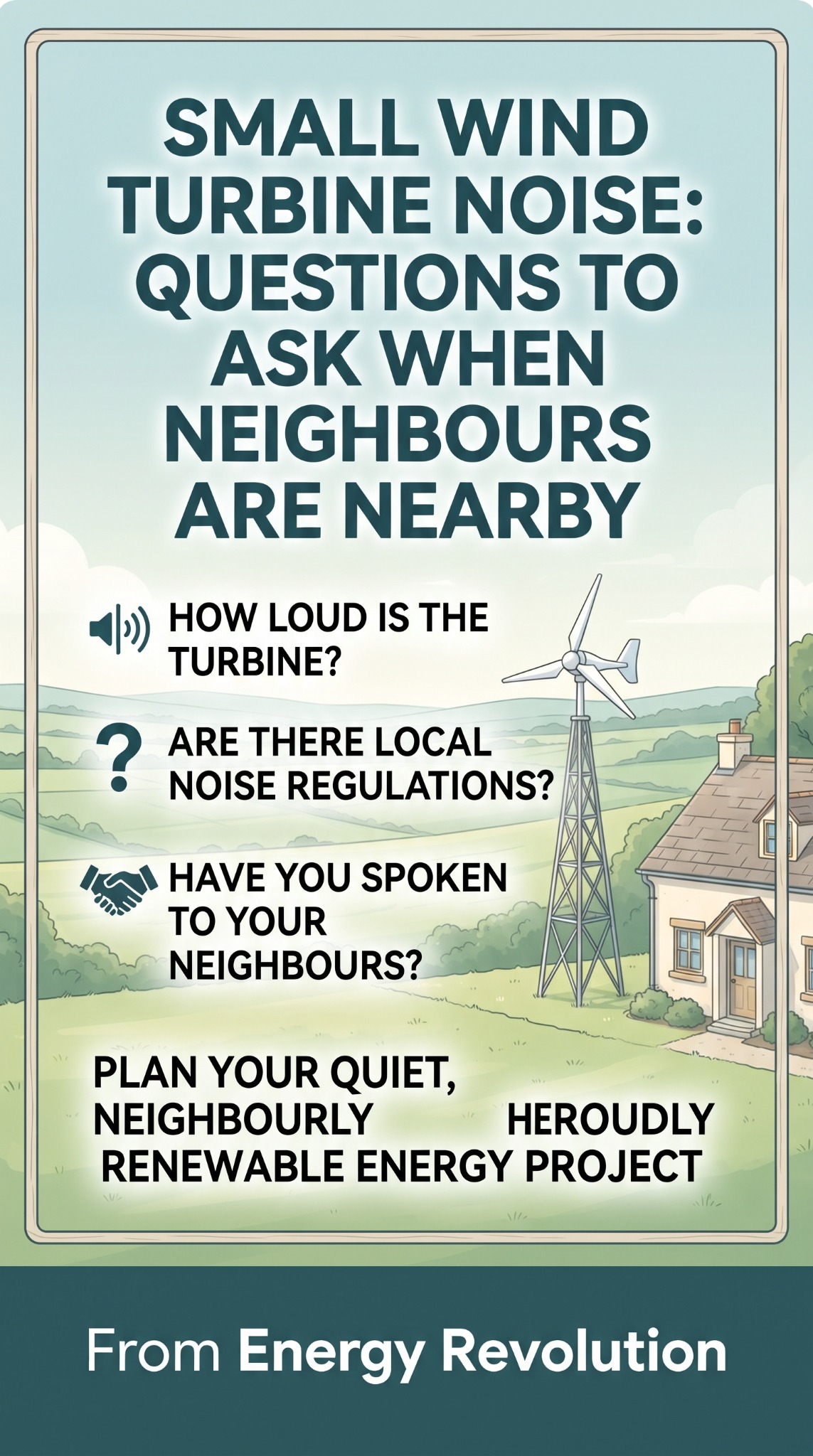
Our Pinterest pin asks three useful questions: how loud is the turbine, are there local noise regulations, and have you spoken to your neighbours? This guide turns those questions into practical checks you can take to an installer. You do not need to become an acoustics expert; you do need evidence that relates to your proposed installation.
Affiliate disclosure: We may earn a commission from purchases through affiliate links, at no extra cost to you. We also link to our own digital bundle. These links do not constitute an acoustic assessment or a recommendation for a tested wind turbine.
1. What sounds could this particular turbine make?
Start with the character of the sound. The US Department of Energy’s wind sound guidance distinguishes blade-related swishing from mechanical sounds such as a generator hum. Wind conditions, terrain and nearby background sounds affect what someone hears.
Ask whether the proposed model produces a noticeable tone, pulsing or changes in sound during starting, stopping and strong-wind control. A repeated whine or rattle is a different experience from a steady soft swish, even when a headline average appears similar.
A helpful supplier should explain normal operation, provide acoustic documentation and describe sounds that could indicate a maintenance problem. “You will never hear it” is not a useful substitute for that information.
2. What does the quoted decibel figure actually describe?
A specification saying “40dB” is incomplete without context. Ask whether it is a sound power level describing the source, or a sound pressure level at a stated measurement position. They are different quantities and cannot be compared as though they were interchangeable.
Request the distance, wind speed, operating mode, measurement method and test report. Check that the report covers the exact rotor, controller and turbine version being quoted. An attractive number from another model or a very gentle breeze may tell you little about your project.
| Ask the supplier | What a useful answer includes |
|---|---|
| Which turbine was tested? | Exact model, configuration and report reference |
| What does the noise number mean? | Acoustic quantity, units and measurement conditions |
| How does sound change with wind? | Data covering relevant operating conditions |
| What is predicted at nearby homes? | Assessment locations, assumptions and documented results |
| What happens if there is a problem? | Named contact, investigation process and agreed responsibilities |
A video can introduce the type of sound, but playback volume, microphone processing and wind noise prevent a reliable loudness comparison. Where possible, arrange a visit to the same model operating in comparable conditions, with the owner’s permission. Treat that visit as useful context, not proof of compliance at your home.
3. Where are the homes and rooms that matter?
Put the proposed turbine, neighbouring buildings and changes in ground level on a sketch. Identify nearby bedroom and living-room windows, including upstairs rooms. For neighbour discussions, also note gardens, patios and places where people spend quiet time outdoors.
The closest fence is not automatically the formal assessment position. Ask the assessor to identify the positions required by the applicable method. A turbine uphill from a house can have a different relationship to its windows than a flat garden plan suggests.
There is no universal neighbour-friendly setback that works for every turbine. Distance helps, but machine characteristics, height, terrain and weather also matter. Do not treat a boundary-clearance rule as proof that noise will be acceptable.
4. What happens in gusty weather and at night?
A listening visit on a calm afternoon does not describe every operating condition. Ask which wind speeds and directions the assessment considers, and whether turbine operation changes in stronger winds. Background sound may differ between your exposed turbine position and a sheltered neighbouring garden.
Neighbours may be more aware of a sound during quiet evening periods. Discuss bedrooms, open-window habits and people who sleep during the day. These details help explain concerns without assuming everyone uses their home in the same way.
For your early observations, record date, time, wind direction, weather and existing sound sources. Our wind-site log guide helps organise the site information. Any formal background survey should follow the method agreed with the assessor and authority.
5. Could the mounting transmit vibration?
Outdoor blade sound is only part of the picture. The Department of Energy’s small-wind guidance explains that rooftop turbines can transmit vibration into the building and encounter turbulent airflow. That can create indoor noise concerns as well as performance and durability problems.
Ask how the structure, mounting and vibration behaviour will be assessed. Do not assume rubber pads added afterwards will solve an unsuitable design. A free-standing installation avoids fixing the turbine directly to your roof, but still needs suitable foundations, siting and a noise assessment.
Read our comparison of roof-mounted and pole-mounted turbines before choosing the easiest-looking mounting position.
6. Which planning and noise assessment route applies?
For England, some domestic installations may qualify as permitted development only when all applicable conditions are met. A small turbine is not automatically exempt. Check the current legal position and the proposed route with your local planning authority before ordering.
The MCS 020 b) wind turbine sound standard, Issue 1.0 provides a permitted-development assessment procedure using a limit of 42dB LAeq,5mins. This is an A-weighted equivalent sound level over five minutes within that defined procedure—not a universal boundary limit or a promise of inaudibility.
The standard defines assessment positions outside neighbouring habitable-room doors and windows, uses turbine-specific acoustic information and requires documented calculations. Ask for your copy of the completed assessment. Passing its sound test alone does not satisfy every planning condition.
For planning applications, the government published updated wind turbine noise assessment guidance in June 2026, replacing the 1996 ETSU-R-97 document. Ask your authority or acoustic consultant which guidance and evidence apply to your scheme; do not rely on an old online checklist.
Rules differ across UK nations and abroad. Our solar and wind planning guide introduces the wider checks, but your authority should confirm the requirements for your actual proposal.
7. Have you spoken to neighbours while changes are still possible?
Approach neighbours before a purchase becomes a fixed decision. Show the proposed position and height, explain why you are considering wind, and say what you are checking. Ask which rooms or times of day they are most concerned about.
Share the assessment when it is available and explain technical terms in ordinary language. Avoid promising silence or guaranteed savings. A useful starting phrase is: “We are investigating whether this position is suitable, and we want to understand any concerns before we decide.”
Friendly agreement does not replace permissions, and a concern does not automatically settle the planning decision. Early discussion gives you a chance to adjust the design and avoids surprising someone with a mast beside their home.
8. What will you do if noise becomes a problem?
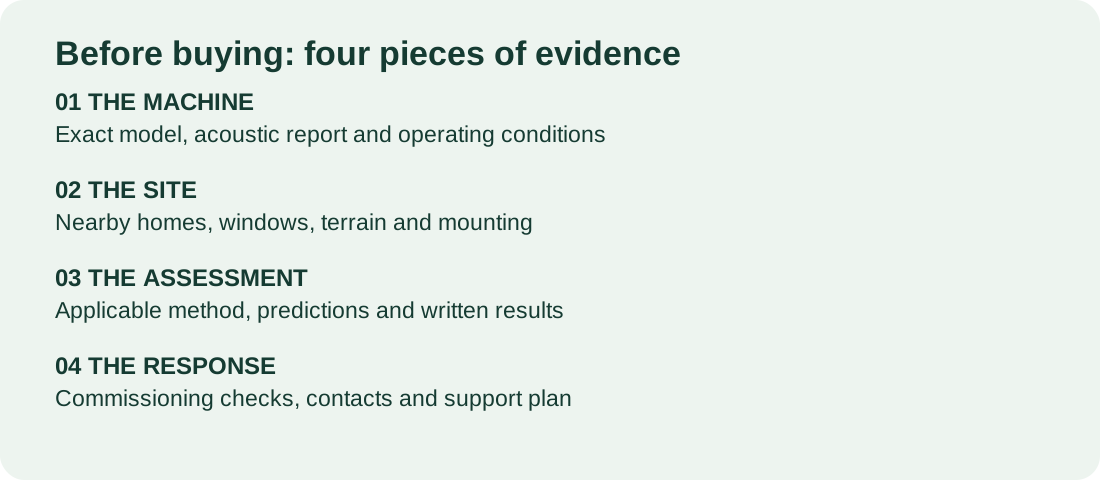
Agree a written handover and support plan with the installer. Who checks unexpected sound? How quickly will they respond? Who pays for an investigation, adjustment or relocation, and what do the contract and warranty actually cover?
Ask whether approved reduced-noise operation or scheduled curtailment is available, and what it would do to annual generation. Do not assume every small turbine supports it. Any shutdown must follow the manufacturer’s procedure; do not improvise by disconnecting equipment while it is running.
After commissioning, keep a dated record of reported issues and operating conditions. Phone recordings can document timing and character, but a phone sound-meter app is not a replacement for a properly specified acoustic measurement. Refer unresolved concerns to the installer and relevant council team.
9. Is the likely energy worth the compromise?
A turbine that needs frequent shutdowns or a poor, sheltered position may offer little useful energy. Ask for expected annual output at the proposed location, including any operating restrictions, maintenance and installation costs.
Our guides to wind turbines near trees and reading a turbine power curve explain why rated watts alone are insufficient. Compare the complete proposal with solar or simply reducing the loads you want to supply.
If your aim is modest shed lighting, our Photonic Universe 15W lighting-kit listing is one alternative to investigate. For larger solar-and-storage ideas, see the ECO-WORTHY 400W kit listing. Check current specifications and seasonal suitability. Solar panels have no rotating blades, although associated inverters and battery equipment can have fans or other audible components.
Frequently asked questions
Are small wind turbines silent?
No blanket claim is reliable. Ask for tested acoustic data and predictions at the relevant neighbouring properties for the exact installation.
How far from a neighbour should a turbine be?
There is no single distance that guarantees acceptability. Have the specific turbine, site geometry and applicable rules assessed together.
Will a fence or hedge solve the noise?
Do not assume so, especially when the rotor is well above it. Any claimed acoustic benefit needs professional justification; nearby obstacles can also disturb airflow.
Can I use a phone app to prove compliance?
No. It may help keep an informal record, but formal assessment needs suitable equipment, procedures and operating conditions.
Should I abandon wind if neighbours are close?
Not automatically. Get evidence early. If the site cannot support a practical, acceptable installation, choosing another energy option is a useful outcome.
Make the decision before making the purchase
Gather the turbine report, site plan, applicable assessment and support arrangements. Then discuss a concrete proposal with your neighbours. Good preparation makes it easier to choose a project that fits both your energy needs and the place where you live.
For broader research, you can view this separate affiliate energy offer. Check the seller’s description and terms; it is not an acoustic report or a tested turbine recommendation.
Explore practical renewable-energy ideas
Our DIY Alternative Energy Projects bundle includes the ebook and additional project pack. Explore the listing for ideas to investigate alongside professional advice where needed.
Explore the DIY Alternative Energy Bundle on PayhipPlanning a temporary setup? Compare portable wind and solar for an exposed campsite.